
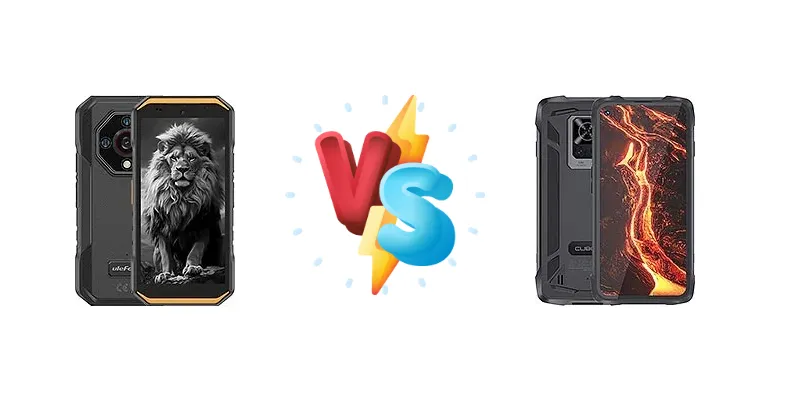
Ulefone Armor X32 Pro vs Cubot KingKong 7: A Deep Dive into Rugged Performance
| Phones Images | |||||
|---|---|---|---|---|---|
|
🏆 Quick Verdict
For the average user prioritizing performance and future-proofing, the Ulefone Armor X32 Pro is the clear winner. Its Dimensity 6300 chipset offers a substantial upgrade over the Cubot KingKong 7’s Helio P60, translating to smoother multitasking and a more responsive user experience. While the KingKong 7 remains a viable budget option, the X32 Pro provides better value.
| PHONES | ||
|---|---|---|
| Phone Names | Ulefone Armor X32 Pro | Cubot KingKong 7 |
| Network | ||
|---|---|---|
| 2G bands | GSM 850 / 900 / 1800 / 1900 | GSM 850 / 900 / 1800 / 1900 |
| 3G bands | HSDPA 800 / 850 / 900 / 1700(AWS) / 1900 / 2100 | HSDPA 850 / 900 / 1700(AWS) / 1900 / 2100 |
| 4G bands | 1, 2, 3, 4, 5, 7, 8, 12, 13, 17, 18, 19, 20, 25, 26, 28, 32, 66, 71 | 1, 2, 3, 4, 5, 7, 8, 12, 13, 17, 18, 19, 20, 25, 26, 28, 38, 40, 41, 66 |
| 5G bands | 1, 2, 3, 5, 7, 8, 20, 25, 28, 38, 40, 41, 66, 71, 77, 78, 79 SA/NSA/Sub6 | - |
| Speed | HSPA, LTE, 5G | HSPA, LTE |
| Technology | GSM / CDMA / HSPA / LTE / 5G | GSM / CDMA / HSPA / LTE |
| Launch | ||
|---|---|---|
| Announced | 2025, April 03 | 2022 |
| Status | Available. Released 2025, April 14 | Available. Released 2022 |
| Body | ||
|---|---|---|
| Dimensions | 163.4 x 80.8 x 14.5 mm (6.43 x 3.18 x 0.57 in) | 166.8 x 83.5 x 14 mm (6.57 x 3.29 x 0.55 in) |
| SIM | Nano-SIM + Nano-SIM | Nano-SIM + Nano-SIM |
| Weight | 280 g (9.88 oz) | 267 g (9.42 oz) |
| Display | ||
|---|---|---|
| Protection | Corning Gorilla Glass 5, Mohs level 4 | - |
| Resolution | 720 x 1440 pixels, 18:9 ratio (~285 ppi density) | 1080 x 2300 pixels (~400 ppi density) |
| Size | 5.65 inches, 82.4 cm2 (~62.4% screen-to-body ratio) | 6.36 inches, 100.4 cm2 (~72.1% screen-to-body ratio) |
| Type | IPS LCD, 90Hz, 600 nits (peak) | IPS LCD |
| Platform | ||
|---|---|---|
| CPU | Octa-core (2x2.4 GHz Cortex-A76 & 6x2.0 GHz Cortex-A55) | Octa-core (4x2.0 GHz Cortex-A73 & 4x2.0 GHz Cortex-A53) |
| Chipset | Mediatek Dimensity 6300 (6 nm) | Mediatek MT6771V/CA Helio P60 (12 nm) |
| GPU | Mali-G57 MC2 | Mali-G72 MP3 |
| OS | Android 14 | Android 11 |
| Memory | ||
|---|---|---|
| Card slot | microSDXC (dedicated slot) | microSDXC (uses shared SIM slot) |
| Internal | 256GB 8GB RAM | 128GB 8GB RAM |
| Main Camera | ||
|---|---|---|
| Features | LED flash, HDR, panorama | LED flash |
| Triple | 64 MP, f/1.9, (wide), 1/1.73", 0.8µm, PDAF 25 MP, f/1.8, (night vision), 2 infrared lights 2 MP (macro) | 64 MP, (wide), AF 16 MP, (ultrawide) 5 MP (macro) |
| Video | 1440p@30fps, 1080p@30fps | Yes |
| Selfie camera | ||
|---|---|---|
| Single | 16 MP, f/2.2, (wide), 1.0µm | 32 MP |
| Video | 1080p@30fps | Yes |
| Sound | ||
|---|---|---|
| 35mm jack | Yes | Unspecified |
| Loudspeaker | Yes | Yes |
| Comms | ||
|---|---|---|
| Bluetooth | 5.2, A2DP, LE | 4.2, A2DP |
| Infrared port | Yes | - |
| NFC | Yes | Yes |
| Positioning | GPS, GALILEO, GLONASS, BDS, QZSS | GPS, GLONASS, BDS |
| Radio | Wireless FM radio | Unspecified |
| USB | USB Type-C 2.0 | USB Type-C, OTG |
| WLAN | Wi-Fi 802.11 a/b/g/n/ac, dual-band | Wi-Fi 802.11 a/b/g/n |
| Features | ||
|---|---|---|
| Sensors | Fingerprint (side-mounted), accelerometer, gyro, proximity, compass, barometer | Fingerprint (rear-mounted), accelerometer, gyro, proximity, compass |
| Battery | ||
|---|---|---|
| Charging | 18W wired | - |
| Type | Li-Po 5500 mAh | 5000 mAh |
| Misc | ||
|---|---|---|
| Colors | Black, Black/Orange, Black/Green | Black |
| Price | About 230 EUR | - |
| EU LABEL | ||
|---|---|---|
| Battery | 53:15h endurance, 1000 cycles | - |
| Energy | Class B | - |
| Free fall | Class A (270 falls) | - |
| Repairability | Class C | - |
Ulefone Armor X32 Pro
- Significantly faster processor for smoother performance
- More power-efficient chipset for longer battery life
- Potentially better camera image processing
- May be more expensive than the Cubot KingKong 7
- Rugged design may add bulk
Cubot KingKong 7
- More affordable price point
- Rugged design for durability
- Acceptable performance for basic tasks
- Older, less efficient chipset
- Slower performance for demanding applications
- Potentially shorter battery life
Display Comparison
Display specifications are absent from the provided data, but given the market segment, both likely feature LCD panels. However, the chipset difference suggests the X32 Pro could potentially drive a higher resolution or refresh rate display without significant performance impact. The KingKong 7’s older Helio P60 might struggle with a demanding display, potentially leading to lower frame rates in animations and games. Bezels are likely similar, focusing on maximizing screen real estate within a ruggedized frame.
Camera Comparison
Camera details are missing, but the chipset difference implies the X32 Pro will have a more capable image signal processor (ISP). This translates to faster image processing, better noise reduction, and potentially more advanced features like HDR. While both phones likely feature multiple cameras, the X32 Pro’s ISP will be better equipped to handle complex scenes and deliver higher-quality images. Without sensor size data, it’s difficult to make definitive claims, but the X32 Pro’s processing power gives it a clear advantage.
Performance
The core of the difference lies in the chipsets. The Ulefone Armor X32 Pro’s Mediatek Dimensity 6300 (6nm) is a significant leap forward from the Cubot KingKong 7’s Helio P60 (12nm). The 6nm process node inherently offers better power efficiency and thermal performance. Architecturally, the Dimensity 6300’s Cortex-A76 cores are considerably more powerful than the Helio P60’s Cortex-A73 cores, resulting in faster application loading and smoother multitasking. The X32 Pro’s CPU configuration (2x2.4 GHz A76 & 6x2.0 GHz A55) provides a more balanced performance profile than the KingKong 7’s (4x2.0 GHz A73 & 4x2.0 GHz A53).
Battery Life
The Ulefone Armor X32 Pro boasts a remarkable 53:15h endurance rating, suggesting excellent battery optimization alongside its efficient chipset. While the KingKong 7’s battery capacity is unknown, the Helio P60’s less efficient 12nm process will likely result in shorter battery life. The X32 Pro’s 18W charging is standard for this segment, and the 1000 charge cycles indicate a focus on long-term battery health. The KingKong 7’s charging speed is unspecified, but likely slower, and its battery longevity may be lower due to the less efficient chipset.
Buying Guide
Buy the Ulefone Armor X32 Pro if you need a rugged phone capable of handling demanding tasks like gaming or video editing, and if you value a longer software support lifespan. Its modern chipset ensures better compatibility with future app updates. Buy the Cubot KingKong 7 if you prioritize absolute affordability and only require basic smartphone functionality – calls, texts, and light social media use – and are comfortable with a less powerful processor.