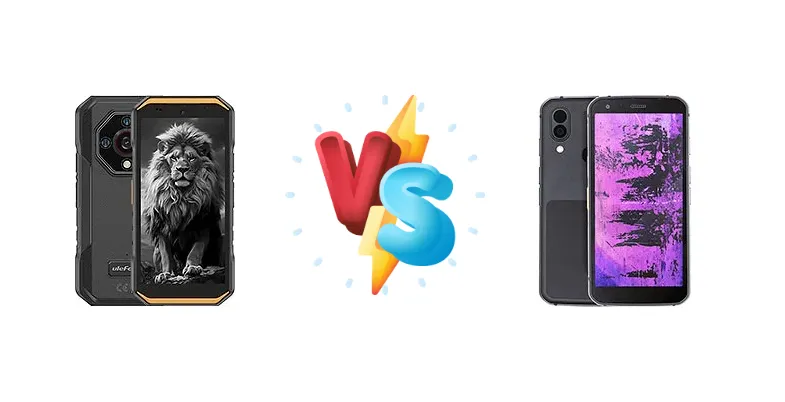
The rugged smartphone market caters to a specific need: durability. Both the Ulefone Armor X32 Pro and the Cat S62 Pro aim to deliver that, but they approach it with different philosophies. The Ulefone leverages newer chipset technology, while the Cat S62 Pro relies on a proven, albeit older, platform. This comparison dissects their core components to determine which device offers the best blend of performance and resilience.
🏆 Quick Verdict
For the average user prioritizing longevity and future-proofing, the Ulefone Armor X32 Pro emerges as the stronger contender. Its Mediatek Dimensity 6300 chipset, built on a 6nm process, offers a significant architectural advantage over the Cat S62 Pro’s Snapdragon 660, translating to better efficiency and potential for software updates.
| Network |
|---|
| 2G bands | GSM 850 / 900 / 1800 / 1900 | GSM 850 / 900 / 1800 / 1900 |
| 3G bands | HSDPA 800 / 850 / 900 / 1700(AWS) / 1900 / 2100 | HSDPA 850 / 900 / 1700(AWS) / 1900 / 2100 |
| 4G bands | 1, 2, 3, 4, 5, 7, 8, 12, 13, 17, 18, 19, 20, 25, 26, 28, 32, 66, 71 | 1, 2, 3, 4, 5, 7, 8, 20, 28, 38, 40 |
| 5G bands | 1, 2, 3, 5, 7, 8, 20, 25, 28, 38, 40, 41, 66, 71, 77, 78, 79 SA/NSA/Sub6 | - |
| Speed | HSPA, LTE, 5G | HSPA 42.2/5.76 Mbps, LTE (2CA) Cat13 400/150 Mbps |
| Technology | GSM / CDMA / HSPA / LTE / 5G | GSM / HSPA / LTE |
| Launch |
|---|
| Announced | 2025, April 03 | 2020, June 28. Released 2020, August 17 |
| Status | Available. Released 2025, April 14 | Discontinued |
| Body |
|---|
| Build | - | Glass front (Gorilla Glass 6), plastic back, aluminum frame |
| Dimensions | 163.4 x 80.8 x 14.5 mm (6.43 x 3.18 x 0.57 in) | 158.5 x 76.7 x 11.9 mm (6.24 x 3.02 x 0.47 in) |
| SIM | Nano-SIM + Nano-SIM | · Nano-SIM· Nano-SIM + Nano-SIM |
| Weight | 280 g (9.88 oz) | 248 g (8.75 oz) |
| | - | IP68/IP69 dust/water resistant (up to 1.5m for 35 mins)
Drop-to-concrete resistance from up to 1.8m
MIL-STD-810H compliant |
| Display |
|---|
| Protection | Corning Gorilla Glass 5, Mohs level 4 | Corning Gorilla Glass 6 |
| Resolution | 720 x 1440 pixels, 18:9 ratio (~285 ppi density) | 1080 x 2160 pixels, 18:9 ratio (~424 ppi density) |
| Size | 5.65 inches, 82.4 cm2 (~62.4% screen-to-body ratio) | 5.7 inches, 83.8 cm2 (~69.0% screen-to-body ratio) |
| Type | IPS LCD, 90Hz, 600 nits (peak) | IPS LCD |
| Platform |
|---|
| CPU | Octa-core (2x2.4 GHz Cortex-A76 & 6x2.0 GHz Cortex-A55) | Octa-core (4x2.2 GHz Kryo 260 Gold & 4x1.8 GHz Kryo 260 Silver) |
| Chipset | Mediatek Dimensity 6300 (6 nm) | Qualcomm SDM660 Snapdragon 660 (14 nm) |
| GPU | Mali-G57 MC2 | Adreno 512 |
| OS | Android 14 | Android 10 |
| Memory |
|---|
| Card slot | microSDXC (dedicated slot) | microSDXC (dedicated slot) |
| Internal | 256GB 8GB RAM | 128GB 6GB RAM |
| Main Camera |
|---|
| Dual | - | 12 MP, f/1.8, (wide), 1/2.55", 1.4µm, dual pixel PDAF
FLIR thermal camera (Lepton 3.5 module) |
| Features | LED flash, HDR, panorama | Thermal imaging, heat palettes, temp. spot meter, LED flash |
| Triple | 64 MP, f/1.9, (wide), 1/1.73", 0.8µm, PDAF
25 MP, f/1.8, (night vision), 2 infrared lights
2 MP (macro) | - |
| Video | 1440p@30fps, 1080p@30fps | 1080p@30fps, gyro-EIS |
| Selfie camera |
|---|
| Single | 16 MP, f/2.2, (wide), 1.0µm | 8 MP |
| Video | 1080p@30fps | 1080p@30fps |
| Sound |
|---|
| 3.5mm jack | - | No |
| 35mm jack | Yes | No |
| Loudspeaker | Yes | Yes |
| Comms |
|---|
| Bluetooth | 5.2, A2DP, LE | 5.0, A2DP, LE |
| Infrared port | Yes | - |
| NFC | Yes | Yes |
| Positioning | GPS, GALILEO, GLONASS, BDS, QZSS | GPS, GLONASS, GALILEO, BDS |
| Radio | Wireless FM radio | FM radio |
| USB | USB Type-C 2.0 | USB Type-C 2.0, OTG |
| WLAN | Wi-Fi 802.11 a/b/g/n/ac, dual-band | Wi-Fi 802.11 a/b/g/n/ac, dual-band, Wi-Fi Direct |
| Features |
|---|
| Sensors | Fingerprint (side-mounted), accelerometer, gyro, proximity, compass, barometer | Fingerprint (rear-mounted), accelerometer, gyro, proximity, compass |
| Battery |
|---|
| Charging | 18W wired | - |
| Type | Li-Po 5500 mAh | Li-Ion 4000 mAh |
| Misc |
|---|
| Colors | Black, Black/Orange, Black/Green | Black |
| Price | About 230 EUR | About 530 EUR |
| EU LABEL |
|---|
| Battery | 53:15h endurance, 1000 cycles | - |
| Energy | Class B | - |
| Free fall | Class A (270 falls) | - |
| Repairability | Class C | - |
Ulefone Armor X32 Pro
- More modern and efficient chipset (Dimensity 6300)
- Superior CPU architecture for better performance
- Potentially longer software support due to newer hardware
- Charging speed is relatively standard (18W)
- Display specifications are unknown
Cat S62 Pro
- Established brand reputation in the rugged phone market
- Proven Snapdragon 660 chipset (reliable, if dated)
- Potentially lower price point due to age
- Older, less efficient chipset (Snapdragon 660)
- Likely limited software update support
- Inferior CPU architecture compared to the Ulefone
Display Comparison
Neither device’s display specifications are provided, so a direct comparison is limited. However, given the Cat S62 Pro’s age, it likely utilizes an older LCD panel. The Ulefone, being a newer device, *may* incorporate a more modern panel with improved color accuracy and viewing angles. The absence of refresh rate data suggests both likely operate at 60Hz. Bezels are likely substantial on both, given the rugged design constraints.
Camera Comparison
Without detailed camera specifications, a comprehensive comparison is impossible. However, the market segment suggests both phones prioritize practicality over photographic excellence. The absence of information regarding sensor size and aperture makes it difficult to assess image quality. It’s reasonable to assume both phones feature a primary camera suitable for basic documentation, but likely struggle in low-light conditions. Any 2MP macro or depth sensors on either device are likely to offer minimal benefit.
Performance
The core difference lies in the chipsets. The Ulefone Armor X32 Pro’s Mediatek Dimensity 6300 (6nm) represents a substantial leap forward in architecture compared to the Cat S62 Pro’s Qualcomm Snapdragon 660 (14nm). The 6nm process allows for greater transistor density and improved power efficiency, meaning the Ulefone will likely run cooler and offer better sustained performance under load. While both are octa-core CPUs, the Cortex-A76 cores in the Dimensity 6300 are significantly more powerful than the Kryo 260 Gold cores in the Snapdragon 660. This translates to faster app loading times, smoother multitasking, and a more responsive user experience for the Ulefone.
Battery Life
The Ulefone Armor X32 Pro boasts an impressive 53 hours and 15 minutes of endurance, suggesting a well-optimized power management system alongside its efficient chipset. While the Cat S62 Pro’s battery capacity isn’t specified, the older, less efficient Snapdragon 660 likely requires more power to operate. The Ulefone’s 18W charging is relatively standard, but the efficiency gains of the Dimensity 6300 may allow it to reach a full charge slightly faster than the Cat S62 Pro, even with similar wattage.
Buying Guide
Buy the Ulefone Armor X32 Pro if you need a rugged phone with a modern chipset for sustained performance and longer software support. It’s ideal for users who frequently use demanding apps or anticipate needing their phone for several years. Buy the Cat S62 Pro if you prioritize a well-established brand in the rugged space and are comfortable with a slightly older, but still capable, processor. It’s a solid choice for basic rugged needs and those who prefer a known quantity.
Frequently Asked Questions
❓ Will the Mediatek Dimensity 6300 in the Ulefone Armor X32 Pro struggle with graphically intensive games?
While not a flagship gaming chip, the Dimensity 6300 is a capable processor. It should handle most mobile games at medium settings without significant issues. The 6nm process also aids in thermal management, reducing the likelihood of throttling during extended gaming sessions compared to the Snapdragon 660.
❓ How long can I realistically expect software updates for the Cat S62 Pro, given its age?
The Cat S62 Pro is an older device, and its software update support is likely nearing its end. While it may still receive critical security patches, major Android version updates are unlikely. The Ulefone Armor X32 Pro, with its newer chipset, should receive updates for a longer period.
❓ Is the ruggedness of the Cat S62 Pro significantly better than the Ulefone Armor X32 Pro?
Both phones are built to withstand harsh conditions, meeting MIL-STD-810H standards. Without specific drop test or ingress protection (IP) ratings for both devices, it's difficult to definitively say which is more rugged. However, the Ulefone's newer construction *may* benefit from improved sealing techniques.