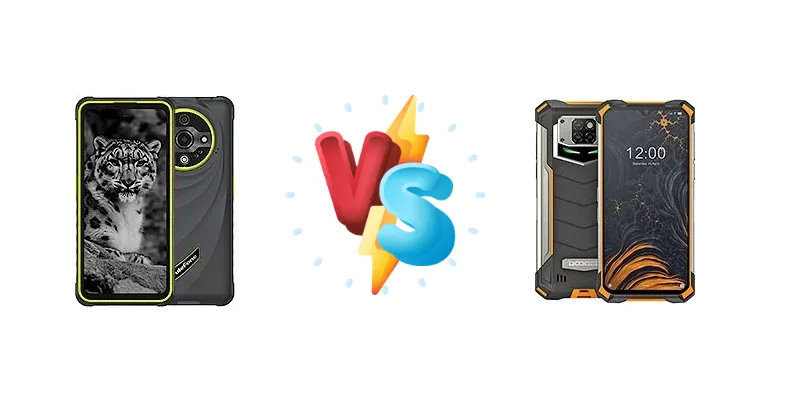
The rugged smartphone market caters to a specific need: durability and reliability in challenging environments. Both the Ulefone Armor X31 and Doogee S88 Pro aim to deliver on this promise, but they take different approaches. The X31 prioritizes exceptional battery life and a newer chipset, while the S88 Pro offers wireless charging and a slightly older, but still capable, processor. This comparison dissects their key specifications to determine which device best suits your needs.
🏆 Quick Verdict
For the average user prioritizing longevity and sustained performance, the Ulefone Armor X31 emerges as the winner. Its staggering 81:03h endurance rating, powered by the Mediatek Helio G91, significantly outlasts the Doogee S88 Pro’s 202h rating, making it ideal for extended fieldwork or travel.
| Network |
|---|
| 2G bands | GSM 850 / 900 / 1800 / 1900 | GSM 850 / 900 / 1800 / 1900 |
| 3G bands | HSDPA 800 / 850 / 900 / 1700(AWS) / 1900 / 2100 | HSDPA 850 / 900 / 1700(AWS) / 1900 / 2100 |
| 4G bands | 1, 2, 3, 4, 5, 7, 8, 12, 13, 17, 18, 19, 20, 25, 26, 28, 34, 38, 39, 40, 41, 66, 71 | 1, 3, 7, 8, 20 |
| Speed | HSPA, LTE | HSPA, LTE |
| Technology | GSM / CDMA / HSPA / LTE | GSM / HSPA / LTE |
| Launch |
|---|
| Announced | 2025, April | 2020, June 06. Released 2020, June 06 |
| Status | Available. Released 2025, April | Discontinued |
| Body |
|---|
| Build | - | Glass front (Gorilla Glass), aluminum back with rubber, aluminum frame |
| Dimensions | 173.8 x 82 x 13.7 mm (6.84 x 3.23 x 0.54 in) | 171.6 x 85.5 x 18.7 mm (6.76 x 3.37 x 0.74 in) |
| SIM | Nano-SIM + Nano-SIM | Nano-SIM + Nano-SIM |
| Weight | 305.5 g (10.79 oz) | 372 g (13.12 oz) |
| Display |
|---|
| Protection | Corning Gorilla Glass 5, Mohs level 4 | Corning Gorilla Glass |
| Resolution | 720 x 1612 pixels, 20:9 ratio (~269 ppi density) | 1080 x 2340 pixels, 19.5:9 ratio (~409 ppi density) |
| Size | 6.56 inches, 103.4 cm2 (~72.5% screen-to-body ratio) | 6.3 inches, 97.4 cm2 (~66.4% screen-to-body ratio) |
| Type | IPS LCD, 90Hz, 600 nits | IPS LCD |
| Platform |
|---|
| CPU | Octa-core (2x2.0 GHz Cortex-A75 & 6x1.8 GHz Cortex-A55) | Octa-core (4x2.1 GHz Cortex-A73 & 4x2.0 GHz Cortex-A53) |
| Chipset | Mediatek Helio G91 (12 nm) | Mediatek MT6771T Helio P70 (12 nm) |
| GPU | Mali-G52 MC2 | Mali-G72 MP3 |
| OS | Android 14 | Android 10 |
| Memory |
|---|
| Card slot | microSDXC (dedicated slot) | microSDXC (uses shared SIM slot) |
| Internal | 128GB 6GB RAM | 128GB 6GB RAM |
| Main Camera |
|---|
| Features | LED flash, HDR, panorama | Dual-LED dual-tone flash, HDR, panorama |
| Triple | 48 MP, f/1.8, (wide), 0.8µm, PDAF
20 MP, f/1.8, (night vision), 2 infrared lights
2 MP (macro) | 21 MP, f/2.2, (wide), 1/2.4", 1.12µm, PDAF
8 MP, f/2.2, 130˚, (ultrawide), 1/4.0", 1.12µm
Auxiliary lens |
| Video | 1440p@30fps, 1080p@30fps | 1080p@30fps |
| Selfie camera |
|---|
| Single | 16 MP, f/2.3, (wide), 1.0µm | 16 MP, f/2.2, 26mm (wide) |
| Video | 1080p@30fps | 1080p@30fps |
| Sound |
|---|
| 35mm jack | Yes | No |
| Loudspeaker | Yes | Yes |
| Comms |
|---|
| Bluetooth | 5.2, A2DP, LE | 4.2, A2DP |
| Infrared port | Yes | - |
| NFC | Yes | Yes |
| Positioning | GPS, GLONASS, GALILEO, BDS | GPS, GLONASS, BDS, GALILEO |
| Radio | Wireless FM radio | FM radio |
| USB | USB Type-C 2.0, OTG | USB Type-C 2.0, OTG |
| WLAN | Wi-Fi 802.11 a/b/g/n/ac, dual-band | Wi-Fi 802.11 b/g/n |
| Features |
|---|
| Sensors | Fingerprint (side-mounted), accelerometer, gyro, proximity, compass, barometer | Fingerprint (side-mounted), accelerometer, gyro, proximity, compass |
| Battery |
|---|
| Charging | 18W wired | 24W wired
10W wireless
5W Reverse wireless |
| Type | Li-Po 6050 mAh | 10000 mAh |
| Misc |
|---|
| Colors | Black, Black/Orange, Black/Green | Fire Orange, Army Green, Mineral Black |
| Price | About 130 EUR | About 130 EUR |
| EU LABEL |
|---|
| Battery | 81:03h endurance, 1000 cycles | - |
| Energy | Class A | - |
| Free fall | Class A (270 falls) | - |
| Repairability | Class C | - |
Ulefone Armor X31
- Exceptional battery life (81:03h endurance)
- More modern and efficient Mediatek Helio G91 chipset
- 1000 charge cycles promise long-term battery health
- Slower 18W wired charging
- No wireless charging capabilities
Doogee S88 Pro
- Faster 24W wired charging
- Convenient 10W wireless charging
- 5W reverse wireless charging for accessories
- Significantly shorter battery life (202h endurance)
- Older Mediatek Helio P70 chipset
Display Comparison
The Doogee S88 Pro boasts a contrast ratio of 1641:1, indicating good black levels and vibrant colors, though specific brightness data is missing. The Ulefone Armor X31’s display specifications are not provided, making a direct comparison difficult. However, given its market positioning, it likely prioritizes durability over display fidelity. Users concerned with outdoor visibility will need to research independent reviews for the X31’s peak brightness.
Camera Comparison
Neither device is positioned as a photography powerhouse, and detailed camera specifications are limited. The absence of information regarding sensor sizes and apertures makes a meaningful comparison challenging. It’s reasonable to assume both phones feature basic camera setups suitable for casual snapshots. The focus should be on durability rather than image quality for these devices. The inclusion of a 2MP macro lens on the S88 Pro is likely a marketing feature with limited practical benefit.
Performance
The Ulefone Armor X31’s Mediatek Helio G91 (12nm) chipset, featuring a combination of Cortex-A75 (2x2.0 GHz) and Cortex-A55 (6x1.8 GHz) cores, represents a generational leap over the Doogee S88 Pro’s Helio P70 (12nm). The G91’s A75 cores offer significantly improved single-core performance, crucial for responsive app launches and smoother multitasking. While the S88 Pro utilizes Cortex-A73 (4x2.1 GHz) and A53 (4x2.0 GHz) cores, the newer architecture of the G91 provides a performance edge, particularly in sustained workloads. This translates to a more fluid user experience for demanding applications.
Battery Life
The Ulefone Armor X31’s 81:03h endurance rating is the standout feature, dwarfing the Doogee S88 Pro’s 202h. This difference is substantial and directly impacts usability for users who rely on their phones for extended periods without access to power. The X31’s 18W wired charging is slower than the S88 Pro’s 24W wired charging, but the massive battery capacity mitigates this concern. The S88 Pro’s inclusion of 10W wireless and 5W reverse wireless charging adds convenience, allowing users to charge compatible accessories or share power with other devices, a feature absent on the X31.
Buying Guide
Buy the Ulefone Armor X31 if you need a phone that can genuinely last for days on a single charge, and you value a more modern chipset for smoother application performance. Buy the Doogee S88 Pro if you prioritize the convenience of wireless charging, including reverse wireless charging for accessories, and are comfortable with a shorter battery life in exchange for that feature.
Frequently Asked Questions
❓ How does the Helio G91 in the Ulefone Armor X31 handle graphically intensive games like PUBG?
The Helio G91, while not a flagship gaming chip, offers a noticeable improvement over the Helio P70 in the Doogee S88 Pro. It can handle PUBG at medium settings with reasonable frame rates. However, extended gaming sessions may lead to some thermal throttling, impacting sustained performance. The G91’s architecture is better suited for gaming than the P70, providing a smoother experience overall.
❓ Is the 24W charging on the Doogee S88 Pro significantly faster in real-world use compared to the Ulefone Armor X31’s 18W charging, considering the battery size difference?
While 24W is faster on paper, the Ulefone Armor X31’s much larger battery capacity means the difference in 0-100% charge time won’t be as dramatic as the wattage suggests. The S88 Pro will likely charge faster initially, but the X31’s larger battery will take longer to fully replenish. The convenience of wireless charging on the S88 Pro may offset the slower wired charging speed for some users.
❓ What does '1000 charge cycles' mean for the Ulefone Armor X31's battery longevity?
A '1000 charge cycles' rating indicates the battery is designed to retain at least 80% of its original capacity after being fully charged and discharged 1000 times. This is a significant advantage, suggesting the X31’s battery will maintain its performance for a longer period compared to phones with lower cycle ratings. It’s a key indicator of long-term battery health and reliability.