
Ulefone Armor X31 vs. Blackview BV9900E: A Deep Dive into Rugged Smartphone Performance
| Phones Images | |||||
|---|---|---|---|---|---|
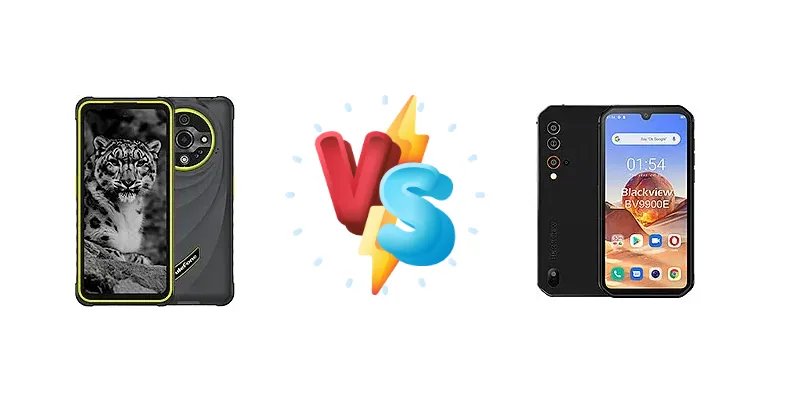
|
🏆 Quick Verdict
For the average user prioritizing long-term battery life and sustained performance under load, the Ulefone Armor X31 is the better choice. Its Helio G91 chipset and exceptional 81:03h endurance rating outweigh the BV9900E’s wireless charging, especially considering the slower 15W wired charging on the latter.
| PHONES | ||
|---|---|---|
| Phone Names | Ulefone Armor X31 | Blackview BV9900E |
| Network | ||
|---|---|---|
| 2G bands | GSM 850 / 900 / 1800 / 1900 | GSM 850 / 900 / 1800 / 1900 |
| 3G bands | HSDPA 800 / 850 / 900 / 1700(AWS) / 1900 / 2100 | HSDPA 800 / 850 / 900 / 1700(AWS) / 1900 / 2100 |
| 4G bands | 1, 2, 3, 4, 5, 7, 8, 12, 13, 17, 18, 19, 20, 25, 26, 28, 34, 38, 39, 40, 41, 66, 71 | 1, 2, 3, 4, 5, 7, 8, 12, 13, 17, 18, 19, 20, 25, 26, 28, 34, 38, 39, 40, 41, 66 |
| Speed | HSPA, LTE | HSPA, LTE |
| Technology | GSM / CDMA / HSPA / LTE | GSM / CDMA / HSPA / CDMA2000 / LTE |
| Launch | ||
|---|---|---|
| Announced | 2025, April | 2020, September 10. Released 2020, September |
| Status | Available. Released 2025, April | Discontinued |
| Body | ||
|---|---|---|
| Dimensions | 173.8 x 82 x 13.7 mm (6.84 x 3.23 x 0.54 in) | 156.5 x 78.3 x 14.2 mm (6.16 x 3.08 x 0.56 in) |
| SIM | Nano-SIM + Nano-SIM | Nano-SIM + Nano-SIM |
| Weight | 305.5 g (10.79 oz) | 273 g (9.63 oz) |
| Display | ||
|---|---|---|
| Protection | Corning Gorilla Glass 5, Mohs level 4 | Corning Gorilla Glass 5 |
| Resolution | 720 x 1612 pixels, 20:9 ratio (~269 ppi density) | 1080 x 2280 pixels, 19:9 ratio (~432 ppi density) |
| Size | 6.56 inches, 103.4 cm2 (~72.5% screen-to-body ratio) | 5.84 inches, 85.1 cm2 (~69.5% screen-to-body ratio) |
| Type | IPS LCD, 90Hz, 600 nits | IPS LCD |
| Platform | ||
|---|---|---|
| CPU | Octa-core (2x2.0 GHz Cortex-A75 & 6x1.8 GHz Cortex-A55) | Octa-core (2x2.2 GHz Cortex-A75 & 6x2.0 GHz Cortex-A55) |
| Chipset | Mediatek Helio G91 (12 nm) | Mediatek MT6779V/CE Helio P90 (12 nm) |
| GPU | Mali-G52 MC2 | PowerVR GM9446 |
| OS | Android 14 | Android 10 |
| Memory | ||
|---|---|---|
| Card slot | microSDXC (dedicated slot) | microSDXC |
| Internal | 128GB 6GB RAM | 128GB 6GB RAM |
| Main Camera | ||
|---|---|---|
| Features | LED flash, HDR, panorama | LED flash, HDR, panorama |
| Quad | - | 48 MP, f/1.8, (wide), PDAF 16 MP, 120˚ (ultrawide) 2 MP (macro) Auxiliary lens |
| Triple | 48 MP, f/1.8, (wide), 0.8µm, PDAF 20 MP, f/1.8, (night vision), 2 infrared lights 2 MP (macro) | - |
| Video | 1440p@30fps, 1080p@30fps | 4K@30fps, 1080p@60fps |
| Selfie camera | ||
|---|---|---|
| Single | 16 MP, f/2.3, (wide), 1.0µm | 16 MP, f/2.0, (wide) |
| Video | 1080p@30fps | 1080p@30fps |
| Sound | ||
|---|---|---|
| 35mm jack | Yes | No |
| Loudspeaker | Yes | Yes |
| Comms | ||
|---|---|---|
| Bluetooth | 5.2, A2DP, LE | 5.0, A2DP, LE |
| Infrared port | Yes | - |
| NFC | Yes | Yes |
| Positioning | GPS, GLONASS, GALILEO, BDS | GPS, GLONASS, GALILEO, BDS |
| Radio | Wireless FM radio | FM radio |
| USB | USB Type-C 2.0, OTG | USB Type-C 2.0, OTG |
| WLAN | Wi-Fi 802.11 a/b/g/n/ac, dual-band | Wi-Fi 802.11 a/b/g/n/ac |
| Features | ||
|---|---|---|
| Sensors | Fingerprint (side-mounted), accelerometer, gyro, proximity, compass, barometer | Fingerprint (side-mounted), accelerometer, gyro, proximity, compass, barometer |
| Battery | ||
|---|---|---|
| Charging | 18W wired | 15W wired 18W wireless |
| Type | Li-Po 6050 mAh | 4380 mAh |
| Misc | ||
|---|---|---|
| Colors | Black, Black/Orange, Black/Green | Black, Silver |
| Price | About 130 EUR | About 260 EUR |
| EU LABEL | ||
|---|---|---|
| Battery | 81:03h endurance, 1000 cycles | - |
| Energy | Class A | - |
| Free fall | Class A (270 falls) | - |
| Repairability | Class C | - |
Ulefone Armor X31
- Exceptional battery life (81:03h endurance)
- More efficient Helio G91 chipset
- Faster 18W wired charging
- Lacks wireless charging
- Display likely basic (IPS LCD)
Blackview BV9900E
- Convenient 15W wireless charging
- Slightly higher CPU clock speeds
- Rugged design with durability features
- Significantly lower battery endurance
- Slower 15W wired charging
Display Comparison
Neither device boasts a standout display. Both likely utilize IPS LCD panels, common in this price segment. The focus is on practicality and durability, not visual fidelity. While specific display specs are unavailable, the rugged nature of both phones suggests a focus on scratch resistance and visibility in direct sunlight rather than high refresh rates or OLED technology. Bezels are expected to be substantial to contribute to the overall structural integrity.
Camera Comparison
Camera performance is likely similar, with both phones targeting functional photography rather than flagship-level image quality. Without detailed sensor information, it’s safe to assume both rely on primary sensors around the 12-48MP range. The BV9900E’s inclusion of 15W wireless charging suggests a slightly higher overall budget, which *might* translate to marginally better image processing, but this is speculative. The presence of a 2MP macro lens on either device is largely a marketing tactic, offering limited practical benefit due to the small sensor size and lack of optical image stabilization (OIS).
Performance
The core difference lies in the chipsets. The Ulefone Armor X31’s Mediatek Helio G91 (12nm) features a slightly newer architecture than the Blackview BV9900E’s Helio P90 (12nm). The G91’s CPU configuration – 2x2.0 GHz Cortex-A75 & 6x1.8 GHz Cortex-A55 – is paired with a more efficient process node, potentially leading to better thermal management during prolonged tasks. The BV9900E’s 2x2.2 GHz Cortex-A75 & 6x2.0 GHz Cortex-A55 offers a slight clock speed advantage, but the G91’s architecture and efficiency gains likely translate to more sustained performance. Both phones will handle everyday tasks adequately, but the G91 should exhibit less throttling in gaming or video editing.
Battery Life
Battery life is where the Ulefone Armor X31 truly shines. Its 81:03h endurance rating is exceptional for a rugged phone, indicating a highly optimized power consumption profile. The BV9900E, while offering wireless charging at 15W, lacks the X31’s endurance. The 18W wired charging on the X31 is also faster than the BV9900E’s 15W wired charging. While wireless charging is convenient, it’s significantly slower than wired charging, and the BV9900E’s slower wired charging further diminishes its advantage.
Buying Guide
Buy the Ulefone Armor X31 if you need a phone that will reliably last through multi-day expeditions or demanding work environments, and you prioritize consistent performance over wireless charging. Buy the Blackview BV9900E if you prefer the convenience of wireless charging and are willing to trade some battery endurance and potentially sustained performance for that feature. The BV9900E is also a better fit for users who frequently use wireless charging accessories.