
Ulefone Armor X31 Pro vs. Nokia XR20: A Deep Dive into Rugged Smartphone Performance
| Phones Images | |||||
|---|---|---|---|---|---|
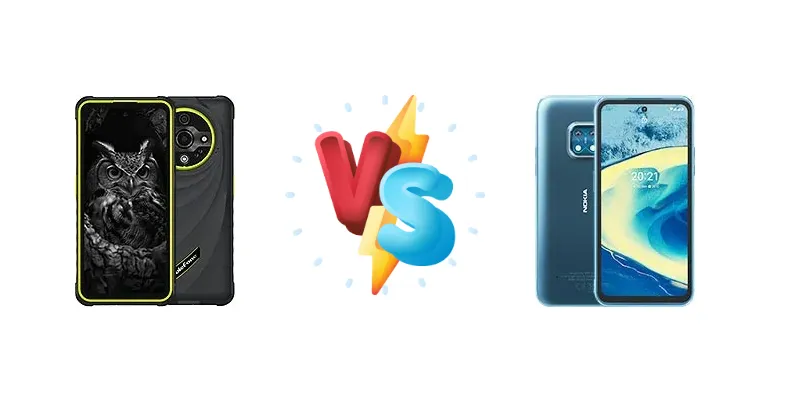
|
🏆 Quick Verdict
For users prioritizing raw performance and extended battery life, the Ulefone Armor X31 Pro emerges as the winner. Its Dimensity 6300 chipset, built on a 6nm process, offers a noticeable advantage over the Snapdragon 480 in the Nokia XR20, despite the latter's 8nm fabrication. However, the XR20's wireless charging and Nokia's software support are compelling considerations.
| PHONES | ||
|---|---|---|
| Phone Names | Ulefone Armor X31 Pro | Nokia XR20 |
| Network | ||
|---|---|---|
| 2G bands | GSM 850 / 900 / 1800 / 1900 | GSM 850 / 900 / 1800 / 1900 |
| 3G bands | HSDPA 800 / 850 / 900 / 1700(AWS) / 1900 / 2100 | HSDPA 850 / 900 / 1700(AWS) / 1900 / 2100 |
| 4G bands | 1, 2, 3, 4, 5, 7, 8, 12, 13, 17, 18, 19, 20, 25, 26, 28, 32, 34, 38, 39, 40, 41, 66, 71 | 1, 2, 3, 4, 5, 7, 8, 12, 13, 14, 20, 25, 26, 28, 30, 38, 40, 41, 48, 66, 71 |
| 5G bands | 1, 2, 3, 5, 7, 8, 20, 25, 28, 38, 40, 41, 66, 71, 77, 78, 79 SA/NSA | 2, 5, 25, 38, 41, 48, 66, 77, 78 SA/NSA |
| Speed | HSPA, LTE, 5G | HSPA, LTE, 5G |
| Technology | GSM / CDMA / HSPA / LTE / 5G | GSM / CDMA / HSPA / EVDO / LTE / 5G |
| - | CDMA2000 1xEV-DO | |
| Launch | ||
|---|---|---|
| Announced | 2024, December 21 | 2021, July 27 |
| Status | Available. Released 2025, January 01 | Available. Released 2021, August 04 |
| Body | ||
|---|---|---|
| Dimensions | 173.8 x 82 x 13.7 mm (6.84 x 3.23 x 0.54 in) | 171.6 x 81.5 x 10.6 mm (6.76 x 3.21 x 0.42 in) |
| SIM | Nano-SIM + Nano-SIM | · Nano-SIM· Nano-SIM + Nano-SIM |
| Weight | 306 g (10.79 oz) | 248 g (8.75 oz) |
| - | IP68 dust/water resistant (up to 1.5m for 60 min) Drop-to-concrete resistance from up to 1.8m MIL-STD-810H compliant | |
| Display | ||
|---|---|---|
| Protection | Corning Gorilla Glass 5, Mohs level 4 | Corning Gorilla Glass Victus |
| Resolution | 720 x 1612 pixels, 20:9 ratio (~269 ppi density) | 1080 x 2400 pixels, 20:9 ratio (~395 ppi density) |
| Size | 6.56 inches, 103.4 cm2 (~72.5% screen-to-body ratio) | 6.67 inches, 107.4 cm2 (~76.8% screen-to-body ratio) |
| Type | IPS LCD, 120Hz, 800 nits (HBM) | IPS LCD, 550 nits |
| Platform | ||
|---|---|---|
| CPU | Octa-core (2x2.4 GHz Cortex-A76 & 6x2.0 GHz Cortex-A55) | Octa-core (2x2.0 GHz Kryo 460 & 6x1.8 GHz Kryo 460) |
| Chipset | Mediatek Dimensity 6300 (6 nm) | Qualcomm SM4350 Snapdragon 480 5G (8 nm) |
| GPU | Mali-G57 MC2 | Adreno 619 |
| OS | Android 14 | Android 11, upgradable to Android 13 |
| Memory | ||
|---|---|---|
| Card slot | microSDXC (dedicated slot) | microSDXC (uses shared SIM slot) |
| Internal | 256GB 8GB RAM | 64GB 4GB RAM, 128GB 6GB RAM |
| Main Camera | ||
|---|---|---|
| Dual | - | 48 MP, f/1.8, (wide), 1/2.25", 0.8µm, PDAF 13 MP, f/2.4, 123˚ (ultrawide), 1/3.0", 1.12µm |
| Features | LED flash, HDR, panorama | Zeiss optics, Dual-LED dual-tone flash, second LED flash, HDR, panorama |
| Single | - | 8 MP, f/2.0 (wide), 1/4.0", 1.12µm |
| Triple | 64 MP, f/1.9, (wide), 0.8µm, PDAF 25 MP, f/1.8, (night vision), 2 infrared lights 2 MP (macro) | - |
| Video | 1440p@30fps, 1080p@30fps | 1080p@30fps |
| Selfie camera | ||
|---|---|---|
| Single | 16 MP, f/2.3, (wide), 1.0µm | 8 MP, f/2.0 (wide), 1/4.0", 1.12µm |
| Video | 1080p@30fps | 1080p@30fps |
| Sound | ||
|---|---|---|
| 3.5mm jack | - | Yes |
| 35mm jack | Yes | Yes |
| Loudspeaker | Yes | Yes, with stereo speakers |
| Comms | ||
|---|---|---|
| Bluetooth | 5.2, A2DP, LE | 5.1, A2DP, LE, aptX Adaptive |
| Infrared port | Yes | - |
| NFC | Yes | Yes |
| Positioning | GPS, GLONASS, GALILEO, BDS | GPS (L1+L5), GLONASS, BDS, GALILEO, QZSS, NavIC |
| Radio | Wireless FM radio | Unspecified |
| USB | USB Type-C 2.0 | USB Type-C 3.0 |
| WLAN | Wi-Fi 802.11 a/b/g/n/ac, dual-band | Wi-Fi 802.11 a/b/g/n/ac/6, dual-band, Wi-Fi Direct |
| Features | ||
|---|---|---|
| Sensors | Fingerprint (side-mounted), accelerometer, gyro, proximity, compass | Fingerprint (side-mounted), accelerometer, gyro, proximity, compass, barometer |
| Battery | ||
|---|---|---|
| Charging | 18W wired | 18W wired 15W wireless |
| Type | Li-Po 6050 mAh | Li-Po 4630 mAh |
| Misc | ||
|---|---|---|
| Colors | Black, Black/Orange, Black/Green | Ultra Blue, Granite Gray |
| Models | - | TA-1368, TA-1362 |
| Price | About 200 EUR | About 270 EUR |
| SAR EU | - | 1.13 W/kg (head) 1.43 W/kg (body) |
| EU LABEL | ||
|---|---|---|
| Battery | 81:30h endurance, 1000 cycles | - |
| Energy | Class A | - |
| Free fall | Class A (270 falls) | - |
| Repairability | Class C | - |
Ulefone Armor X31 Pro
- Superior chipset performance with the Dimensity 6300
- Exceptional battery life (81:30h endurance)
- Long battery lifespan (1000 charge cycles)
- Lacks wireless charging
- Display specifications are unknown, potentially lower quality
Nokia XR20
- Convenient 15W wireless charging
- Nokia's clean software experience and update commitment
- 5G connectivity
- Less powerful Snapdragon 480 chipset
- Shorter battery life compared to the Ulefone
Display Comparison
Neither device's display specifications are provided, so a direct comparison is limited. However, given the price points, we can assume both utilize LCD panels. The XR20's inclusion of wireless charging suggests a focus on convenience, potentially indicating a slightly more refined display assembly. The Armor X31 Pro, targeting a more performance-focused user, may prioritize durability over display finesse.
Camera Comparison
Without detailed camera specifications, a comprehensive comparison is difficult. However, the market segment suggests both phones will feature capable, but not flagship-level, camera systems. The focus will likely be on practicality and durability rather than cutting-edge image quality. The absence of information regarding sensor size or optical image stabilization (OIS) suggests neither phone prioritizes advanced photographic features. Users should expect adequate performance in good lighting conditions, but potentially struggle in low-light scenarios.
Performance
The Ulefone Armor X31 Pro's Mediatek Dimensity 6300 (6nm) chipset represents a significant architectural leap over the Nokia XR20's Qualcomm Snapdragon 480 5G (8nm). The 6nm process generally translates to improved power efficiency and thermal performance. The Dimensity 6300’s octa-core configuration (2x2.4 GHz Cortex-A76 & 6x2.0 GHz Cortex-A55) is also clocked higher than the XR20’s (2x2.0 GHz Kryo 460 & 6x1.8 GHz Kryo 460), suggesting faster processing speeds for applications and multitasking. This difference will be most noticeable in demanding tasks like gaming or video editing.
Battery Life
The Ulefone Armor X31 Pro boasts an impressive 81:30h endurance rating, significantly exceeding what's typically expected from a rugged phone. This is likely due to the efficient 6nm Dimensity 6300 chipset and optimized power management. While both phones offer 18W wired charging, the XR20 adds 15W wireless charging, providing a convenient alternative. However, the X31 Pro’s exceptional battery life may negate the need for faster charging speeds, making the wireless charging feature on the XR20 less critical for many users. The X31 Pro also claims 1000 charge cycles, suggesting a longer lifespan for the battery itself.
Buying Guide
Buy the Ulefone Armor X31 Pro if you need a rugged phone for demanding tasks, extended outdoor use, or prioritize maximizing battery endurance. Its superior chipset and impressive 81:30h battery life make it ideal for professionals and adventurers. Buy the Nokia XR20 if you prefer a cleaner software experience, value wireless charging convenience, and appreciate Nokia's commitment to long-term software updates, even if it means sacrificing some processing power.