
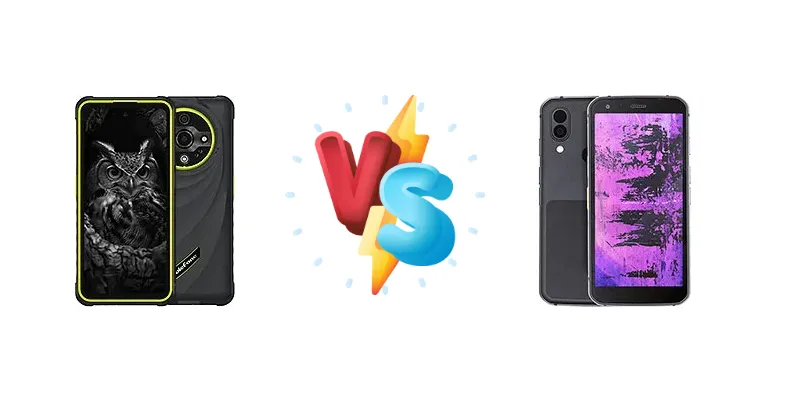
Ulefone Armor X31 Pro vs. Cat S62 Pro: Which Rugged Phone Reigns Supreme?
| Phones Images | |||||
|---|---|---|---|---|---|
|
🏆 Quick Verdict
For the average user prioritizing longevity and modern performance, the Ulefone Armor X31 Pro emerges as the stronger contender. Its Dimensity 6300 chipset, built on a 6nm process, offers a significant efficiency advantage over the Cat S62 Pro’s older Snapdragon 660, translating to exceptional 81:30h battery endurance.
| PHONES | ||
|---|---|---|
| Phone Names | Ulefone Armor X31 Pro | Cat S62 Pro |
| Network | ||
|---|---|---|
| 2G bands | GSM 850 / 900 / 1800 / 1900 | GSM 850 / 900 / 1800 / 1900 |
| 3G bands | HSDPA 800 / 850 / 900 / 1700(AWS) / 1900 / 2100 | HSDPA 850 / 900 / 1700(AWS) / 1900 / 2100 |
| 4G bands | 1, 2, 3, 4, 5, 7, 8, 12, 13, 17, 18, 19, 20, 25, 26, 28, 32, 34, 38, 39, 40, 41, 66, 71 | 1, 2, 3, 4, 5, 7, 8, 20, 28, 38, 40 |
| 5G bands | 1, 2, 3, 5, 7, 8, 20, 25, 28, 38, 40, 41, 66, 71, 77, 78, 79 SA/NSA | - |
| Speed | HSPA, LTE, 5G | HSPA 42.2/5.76 Mbps, LTE (2CA) Cat13 400/150 Mbps |
| Technology | GSM / CDMA / HSPA / LTE / 5G | GSM / HSPA / LTE |
| Launch | ||
|---|---|---|
| Announced | 2024, December 21 | 2020, June 28. Released 2020, August 17 |
| Status | Available. Released 2025, January 01 | Discontinued |
| Body | ||
|---|---|---|
| Build | - | Glass front (Gorilla Glass 6), plastic back, aluminum frame |
| Dimensions | 173.8 x 82 x 13.7 mm (6.84 x 3.23 x 0.54 in) | 158.5 x 76.7 x 11.9 mm (6.24 x 3.02 x 0.47 in) |
| SIM | Nano-SIM + Nano-SIM | · Nano-SIM· Nano-SIM + Nano-SIM |
| Weight | 306 g (10.79 oz) | 248 g (8.75 oz) |
| - | IP68/IP69 dust/water resistant (up to 1.5m for 35 mins) Drop-to-concrete resistance from up to 1.8m MIL-STD-810H compliant | |
| Display | ||
|---|---|---|
| Protection | Corning Gorilla Glass 5, Mohs level 4 | Corning Gorilla Glass 6 |
| Resolution | 720 x 1612 pixels, 20:9 ratio (~269 ppi density) | 1080 x 2160 pixels, 18:9 ratio (~424 ppi density) |
| Size | 6.56 inches, 103.4 cm2 (~72.5% screen-to-body ratio) | 5.7 inches, 83.8 cm2 (~69.0% screen-to-body ratio) |
| Type | IPS LCD, 120Hz, 800 nits (HBM) | IPS LCD |
| Platform | ||
|---|---|---|
| CPU | Octa-core (2x2.4 GHz Cortex-A76 & 6x2.0 GHz Cortex-A55) | Octa-core (4x2.2 GHz Kryo 260 Gold & 4x1.8 GHz Kryo 260 Silver) |
| Chipset | Mediatek Dimensity 6300 (6 nm) | Qualcomm SDM660 Snapdragon 660 (14 nm) |
| GPU | Mali-G57 MC2 | Adreno 512 |
| OS | Android 14 | Android 10 |
| Memory | ||
|---|---|---|
| Card slot | microSDXC (dedicated slot) | microSDXC (dedicated slot) |
| Internal | 256GB 8GB RAM | 128GB 6GB RAM |
| Main Camera | ||
|---|---|---|
| Dual | - | 12 MP, f/1.8, (wide), 1/2.55", 1.4µm, dual pixel PDAF FLIR thermal camera (Lepton 3.5 module) |
| Features | LED flash, HDR, panorama | Thermal imaging, heat palettes, temp. spot meter, LED flash |
| Triple | 64 MP, f/1.9, (wide), 0.8µm, PDAF 25 MP, f/1.8, (night vision), 2 infrared lights 2 MP (macro) | - |
| Video | 1440p@30fps, 1080p@30fps | 1080p@30fps, gyro-EIS |
| Selfie camera | ||
|---|---|---|
| Single | 16 MP, f/2.3, (wide), 1.0µm | 8 MP |
| Video | 1080p@30fps | 1080p@30fps |
| Sound | ||
|---|---|---|
| 3.5mm jack | - | No |
| 35mm jack | Yes | No |
| Loudspeaker | Yes | Yes |
| Comms | ||
|---|---|---|
| Bluetooth | 5.2, A2DP, LE | 5.0, A2DP, LE |
| Infrared port | Yes | - |
| NFC | Yes | Yes |
| Positioning | GPS, GLONASS, GALILEO, BDS | GPS, GLONASS, GALILEO, BDS |
| Radio | Wireless FM radio | FM radio |
| USB | USB Type-C 2.0 | USB Type-C 2.0, OTG |
| WLAN | Wi-Fi 802.11 a/b/g/n/ac, dual-band | Wi-Fi 802.11 a/b/g/n/ac, dual-band, Wi-Fi Direct |
| Features | ||
|---|---|---|
| Sensors | Fingerprint (side-mounted), accelerometer, gyro, proximity, compass | Fingerprint (rear-mounted), accelerometer, gyro, proximity, compass |
| Battery | ||
|---|---|---|
| Charging | 18W wired | - |
| Type | Li-Po 6050 mAh | Li-Ion 4000 mAh |
| Misc | ||
|---|---|---|
| Colors | Black, Black/Orange, Black/Green | Black |
| Price | About 200 EUR | About 530 EUR |
| EU LABEL | ||
|---|---|---|
| Battery | 81:30h endurance, 1000 cycles | - |
| Energy | Class A | - |
| Free fall | Class A (270 falls) | - |
| Repairability | Class C | - |
Ulefone Armor X31 Pro
- Superior battery life (81:30h endurance)
- More efficient and modern Dimensity 6300 chipset
- Potentially improved display technology
- Charging speed is relatively slow (18W)
- Brand recognition is lower than Cat
Cat S62 Pro
- Established brand reputation in the rugged phone market
- Potentially better software support (depending on Cat’s update policy)
- Familiar Qualcomm Snapdragon platform
- Less efficient Snapdragon 660 chipset
- Likely shorter battery life
- Older manufacturing process (14nm)
Display Comparison
Neither device’s display specifications are provided, so a direct comparison is limited. However, given the Cat S62 Pro’s age, it likely utilizes an older LCD panel. The Ulefone, being a newer device, may benefit from advancements in display technology, potentially offering improved color accuracy and viewing angles. The absence of refresh rate data suggests both likely operate at a standard 60Hz.
Camera Comparison
Without detailed camera specifications, a comprehensive comparison is difficult. However, the market segment suggests both phones prioritize practicality over photographic excellence. The absence of information regarding sensor size and aperture makes it hard to assess image quality. It’s reasonable to assume the Ulefone, being newer, may incorporate improved image processing algorithms, but this remains speculative without further data. The presence of a 2MP macro lens on either device is likely a marketing feature with limited real-world utility.
Performance
The core difference lies in the chipsets. The Ulefone Armor X31 Pro’s Mediatek Dimensity 6300 (6nm) represents a significant leap in efficiency compared to the Cat S62 Pro’s Qualcomm Snapdragon 660 (14nm). The 6nm process allows for higher transistor density and lower power consumption, resulting in better thermal management and sustained performance. While both are octa-core CPUs, the Dimensity 6300’s Cortex-A76 cores (2x2.4 GHz) offer a performance advantage over the Snapdragon 660’s Kryo 260 Gold cores (4x2.2 GHz). This translates to snappier app launches and smoother multitasking for the Ulefone.
Battery Life
The Ulefone Armor X31 Pro boasts an impressive 81:30h endurance, a testament to the efficiency of the Dimensity 6300 chipset. While the battery capacity isn’t specified, the endurance figure clearly demonstrates superior power management. The Cat S62 Pro’s battery life is not provided, but given the older, less efficient Snapdragon 660, it’s likely to fall significantly short of the Ulefone. The Ulefone’s 18W charging, while not exceptionally fast, is adequate for topping up the battery overnight.
Buying Guide
Buy the Ulefone Armor X31 Pro if you need a phone that can withstand demanding workdays *and* offer a modern processor for smoother multitasking and app performance. It’s ideal for users who frequently rely on their phone for navigation, communication, and data-intensive tasks in challenging environments. Buy the Cat S62 Pro if you prioritize a brand with a long-standing reputation in the rugged phone space and are comfortable with a slightly older chipset in exchange for potentially better software support and a familiar user experience.