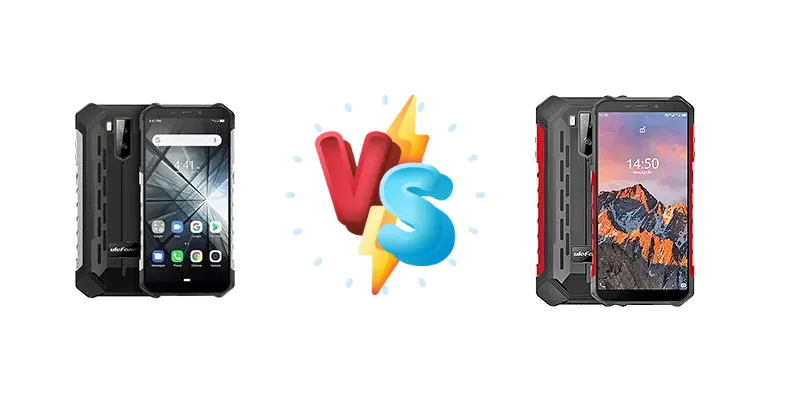
Ulefone's Armor series consistently targets the budget-friendly rugged phone market. The Armor X3 and X5 Pro represent different points within that spectrum, with the X5 Pro aiming for a noticeable performance uplift. This comparison dissects the core differences – primarily the chipset – to determine which device delivers the best value for users needing a durable, reliable smartphone.
🏆 Quick Verdict
For most users, the Ulefone Armor X5 Pro is the superior choice. Its Helio P22 chipset offers a significant performance advantage over the X3’s MT6580, translating to smoother multitasking and a more responsive user experience. While both charge at the same speed, the X5 Pro’s efficiency gains make it the better all-around performer.
| Network |
|---|
| 2G bands | GSM 850 / 900 / 1800 / 1900 | GSM 850 / 900 / 1800 / 1900 |
| 3G bands | HSDPA 850 / 900 / 1700(AWS) / 1900 / 2100 | HSDPA 850 / 900 / 1700(AWS) / 1900 / 2100 |
| 4G bands | - | 1, 2, 3, 4, 5, 7, 8, 12, 13, 17, 19, 20, 28 |
| Speed | HSPA 21.1/5.76 Mbps | HSPA 42.2/11.5 Mbps, LTE Cat7 300/150 Mbps |
| Technology | GSM / HSPA | GSM / HSPA / LTE |
| Launch |
|---|
| Announced | 2019, July. Released 2019, July | 2020, September 08. Released 2020, September 08 |
| Status | Discontinued | Discontinued |
| Body |
|---|
| Dimensions | 158 x 77.5 x 13.9 mm (6.22 x 3.05 x 0.55 in) | 158 x 77.5 x 13.9 mm (6.22 x 3.05 x 0.55 in) |
| SIM | Nano-SIM + Nano-SIM | Nano-SIM + Nano-SIM |
| Weight | 235 g (8.29 oz) | 235 g (8.29 oz) |
| | IP68 dust/water resistant (up to 1.5m for 30 mins)
Drop-to-concrete resistance from up to 1.2 m
MIL-STD-810G compliant | IP68 dust/water resistant (up to 1.5m for 30 min)
Drop-to-concrete resistance from up to 1.2m
MIL-STD-810G compliant |
| Display |
|---|
| Resolution | 720 x 1440 pixels, 18:9 ratio (~293 ppi density) | 720 x 1440 pixels, 18:9 ratio (~293 ppi density) |
| Size | 5.5 inches, 78.1 cm2 (~63.8% screen-to-body ratio) | 5.5 inches, 78.1 cm2 (~63.8% screen-to-body ratio) |
| Type | IPS LCD | IPS LCD |
| Platform |
|---|
| CPU | Quad-core 1.3 GHz Cortex-A7 | Octa-core 2.0 GHz Cortex-A53 |
| Chipset | Mediatek MT6580 (28 nm) | Mediatek MT6762V/WD Helio P22 (12 nm) |
| GPU | Mali-400 | PowerVR GE8320 |
| OS | Android 9.0 (Pie) | Android 10 |
| Memory |
|---|
| Card slot | microSDXC (uses shared SIM slot) | microSDXC (uses shared SIM slot) |
| Internal | 32GB 2GB RAM | 64GB 4GB RAM |
| | eMMC 5.1 | eMMC 5.1 |
| Main Camera |
|---|
| Dual | 8 MP, f/1.8, (wide), AF
2 MP | 13 MP, f/2.0, (wide), PDAF
Auxiliary lens |
| Features | Dual-LED flash | LED flash, Panorama, HDR |
| Video | 1080p@30fps | 1080p@30fps |
| Selfie camera |
|---|
| Single | 5 MP | 5 MP, f/2.2 |
| Video | 720p@30fps | - |
| Sound |
|---|
| 3.5mm jack | Yes | Yes |
| 35mm jack | Yes | Yes |
| Loudspeaker | Yes | Yes |
| Comms |
|---|
| Bluetooth | 4.0, A2DP | 5.0, A2DP, LE |
| NFC | No | No |
| Positioning | GPS | GPS, GLONASS, GALILEO, BDS |
| Radio | Stereo FM radio, RDS, recording | FM radio, RDS, recording |
| USB | microUSB 2.0 | microUSB 2.0 |
| WLAN | Wi-Fi 802.11 b/g/n | Wi-Fi 802.11 a/b/g/n/ac, Wi-Fi Direct |
| Features |
|---|
| Sensors | Accelerometer, proximity, compass | Accelerometer, proximity, compass |
| Battery |
|---|
| Charging | 10W wired | 10W wired |
| Type | Li-Po 5000 mAh | Li-Po 5000 mAh |
| Misc |
|---|
| Colors | Black, Red, Silver | Black, Orange, Red |
| Price | - | About 110 EUR |
Ulefone Armor X3
- Lowest possible price point for a rugged phone.
- Durable build quality consistent with the Armor series.
- Simple and easy-to-use interface.
- Significantly underpowered processor.
- Limited multitasking capabilities.
- Poor performance with demanding apps.
Ulefone Armor X5 Pro
- Much faster and more efficient processor.
- Improved multitasking and app responsiveness.
- Better camera image processing capabilities.
- Potentially longer battery life.
- Slightly higher price compared to the X3.
- Still utilizes a basic 10W charging system.
- May not be a significant upgrade for extremely light users.
Display Comparison
Both devices likely feature similar LCD panels, given their price points. However, the X5 Pro’s more powerful chipset could potentially drive a slightly higher refresh rate or more efficient display management. Neither specification details peak brightness or color accuracy, so it’s reasonable to assume both offer standard performance for this segment. Bezels are likely comparable, focusing on durability rather than minimizing screen borders.
Camera Comparison
Without detailed camera specifications beyond the presence of sensors, a direct comparison is difficult. However, the X5 Pro’s more powerful ISP (Image Signal Processor) within the Helio P22 chipset will likely result in better image processing, particularly in low-light conditions. The X3’s MT6580 lacks the processing power for advanced computational photography techniques. It’s safe to assume both phones include standard features like HDR, but the X5 Pro will likely deliver superior results. The inclusion of a 2MP macro camera on either device is largely a marketing tactic, offering minimal practical benefit.
Performance
The core difference lies in the chipsets. The Ulefone Armor X3 utilizes the Mediatek MT6580, a 28nm quad-core processor clocked at 1.3 GHz. This is an older architecture, designed for basic smartphone functions. Conversely, the Armor X5 Pro boasts the Mediatek MT6762V/WD Helio P22, fabricated on a more efficient 12nm process and featuring an octa-core CPU clocked at 2.0 GHz. This represents a substantial leap in processing power. The P22’s Cortex-A53 cores, while not flagship-level, are significantly faster and more efficient than the X3’s Cortex-A7 cores. This translates to faster app loading times, smoother multitasking, and improved responsiveness. The 12nm process also contributes to better thermal management, reducing the likelihood of throttling under sustained load.
Battery Life
Both phones share the same 10W wired charging capability, meaning charge times will be comparable. While battery capacity isn’t specified, the X5 Pro’s more efficient 12nm Helio P22 chipset will likely result in longer battery life despite potentially having a similar capacity. The P22’s ability to handle tasks more efficiently reduces power consumption, extending usage between charges. The X3’s older, less efficient chipset will drain the battery faster under similar usage scenarios.
Buying Guide
Buy the Ulefone Armor X3 if your primary need is a basic, extremely affordable rugged phone for essential communication – calls, texts, and light app usage. It’s ideal for those prioritizing minimal cost above all else. Buy the Ulefone Armor X5 Pro if you anticipate using your phone for more than just basic tasks, such as social media, navigation, or occasional gaming. The improved processor provides a far more fluid and enjoyable experience, justifying the likely price difference.
Frequently Asked Questions
❓ Will the Helio P22 in the Armor X5 Pro struggle with demanding games like PUBG Mobile?
While the Helio P22 isn't a gaming powerhouse, it's capable of running PUBG Mobile at medium settings with reasonable frame rates. Expect some occasional stuttering, especially in intense firefights. The Armor X3’s MT6580 would likely struggle significantly, making PUBG Mobile largely unplayable.
❓ Is the 10W charging speed on both phones a significant drawback?
Yes, 10W charging is relatively slow by modern standards. Expect a full charge to take around 3-4 hours. However, given the likely battery capacities (around 3000-4000mAh), it’s a trade-off for the ruggedized design and affordability. The X5 Pro’s more efficient chipset will reach 100% slightly faster due to optimized power draw.
❓ How much of a real-world performance difference will I notice between the MT6580 and Helio P22?
The difference is substantial. The Helio P22 offers roughly double the processing power of the MT6580. This translates to noticeably faster app loading, smoother scrolling, and a more responsive overall experience. Basic tasks will be fine on the X3, but the X5 Pro will handle multitasking and more demanding apps with ease.