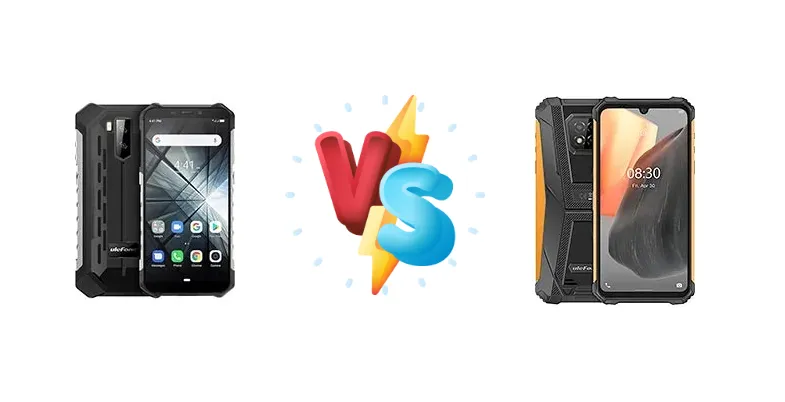
Ulefone caters to a niche market: durable, rugged smartphones. The Armor X3 and Armor 8 Pro represent different tiers within that offering. The X3 is a budget-focused entry point, while the 8 Pro aims for a more balanced experience with a significantly upgraded chipset. This comparison dissects the core differences to determine which device delivers the best value for users needing a phone that can withstand harsh conditions.
🏆 Quick Verdict
For most users, the Ulefone Armor 8 Pro is the superior choice. Its Helio P60 chipset provides a substantial performance boost over the Armor X3’s MT6580, making it far more capable for multitasking, demanding apps, and even light gaming. While the X3 offers affordability, the 8 Pro’s improved processing power justifies the price difference.
| Network |
|---|
| 2G bands | GSM 850 / 900 / 1800 / 1900 | GSM 850 / 900 / 1800 / 1900 |
| 3G bands | HSDPA 850 / 900 / 1700(AWS) / 1900 / 2100 | HSDPA 850 / 900 / 1700(AWS) / 1900 / 2100 |
| 4G bands | - | 1, 2, 3, 4, 5, 7, 8, 12, 13, 17, 18, 19, 20, 25, 26, 28, 66 |
| Speed | HSPA 21.1/5.76 Mbps | HSPA 42.2/11.5 Mbps, LTE Cat7 300/150 Mbps |
| Technology | GSM / HSPA | GSM / HSPA / LTE |
| Launch |
|---|
| Announced | 2019, July. Released 2019, July | 2021, April 28 |
| Status | Discontinued | Available. Released 2021, April 28 |
| Body |
|---|
| Build | - | Front glass, aluminum back with rubber, aluminum frame |
| Dimensions | 158 x 77.5 x 13.9 mm (6.22 x 3.05 x 0.55 in) | 166 x 81.8 x 15 mm (6.54 x 3.22 x 0.59 in) |
| SIM | Nano-SIM + Nano-SIM | Nano-SIM + Nano-SIM |
| Weight | 235 g (8.29 oz) | 282 g (9.95 oz) |
| | IP68 dust/water resistant (up to 1.5m for 30 mins)
Drop-to-concrete resistance from up to 1.2 m
MIL-STD-810G compliant | IP68 dust/water resistant (up to 1.5m for 30 min)
Drop-to-concrete resistance from up to 1.2m
MIL-STD-810G compliant |
| Display |
|---|
| Protection | - | Scratch-resistant glass, oleophobic coating |
| Resolution | 720 x 1440 pixels, 18:9 ratio (~293 ppi density) | 720 x 1560 pixels, 19.5:9 ratio (~282 ppi density) |
| Size | 5.5 inches, 78.1 cm2 (~63.8% screen-to-body ratio) | 6.1 inches, 91.3 cm2 (~67.3% screen-to-body ratio) |
| Type | IPS LCD | IPS LCD |
| Platform |
|---|
| CPU | Quad-core 1.3 GHz Cortex-A7 | Octa-core (4x2.0 GHz Cortex-A73 & 4x2.0 GHz Cortex-A53) |
| Chipset | Mediatek MT6580 (28 nm) | Mediatek MT6771 Helio P60 (12 nm) |
| GPU | Mali-400 | Mali-G72 MP3 |
| OS | Android 9.0 (Pie) | Android 11 |
| Memory |
|---|
| Card slot | microSDXC (uses shared SIM slot) | microSDXC (uses shared SIM slot) |
| Internal | 32GB 2GB RAM | 128GB 6GB RAM, 128GB 8GB RAM |
| | eMMC 5.1 | - |
| Main Camera |
|---|
| Dual | 8 MP, f/1.8, (wide), AF
2 MP | - |
| Features | Dual-LED flash | LED flash, Panorama, HDR |
| Single | - | 8 MP, f/2.2 |
| Triple | - | 16 MP, f/2.2, (wide), PDAF
5 MP (macro)
Auxiliary lens |
| Video | 1080p@30fps | 1080p@30fps |
| Selfie camera |
|---|
| Single | 5 MP | 8 MP, f/2.2 |
| Video | 720p@30fps | 1080p@30fps |
| Sound |
|---|
| 3.5mm jack | Yes | Yes |
| 35mm jack | Yes | Yes |
| Loudspeaker | Yes | Yes |
| Comms |
|---|
| Bluetooth | 4.0, A2DP | 4.2, A2DP, LE |
| NFC | No | Yes |
| Positioning | GPS | GPS, GLONASS, GALILEO, BDS |
| Radio | Stereo FM radio, RDS, recording | FM radio, RDS, recording |
| USB | microUSB 2.0 | USB Type-C 2.0, OTG |
| WLAN | Wi-Fi 802.11 b/g/n | Wi-Fi 802.11 a/b/g/n/ac, Wi-Fi Direct |
| Features |
|---|
| Sensors | Accelerometer, proximity, compass | Fingerprint (side-mounted), accelerometer, gyro, proximity, compass |
| Battery |
|---|
| Charging | 10W wired | 15W wired |
| Type | Li-Po 5000 mAh | Li-Po 5580 mAh |
| Misc |
|---|
| Colors | Black, Red, Silver | Black, Orange, Red |
| Price | - | About 190 EUR |
Ulefone Armor X3
- Most affordable option
- Extremely durable build quality
- Simple and easy-to-use interface
- Very limited performance
- Slow charging speed
- Outdated chipset
Ulefone Armor 8 Pro
- Significantly faster performance
- Faster charging (15W)
- More versatile for apps and gaming
- Higher price point
- May still struggle with very demanding games
- Potentially larger size/weight due to larger components
Display Comparison
Neither Ulefone provides detailed display specifications beyond size. However, the Armor 8 Pro’s more powerful chipset suggests a potentially higher-quality panel with better color reproduction and viewing angles. The difference in processing power allows for more sophisticated image processing, which can enhance the visual experience. While both are likely to feature durable glass, the 8 Pro’s chipset allows for features like potentially higher brightness for outdoor visibility.
Camera Comparison
Detailed camera specs are unavailable, but the Armor 8 Pro’s processing power allows for more advanced image processing algorithms. This means better noise reduction, dynamic range, and overall image quality, even if both phones share similar sensor resolutions. The X3’s limited processing capabilities will likely result in slower image capture and less refined photos. The presence of a more powerful ISP (Image Signal Processor) within the Helio P60 is a key advantage.
Performance
The performance disparity is the most significant difference. The Ulefone Armor X3’s Mediatek MT6580, built on a 28nm process, features a quad-core Cortex-A7 CPU clocked at 1.3 GHz. This is a basic processor designed for essential tasks. Conversely, the Armor 8 Pro boasts the Mediatek Helio P60 (MT6771), fabricated on a more efficient 12nm process. Its octa-core configuration – four Cortex-A73 cores at 2.0 GHz and four Cortex-A53 cores at 2.0 GHz – delivers substantially improved multi-core and single-core performance. This translates to faster app loading times, smoother multitasking, and a more responsive user interface. The Helio P60 also includes a more capable GPU, making the 8 Pro suitable for light gaming, something the X3 would struggle with.
Battery Life
While battery capacity isn’t specified, the Armor 8 Pro’s 15W wired charging is a clear advantage over the X3’s 10W charging. The more efficient 12nm Helio P60 chipset also contributes to better battery life, even with similar capacity batteries. The faster charging will significantly reduce downtime, allowing users to quickly replenish the battery when needed. The 8 Pro’s ability to handle more demanding tasks also means it may drain the battery faster under heavy load, but the faster charging mitigates this concern.
Buying Guide
Buy the Ulefone Armor X3 if you prioritize absolute affordability and only need a phone for basic communication – calls, texts, and light app usage. It’s ideal for those who need a durable device as a backup or for very specific, low-demand tasks. Buy the Ulefone Armor 8 Pro if you require a more responsive and versatile experience, capable of handling modern apps, occasional gaming, and more demanding workloads while still maintaining rugged durability.
Frequently Asked Questions
❓ Will the Helio P60 in the Armor 8 Pro overheat during prolonged use, like gaming or video recording?
The Helio P60 is a relatively efficient chipset, especially compared to the MT6580. While it can generate heat under sustained load, the 12nm process and Ulefone’s rugged design (which typically includes heat dissipation features) should prevent significant overheating. Expect some warmth, but not to the point of performance throttling in most scenarios.
❓ Is the Armor 8 Pro capable of running popular mobile games like PUBG Mobile or Call of Duty Mobile?
The Armor 8 Pro can run PUBG Mobile and Call of Duty Mobile, but likely at medium or low graphics settings to maintain a stable frame rate. The Helio P60 isn’t a high-end gaming chip, so don’t expect flagship-level performance. The Armor X3 would struggle to run these games at playable frame rates.
❓ How much faster will app loading times be on the Armor 8 Pro compared to the Armor X3?
App loading times on the Armor 8 Pro will be noticeably faster – potentially 2-3 times quicker for many applications. This is due to the Helio P60’s significantly more powerful CPU and GPU, as well as its faster memory interface. The X3’s MT6580 will exhibit noticeable lag when launching and using apps.