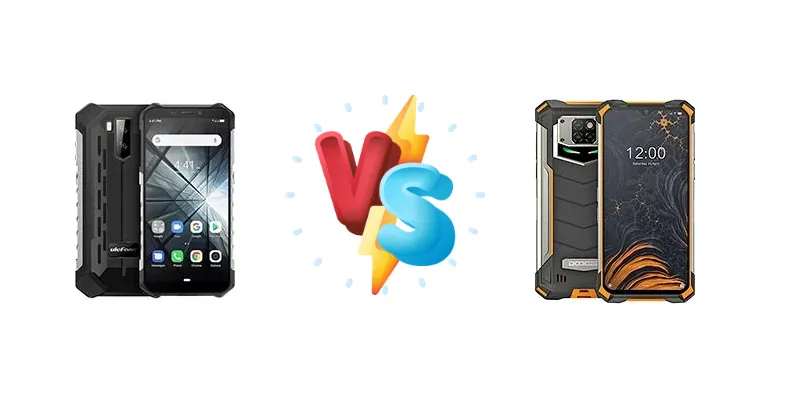
The rugged smartphone market caters to a specific need: durability. But within that segment, choices range from ultra-budget options to feature-packed powerhouses. The Ulefone Armor X3 represents the entry-level, focusing on core ruggedness at a low price point. The Doogee S88 Pro, while still affordable, aims for a more balanced experience with a significantly more powerful chipset and advanced charging capabilities. This comparison dissects these differences to determine which phone delivers the best value for your needs.
🏆 Quick Verdict
For the average user prioritizing performance and future-proofing, the Doogee S88 Pro is the clear winner. Its Helio P70 chipset and 24W charging offer a vastly superior experience to the Ulefone Armor X3’s aging MT6580. However, the Armor X3 remains a viable option for those on an extremely tight budget who only need basic smartphone functionality.
| Network |
|---|
| 2G bands | GSM 850 / 900 / 1800 / 1900 | GSM 850 / 900 / 1800 / 1900 |
| 3G bands | HSDPA 850 / 900 / 1700(AWS) / 1900 / 2100 | HSDPA 850 / 900 / 1700(AWS) / 1900 / 2100 |
| 4G bands | - | 1, 3, 7, 8, 20 |
| Speed | HSPA 21.1/5.76 Mbps | HSPA, LTE |
| Technology | GSM / HSPA | GSM / HSPA / LTE |
| Launch |
|---|
| Announced | 2019, July. Released 2019, July | 2020, June 06. Released 2020, June 06 |
| Status | Discontinued | Discontinued |
| Body |
|---|
| Build | - | Glass front (Gorilla Glass), aluminum back with rubber, aluminum frame |
| Dimensions | 158 x 77.5 x 13.9 mm (6.22 x 3.05 x 0.55 in) | 171.6 x 85.5 x 18.7 mm (6.76 x 3.37 x 0.74 in) |
| SIM | Nano-SIM + Nano-SIM | Nano-SIM + Nano-SIM |
| Weight | 235 g (8.29 oz) | 372 g (13.12 oz) |
| | IP68 dust/water resistant (up to 1.5m for 30 mins)
Drop-to-concrete resistance from up to 1.2 m
MIL-STD-810G compliant | - |
| Display |
|---|
| Protection | - | Corning Gorilla Glass |
| Resolution | 720 x 1440 pixels, 18:9 ratio (~293 ppi density) | 1080 x 2340 pixels, 19.5:9 ratio (~409 ppi density) |
| Size | 5.5 inches, 78.1 cm2 (~63.8% screen-to-body ratio) | 6.3 inches, 97.4 cm2 (~66.4% screen-to-body ratio) |
| Type | IPS LCD | IPS LCD |
| Platform |
|---|
| CPU | Quad-core 1.3 GHz Cortex-A7 | Octa-core (4x2.1 GHz Cortex-A73 & 4x2.0 GHz Cortex-A53) |
| Chipset | Mediatek MT6580 (28 nm) | Mediatek MT6771T Helio P70 (12 nm) |
| GPU | Mali-400 | Mali-G72 MP3 |
| OS | Android 9.0 (Pie) | Android 10 |
| Memory |
|---|
| Card slot | microSDXC (uses shared SIM slot) | microSDXC (uses shared SIM slot) |
| Internal | 32GB 2GB RAM | 128GB 6GB RAM |
| | eMMC 5.1 | - |
| Main Camera |
|---|
| Dual | 8 MP, f/1.8, (wide), AF
2 MP | - |
| Features | Dual-LED flash | Dual-LED dual-tone flash, HDR, panorama |
| Triple | - | 21 MP, f/2.2, (wide), 1/2.4", 1.12µm, PDAF
8 MP, f/2.2, 130˚, (ultrawide), 1/4.0", 1.12µm
Auxiliary lens |
| Video | 1080p@30fps | 1080p@30fps |
| Selfie camera |
|---|
| Single | 5 MP | 16 MP, f/2.2, 26mm (wide) |
| Video | 720p@30fps | 1080p@30fps |
| Sound |
|---|
| 3.5mm jack | Yes | - |
| 35mm jack | Yes | No |
| Loudspeaker | Yes | Yes |
| Comms |
|---|
| Bluetooth | 4.0, A2DP | 4.2, A2DP |
| NFC | No | Yes |
| Positioning | GPS | GPS, GLONASS, BDS, GALILEO |
| Radio | Stereo FM radio, RDS, recording | FM radio |
| USB | microUSB 2.0 | USB Type-C 2.0, OTG |
| WLAN | Wi-Fi 802.11 b/g/n | Wi-Fi 802.11 b/g/n |
| Features |
|---|
| Sensors | Accelerometer, proximity, compass | Fingerprint (side-mounted), accelerometer, gyro, proximity, compass |
| Battery |
|---|
| Charging | 10W wired | 24W wired
10W wireless
5W Reverse wireless |
| Type | Li-Po 5000 mAh | 10000 mAh |
| Misc |
|---|
| Colors | Black, Red, Silver | Fire Orange, Army Green, Mineral Black |
| Price | - | About 130 EUR |
Ulefone Armor X3
- Extremely affordable price point
- Rugged build quality for basic protection
- Simple and easy-to-use interface
- Outdated and slow processor
- Slow 10W charging
- Likely low-resolution display
Doogee S88 Pro
- Significantly faster processor (Helio P70)
- Fast 24W wired and 10W wireless charging
- Better display contrast ratio
- Higher price than the Ulefone Armor X3
- Ruggedness may not be as extreme as some higher-end models
- Camera performance likely average
Display Comparison
The Doogee S88 Pro boasts a contrast ratio of 1641:1, indicating deeper blacks and more vibrant colors compared to what is typical for the Armor X3’s likely IPS panel. While neither phone is expected to compete with flagship displays, the S88 Pro’s contrast ratio suggests a more visually pleasing experience. Details regarding the Armor X3’s display resolution and brightness are absent, but given its price point, it’s likely to be a lower-resolution, less bright panel. This impacts outdoor visibility, where the S88 Pro will likely perform better.
Camera Comparison
Detailed camera specifications for both phones are limited. However, the focus should be on realistic expectations. Both phones likely feature basic camera setups geared towards functional photography rather than high-quality image capture. The absence of detailed sensor information suggests neither phone will excel in low-light conditions. While both may include a macro lens, the 2MP resolution common in this segment offers limited practical utility. The S88 Pro’s more powerful ISP (Image Signal Processor) within the Helio P70 chipset *may* provide slightly better image processing, but the difference will likely be marginal.
Performance
The performance gap between these two devices is substantial. The Ulefone Armor X3’s Mediatek MT6580, a quad-core Cortex-A7 processor built on a 28nm process, is several generations behind the Doogee S88 Pro’s Helio P70. The P70’s octa-core configuration (4x2.1 GHz Cortex-A73 & 4x2.0 GHz Cortex-A53) and 12nm fabrication process deliver significantly faster processing speeds and improved power efficiency. This translates to smoother app launches, better multitasking, and a more responsive user experience on the S88 Pro. The Armor X3 will struggle with demanding applications and may exhibit noticeable lag.
Battery Life
The Doogee S88 Pro’s endurance rating of 202 hours suggests excellent battery life, even with its more powerful processor. Crucially, it supports 24W wired charging, allowing for significantly faster charging times compared to the Ulefone Armor X3’s 10W charging. The S88 Pro also adds 10W wireless charging and 5W reverse wireless charging, offering added convenience. While the Armor X3 may have a comparable or even slightly larger battery capacity (data unavailable), the slower charging speed will be a significant drawback for users who need to quickly top up their device.
Buying Guide
Buy the Ulefone Armor X3 if you need a truly basic, incredibly affordable rugged phone for essential communication – think construction workers needing a reliable call device or those wanting a backup phone for emergencies. Buy the Doogee S88 Pro if you prefer a more modern smartphone experience with faster performance for apps, smoother multitasking, and the convenience of faster wired and wireless charging, all while maintaining rugged durability.
Frequently Asked Questions
❓ Is the Mediatek Helio P70 in the Doogee S88 Pro powerful enough for gaming?
The Helio P70 is capable of handling many popular mobile games at medium settings. While it won't deliver flagship-level performance, it provides a significantly smoother gaming experience than the Ulefone Armor X3’s MT6580. Expect playable frame rates in titles like PUBG Mobile and Call of Duty Mobile, but don't expect to max out the graphics settings.
❓ How durable is the Ulefone Armor X3 compared to more expensive rugged phones?
The Ulefone Armor X3 offers basic ruggedness, protecting against dust, water splashes, and minor drops. However, it likely lacks the more advanced certifications (like MIL-STD-810H) and reinforced construction found in higher-end rugged phones. It's suitable for everyday bumps and scrapes, but may not withstand extreme conditions.
❓ Does the Doogee S88 Pro's reverse wireless charging work with any Qi-compatible device?
Yes, the Doogee S88 Pro supports Qi wireless charging, meaning it can wirelessly charge any device that also supports the Qi standard, such as wireless earbuds or another smartphone. However, the 5W output is relatively slow, so it's best suited for topping up smaller devices.