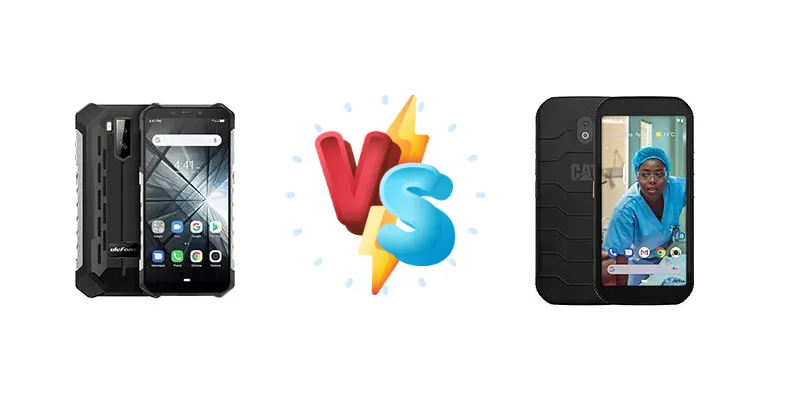
The rugged phone market caters to a specific need: durability. Both the Ulefone Armor X3 and the Cat S42 H+ aim to deliver that, but at different price points and with varying levels of internal hardware. This comparison dissects their core components to determine which offers the best balance of toughness and usability for demanding users.
🏆 Quick Verdict
For the average user prioritizing basic functionality and a slightly more modern chipset, the Cat S42 H+ is the better choice. Its Helio A20 processor offers a noticeable performance uplift over the Armor X3’s MT6580, translating to smoother multitasking and app loading, despite both phones being entry-level.
| Network |
|---|
| 2G bands | GSM 850 / 900 / 1800 / 1900 | GSM 850 / 900 / 1800 / 1900 |
| 3G bands | HSDPA 850 / 900 / 1700(AWS) / 1900 / 2100 | HSDPA 850 / 900 / 1700(AWS) / 1900 / 2100 |
| 4G bands | - | 1, 2, 3, 4, 5, 7, 12, 13, 14, 17, 25, 26, 41, 66, 71 |
| Speed | HSPA 21.1/5.76 Mbps | HSPA 42.2/5.76 Mbps, LTE (2CA) Cat6 300/50 Mbps |
| Technology | GSM / HSPA | GSM / HSPA / LTE |
| Launch |
|---|
| Announced | 2019, July. Released 2019, July | 2021, April 20 |
| Status | Discontinued | Available. Released 2021, April 20 |
| Body |
|---|
| Dimensions | 158 x 77.5 x 13.9 mm (6.22 x 3.05 x 0.55 in) | 161.3 x 77.2 x 12.7 mm (6.35 x 3.04 x 0.5 in) |
| SIM | Nano-SIM + Nano-SIM | Nano-SIM + Nano-SIM |
| Weight | 235 g (8.29 oz) | 220 g (7.76 oz) |
| | IP68 dust/water resistant (up to 1.5m for 30 mins)
Drop-to-concrete resistance from up to 1.2 m
MIL-STD-810G compliant | - |
| Display |
|---|
| Protection | - | Corning Gorilla Glass 5 |
| Resolution | 720 x 1440 pixels, 18:9 ratio (~293 ppi density) | 720 x 1440 pixels, 18:9 ratio (~293 ppi density) |
| Size | 5.5 inches, 78.1 cm2 (~63.8% screen-to-body ratio) | 5.5 inches, 78.1 cm2 (~62.7% screen-to-body ratio) |
| Type | IPS LCD | IPS LCD |
| Platform |
|---|
| CPU | Quad-core 1.3 GHz Cortex-A7 | Quad-core 1.8 GHz Cortex-A53 |
| Chipset | Mediatek MT6580 (28 nm) | Mediatek MT6761D Helio A20 (12 nm) |
| GPU | Mali-400 | PowerVR GE8320 |
| OS | Android 9.0 (Pie) | Android 10, planned upgrade to Android 11 |
| Memory |
|---|
| Card slot | microSDXC (uses shared SIM slot) | microSDXC (dedicated slot) |
| Internal | 32GB 2GB RAM | 32GB 3GB RAM |
| | eMMC 5.1 | - |
| Main Camera |
|---|
| Dual | 8 MP, f/1.8, (wide), AF
2 MP | - |
| Features | Dual-LED flash | LED flash |
| Single | - | 13 MP, f/2.0, (wide), PDAF |
| Video | 1080p@30fps | 1080p@30fps |
| Selfie camera |
|---|
| Single | 5 MP | 5 MP |
| Video | 720p@30fps | - |
| Sound |
|---|
| 3.5mm jack | Yes | - |
| 35mm jack | Yes | Yes |
| Loudspeaker | Yes | Yes |
| Comms |
|---|
| Bluetooth | 4.0, A2DP | 5.0, A2DP, LE |
| NFC | No | Yes |
| Positioning | GPS | GPS, GLONASS, BDS |
| Radio | Stereo FM radio, RDS, recording | FM radio |
| USB | microUSB 2.0 | microUSB 2.0, OTG |
| WLAN | Wi-Fi 802.11 b/g/n | Wi-Fi 802.11 b/g/n |
| Features |
|---|
| Sensors | Accelerometer, proximity, compass | Accelerometer, proximity, compass |
| Battery |
|---|
| Charging | 10W wired | - |
| Type | Li-Po 5000 mAh | Li-Ion 4200 mAh |
| Misc |
|---|
| Colors | Black, Red, Silver | Black |
| Price | - | About 230 EUR |
Ulefone Armor X3
- Lowest possible price for a rugged phone.
- Durable build quality expected from Ulefone.
- Simple and straightforward user experience.
- Significantly slower processor (MT6580).
- Outdated 28nm manufacturing process.
- Slow 10W charging.
Cat S42 H+
- More modern and efficient processor (Helio A20).
- 12nm manufacturing process for better power efficiency.
- Smoother multitasking and app loading.
- Still an entry-level chipset, not suitable for demanding tasks.
- Likely similar slow charging speeds to the Armor X3.
- Higher price point than the Ulefone Armor X3.
Display Comparison
Neither Ulefone nor Cat provide detailed display specifications beyond size. However, given the price bracket, both likely utilize IPS LCD panels. The key difference lies in the underlying architecture. The Cat S42 H+ benefits from the more efficient 12nm Helio A20, potentially allowing for slightly better sustained brightness and color reproduction compared to the Armor X3’s older 28nm MT6580. Bezels are expected to be substantial on both devices, prioritizing durability over a modern, edge-to-edge design.
Camera Comparison
Both phones likely feature basic camera setups geared towards functionality rather than photography excellence. Detailed camera specs are scarce, but it’s safe to assume both will include a primary sensor and potentially a secondary depth or macro lens. Given the focus on ruggedness, image processing will likely prioritize speed and reliability over advanced features. The absence of detailed sensor information makes a direct comparison difficult, but the more modern chipset in the Cat S42 H+ *could* allow for slightly faster image processing and better low-light performance, though expectations should remain modest.
Performance
The performance gap is the most significant differentiator. The Cat S42 H+’s MediaTek Helio A20 (MT6761D) utilizes four Cortex-A53 cores clocked at 1.8 GHz, built on a 12nm process. This is a substantial improvement over the Ulefone Armor X3’s MediaTek MT6580, featuring four Cortex-A7 cores at 1.3 GHz on a 28nm node. The 12nm process node of the Helio A20 translates to better power efficiency and reduced heat generation, meaning the S42 H+ will likely exhibit less throttling under sustained load. While neither chipset is a performance powerhouse, the A20 offers a smoother experience for everyday tasks like web browsing and social media.
Battery Life
Battery capacity isn’t specified for either device, but rugged phones typically prioritize long battery life. The Cat S42 H+’s more efficient Helio A20 chipset will likely result in better battery endurance compared to the Ulefone Armor X3, despite potentially having a similar capacity. The Armor X3’s 10W wired charging is comparatively slow; the Cat S42 H+ likely offers a similar charging speed, but the more efficient chipset means it may reach full charge slightly faster due to less heat generation during the charging process.
Buying Guide
Buy the Ulefone Armor X3 if you absolutely need the lowest possible price point for a rugged device and are willing to accept significantly slower performance. It’s suitable for very basic communication and limited app usage. Buy the Cat S42 H+ if you prefer a more responsive user experience, even for simple tasks, and want a phone built on a more modern, albeit still entry-level, platform. It’s better suited for users who need to run multiple apps or rely on GPS navigation frequently.
Frequently Asked Questions
❓ Will the Helio A20 in the Cat S42 H+ struggle with GPS navigation or offline maps?
While the Helio A20 isn't a powerhouse, it's generally sufficient for GPS navigation and running offline maps. The Cortex-A53 cores are capable of handling these tasks, though loading times for large map files might be slightly slower compared to phones with more powerful processors. Expect reliable GPS lock and stable navigation performance.
❓ Is the 10W charging on the Ulefone Armor X3 realistically usable for a full workday?
10W charging is quite slow by modern standards. A full charge from 0% will take several hours. However, given the likely modest battery capacity and the power efficiency of the MT6580 (albeit an older process), it's plausible to get a full charge overnight. Top-ups during the day will be slow, so planning is essential.
❓ Are either of these phones suitable for running demanding apps like mobile games?
Neither the Ulefone Armor X3 nor the Cat S42 H+ are suitable for demanding mobile games. The MT6580 and Helio A20 are entry-level chipsets and will struggle with graphically intensive titles. You might be able to run very basic 2D games, but expect low frame rates and significant lag in anything more complex.