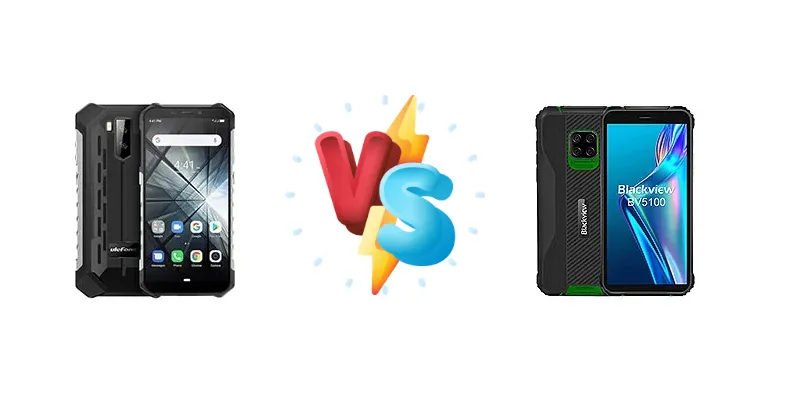
The rugged phone market caters to a specific need: durability. Both the Ulefone Armor X3 and Blackview BV5100 aim to deliver that, but at very different price points and with significantly varying internal specifications. This comparison dissects their core components to determine which offers the best value for users prioritizing resilience and reliability.
🏆 Quick Verdict
For the average user needing a basic, extremely durable phone for essential tasks, the Blackview BV5100 is the clear winner. Its Helio P22 chipset provides a substantial performance uplift over the Armor X3’s MT6580, and the inclusion of 18W charging (including wireless) adds significant convenience. While the Armor X3 is cheaper, the performance deficit is too large to ignore.
| Network |
|---|
| 2G bands | GSM 850 / 900 / 1800 / 1900 | GSM 850 / 900 / 1800 / 1900 |
| 3G bands | HSDPA 850 / 900 / 1700(AWS) / 1900 / 2100 | HSDPA 850 / 900 / 1700(AWS) / 1900 / 2100 |
| 4G bands | - | 1, 2, 3, 4, 5, 7, 8, 12, 13, 17, 18, 19, 20, 25, 26, 28, 38, 40, 41, 66 |
| Speed | HSPA 21.1/5.76 Mbps | HSPA, LTE |
| Technology | GSM / HSPA | GSM / HSPA / LTE |
| Launch |
|---|
| Announced | 2019, July. Released 2019, July | 2020, November 13. Released 2020, November |
| Status | Discontinued | Discontinued |
| Body |
|---|
| Dimensions | 158 x 77.5 x 13.9 mm (6.22 x 3.05 x 0.55 in) | 159.4 x 77.7 x 13.7 mm (6.28 x 3.06 x 0.54 in) |
| SIM | Nano-SIM + Nano-SIM | Nano-SIM + Nano-SIM |
| Weight | 235 g (8.29 oz) | 275 g (9.70 oz) |
| | IP68 dust/water resistant (up to 1.5m for 30 mins)
Drop-to-concrete resistance from up to 1.2 m
MIL-STD-810G compliant | - |
| Display |
|---|
| Protection | - | Corning Gorilla Glass 3 |
| Resolution | 720 x 1440 pixels, 18:9 ratio (~293 ppi density) | 720 x 1440 pixels, 18:9 ratio (~282 ppi density) |
| Size | 5.5 inches, 78.1 cm2 (~63.8% screen-to-body ratio) | 5.7 inches, 83.8 cm2 (~67.7% screen-to-body ratio) |
| Type | IPS LCD | IPS LCD |
| Platform |
|---|
| CPU | Quad-core 1.3 GHz Cortex-A7 | Octa-core (4x1.8 GHz Cortex-A53 & 4x1.5 GHz Cortex-A53) |
| Chipset | Mediatek MT6580 (28 nm) | Mediatek MT6762V/WD Helio P22 (12 nm) |
| GPU | Mali-400 | PowerVR GE8320 |
| OS | Android 9.0 (Pie) | Android 10 |
| Memory |
|---|
| Card slot | microSDXC (uses shared SIM slot) | microSDXC |
| Internal | 32GB 2GB RAM | 64GB 4GB RAM |
| | eMMC 5.1 | - |
| Main Camera |
|---|
| Dual | 8 MP, f/1.8, (wide), AF
2 MP | - |
| Features | Dual-LED flash | LED flash, HDR |
| Triple | - | 16 MP, f/2.0, (wide), AF
8 MP, f/2.2, 117˚ (ultrawide)
0.3 MP |
| Video | 1080p@30fps | 1080p@30fps |
| Selfie camera |
|---|
| Single | 5 MP | 13 MP, f/2.2, (wide) |
| Video | 720p@30fps | 1080p@30fps |
| Sound |
|---|
| 3.5mm jack | Yes | - |
| 35mm jack | Yes | No |
| Loudspeaker | Yes | Yes |
| Comms |
|---|
| Bluetooth | 4.0, A2DP | 5.0, A2DP, LE |
| NFC | No | Yes |
| Positioning | GPS | GPS, GLONASS, GALILEO, BDS |
| Radio | Stereo FM radio, RDS, recording | FM radio |
| USB | microUSB 2.0 | USB Type-C 2.0, OTG |
| WLAN | Wi-Fi 802.11 b/g/n | Wi-Fi 802.11 a/b/g/n |
| Features |
|---|
| Sensors | Accelerometer, proximity, compass | Fingerprint (side-mounted), accelerometer, gyro, proximity, compass |
| Battery |
|---|
| Charging | 10W wired | 18W wired
Wireless |
| Type | Li-Po 5000 mAh | 5580 mAh |
| Misc |
|---|
| Colors | Black, Red, Silver | Black, Orange, Green, Yellow |
| Price | - | About 180 EUR |
Ulefone Armor X3
- Lowest possible price for a rugged phone
- Extremely durable build quality
- Simple and easy to use
- Very slow performance
- Slow 10W charging
- Outdated chipset
Blackview BV5100
- Significantly faster performance
- 18W wired and wireless charging
- More efficient processor for better battery life
- Higher price than the Armor X3
- Camera quality is still basic
- May not be as compact as the Armor X3
Display Comparison
Neither Ulefone nor Blackview provide detailed display specifications beyond size. However, given the price bracket, both likely utilize IPS LCD panels. The key difference lies elsewhere. The Armor X3, with its older chipset, likely has a lower peak brightness and potentially narrower color gamut. The BV5100, benefiting from a more modern processor, may offer slightly better image processing for improved color accuracy and viewing angles, though neither is expected to compete with higher-end displays.
Camera Comparison
Both phones likely feature basic camera setups geared towards functionality rather than photography excellence. Without detailed sensor information, it’s difficult to make precise comparisons. However, the BV5100’s more powerful processor allows for more sophisticated image processing, potentially resulting in better dynamic range and noise reduction. The inclusion of a 2MP macro camera on the BV5100 is largely a marketing gimmick; its utility is limited by the low resolution and lack of optical image stabilization (OIS).
Performance
The performance gap is the most significant differentiator. The Ulefone Armor X3’s Mediatek MT6580, built on a 28nm process, features a quad-core Cortex-A7 CPU clocked at 1.3GHz. This is a decidedly entry-level processor. Conversely, the Blackview BV5100 boasts the Mediatek Helio P22 (MT6762V/WD), fabricated on a more efficient 12nm process, and equipped with an octa-core CPU (4x1.8 GHz Cortex-A53 & 4x1.5 GHz Cortex-A53). This translates to a substantially faster and more responsive experience for the BV5100, particularly when multitasking or running apps. The P22’s GPU also offers a considerable advantage for basic gaming.
Battery Life
While battery capacity isn’t specified, the Blackview BV5100’s 18W wired and wireless charging capabilities are a major advantage. The Ulefone Armor X3 is limited to 10W wired charging, meaning significantly longer charge times. The more efficient 12nm Helio P22 processor in the BV5100 also contributes to better battery life, even if the battery capacity is similar. The convenience of wireless charging on the BV5100 is a notable benefit for users who frequently need to top up their device.
Buying Guide
Buy the Ulefone Armor X3 if you absolutely need the lowest possible price point for a rugged device and your usage is limited to calls, texts, and very light app use. Buy the Blackview BV5100 if you prioritize a smoother user experience, faster charging, and the ability to run more demanding applications without significant lag, even if it means spending a bit more.
Frequently Asked Questions
❓ Will the Blackview BV5100 struggle with demanding apps like WhatsApp or Facebook?
While not a powerhouse, the Helio P22 in the BV5100 is capable of running apps like WhatsApp and Facebook smoothly. You might experience some slowdown with multiple apps open simultaneously, but it’s a significant improvement over the Armor X3’s MT6580, which would likely struggle even with basic social media usage.
❓ Is the 18W charging on the Blackview BV5100 significantly faster than the Ulefone Armor X3's 10W charging?
Yes, the difference is substantial. 18W charging will reduce the 0-100% charge time considerably compared to the Armor X3. Expect the BV5100 to charge from empty to full in around 2.5-3 hours, while the Armor X3 could take upwards of 4-5 hours. The addition of wireless charging on the BV5100 further enhances convenience.
❓ Can the Ulefone Armor X3 handle basic mobile gaming?
The Ulefone Armor X3 can handle very basic 2D games, but don't expect a smooth experience with anything more demanding. The MT6580's integrated GPU is simply not powerful enough for modern 3D titles. Frame rates will be low, and you'll likely encounter significant lag.
❓ How does the ruggedness of the Blackview BV5100 compare to the Ulefone Armor X3?
Both phones are built to withstand drops, dust, and water. Specific IP ratings aren't provided in the context data, but both brands specialize in rugged devices, suggesting comparable levels of protection. The BV5100's slightly larger size might offer a bit more physical protection, but both are designed for harsh environments.