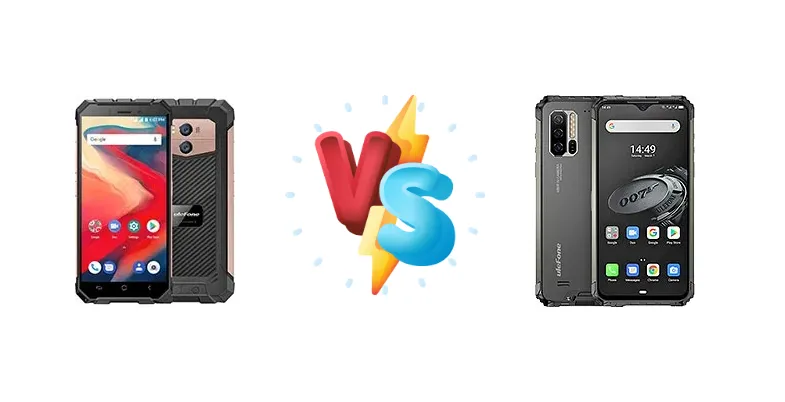
Ulefone's Armor series caters to users needing durable smartphones, but the X2 and 7E represent vastly different approaches to power and price. The X2 is an entry-level option, while the 7E aims for a more substantial performance boost. This comparison dissects the core differences to determine which device best suits your needs.
🏆 Quick Verdict
For most users, the Ulefone Armor 7E is the clear winner. Its Helio P90 chipset delivers significantly faster performance and supports 15W wired and 10W wireless charging, justifying the price difference over the aging MT6580-powered Armor X2. However, the X2 remains a viable option for those on an extremely tight budget.
| Network |
|---|
| 2G bands | GSM 850 / 900 / 1800 / 1900 | GSM 850 / 900 / 1800 / 1900 |
| 3G bands | HSDPA 900 / 2100 | HSDPA 850 / 900 / 1700(AWS) / 1900 / 2100 |
| 4G bands | - | 1, 2, 3, 4, 5, 7, 8, 12, 13, 17, 18, 19, 20, 25, 26, 28, 34, 38, 39, 40, 41, 66, 71 |
| Speed | HSPA 21.1/5.76 Mbps | HSPA 42.2/11.5 Mbps, LTE (2CA) Cat13 600/150 Mbps |
| Technology | GSM / HSPA | GSM / CDMA / HSPA / EVDO / LTE |
| | - | CDMA2000 1xEV-DO |
| Launch |
|---|
| Announced | 2018, December. Released 2018, December | 2020, March 30. Released 2020, March 30 |
| Status | Discontinued | Discontinued |
| Body |
|---|
| Dimensions | 163 x 76.6 x 13.9 mm (6.42 x 3.02 x 0.55 in) | 165.9 x 81 x 13.6 mm (6.53 x 3.19 x 0.54 in) |
| SIM | Nano-SIM + Nano-SIM | Nano-SIM + Nano-SIM |
| Weight | 256 g (9.03 oz) | 290 g (10.23 oz) |
| | IP68 dust/water resistant (up to 1.5m for 30 mins)
Drop-to-concrete resistance from up to 1.2 m
MIL-STD-810G compliant | IP68 dust/water resistant
Drop-to-concrete resistance from up to 1.2m
MIL-STD-810G compliant |
| Display |
|---|
| Resolution | 720 x 1440 pixels, 18:9 ratio (~293 ppi density) | 1080 x 2340 pixels, 19.5:9 ratio (~409 ppi density) |
| Size | 5.5 inches, 78.1 cm2 (~62.5% screen-to-body ratio) | 6.3 inches, 97.4 cm2 (~72.5% screen-to-body ratio) |
| Type | IPS LCD | IPS LCD |
| Platform |
|---|
| CPU | Quad-core 1.3 GHz Cortex-A7 | Octa-core (2x2.2 GHz Cortex-A75 & 6x2.0 GHz Cortex-A55) |
| Chipset | Mediatek MT6580 (28 nm) | Mediatek MT6779 Helio P90 (12 nm) |
| GPU | Mali-400 | PowerVR GM9446 |
| OS | Android 8.1 (Oreo) | Android 9.0 (Pie) |
| Memory |
|---|
| Card slot | microSDXC (uses shared SIM slot) | microSDXC (uses shared SIM slot) |
| Internal | 16GB 2GB RAM | 128GB 4GB RAM |
| | eMMC 5.1 | - |
| Main Camera |
|---|
| Dual | 8 MP, f/1.8, (wide), AF
5 MP | - |
| Features | Dual-LED flash, HDR | 5-LED flash, HDR, panorama |
| Triple | - | 48 MP, f/1.7, (wide), 1/2.0", 0.8µm, PDAF
2 MP (macro)
Auxiliary lens |
| Video | 720p@30fps | 4K@30fps, 1080p@30fps |
| Selfie camera |
|---|
| Single | 5 MP | 16 MP, f/2.0, (wide), 1/3.06", 1.0µm |
| Video | 720p@30fps | 1080p@30fps |
| Sound |
|---|
| 3.5mm jack | Yes | No |
| 35mm jack | Yes | No |
| Loudspeaker | Yes | Yes |
| Comms |
|---|
| Bluetooth | 4.0, A2DP | 5.0, A2DP, LE |
| NFC | Yes | Yes |
| Positioning | GPS | GPS, GLONASS, GALILEO, BDS |
| Radio | Stereo FM radio, RDS, recording | Stereo FM radio, RDS, recording |
| USB | microUSB 2.0 | USB Type-C 2.0, OTG |
| WLAN | Wi-Fi 802.11 b/g/n | Wi-Fi 802.11 a/b/g/n/ac, dual-band, Wi-Fi Direct |
| Features |
|---|
| Sensors | Fingerprint (side-mounted), accelerometer, proximity | Fingerprint (side-mounted), accelerometer, gyro, proximity, compass, heart rate, baroceptor, coulombmeter |
| Battery |
|---|
| Charging | 10W wired | 15W wired
10W wireless |
| Type | Li-Po 5500 mAh | Li-Po 5500 mAh |
| Misc |
|---|
| Colors | Dark Gray, Rose Gold | Black |
| Price | - | About 250 EUR |
Ulefone Armor X2
- Extremely affordable price point
- Durable, rugged design
- Simple and easy to use
- Outdated and slow processor
- Slow charging speeds
- Limited multitasking capabilities
Ulefone Armor 7E
- Significantly faster performance
- Wireless charging support
- More efficient processor
- Higher price than the Armor X2
- May still struggle with extremely demanding games
- Rugged design adds bulk
Display Comparison
Neither Ulefone provides detailed display specifications. However, given the Armor X2's entry-level positioning, it likely features a lower-resolution panel with narrower viewing angles compared to the Armor 7E. The 7E, benefiting from its more modern chipset, likely has a more vibrant and responsive display. Expect the Armor X2 to have thicker bezels, contributing to a less immersive viewing experience. Color accuracy is likely similar on both, leaning towards the budget-friendly side.
Camera Comparison
Detailed camera specs are unavailable, but the chipset difference heavily implies a superior image processing pipeline in the Armor 7E. While both phones likely feature similar sensor resolutions, the Helio P90's ISP (Image Signal Processor) will deliver better noise reduction, dynamic range, and overall image quality. The Armor X2 will likely exhibit slower processing times and less detail in challenging lighting conditions. Any 2MP macro or depth sensors on either device should be considered marketing features rather than significant photographic assets.
Performance
The performance disparity is the most significant difference. The Ulefone Armor X2's Mediatek MT6580, built on a 28nm process, features a quad-core Cortex-A7 CPU clocked at 1.3 GHz. This is a decidedly entry-level chipset, struggling with modern multitasking and demanding applications. Conversely, the Armor 7E boasts the Mediatek Helio P90 (12nm), an octa-core processor with a mix of Cortex-A75 and A55 cores, peaking at 2.2 GHz. This architecture provides a substantial performance leap, enabling smoother gaming, faster app launches, and improved overall responsiveness. The 12nm process also contributes to better power efficiency, potentially offsetting the higher power draw of the more powerful cores.
Battery Life
While battery capacity isn't specified, the Armor 7E's 15W wired charging and 10W wireless charging capabilities are a major advantage. The Armor X2 is limited to 10W wired charging, resulting in significantly longer charge times. The more efficient Helio P90 chipset in the 7E also contributes to better battery life under load. Even if the Armor X2 has a slightly larger battery capacity, the 7E's faster charging and improved efficiency will likely translate to a more convenient user experience.
Buying Guide
Buy the Ulefone Armor X2 if you prioritize absolute affordability and only need a smartphone for basic tasks like calls, texts, and light app usage. Its simplicity and lower cost are its main draws. Buy the Ulefone Armor 7E if you demand a smoother user experience, faster app loading times, and the convenience of wireless charging, even if it means spending more upfront. It's ideal for users who multitask, play mobile games, or rely on demanding applications.
Frequently Asked Questions
❓ Will the Helio P90 in the Armor 7E handle demanding games like PUBG or Call of Duty?
The Helio P90 is capable of running PUBG and Call of Duty, but expect to use medium or low graphics settings for a smooth experience. While not a flagship gaming chip, it's a substantial upgrade over the Armor X2's processor and will provide a playable experience.
❓ Is the 10W wireless charging on the Armor 7E significantly slower than wired charging?
Yes, 10W wireless charging is considerably slower than the 15W wired charging. Expect a full charge to take several hours via wireless charging, but it offers convenience for overnight charging or topping up throughout the day.
❓ How much of a real-world performance difference will I notice between the MT6580 and Helio P90?
The difference is substantial. The Helio P90 will feel significantly faster in everyday tasks like opening apps, browsing the web, and multitasking. The Armor X2 will exhibit noticeable lag and slowdowns, especially with multiple apps open.
❓ Does the Armor 7E support NFC for contactless payments?
Unfortunately, neither Ulefone provides NFC support information for these models. Given the budget nature of the X2, it's unlikely to have NFC. The 7E's inclusion of NFC is uncertain and would require further investigation.