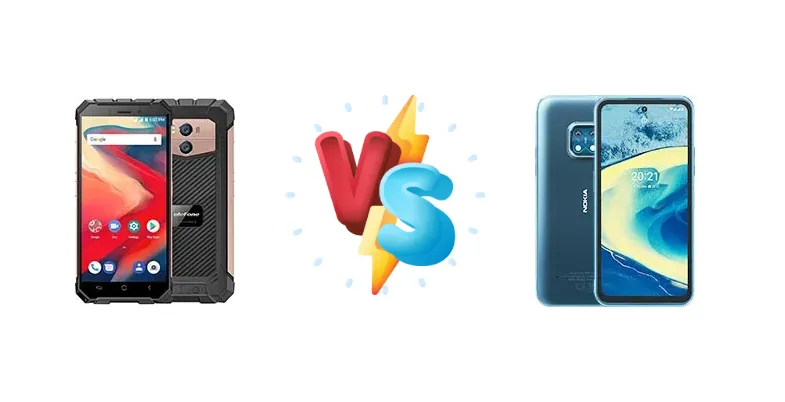
The rugged smartphone market caters to a specific need: durability. However, performance and features vary wildly. We pit the entry-level Ulefone Armor X2 against the more modern Nokia XR20 to determine which offers the best blend of toughness and usability, focusing on the core differences in their processing power and connectivity.
🏆 Quick Verdict
For most users, the Nokia XR20 is the superior choice. Its Qualcomm Snapdragon 480 5G chipset delivers significantly faster performance and 5G connectivity, justifying the price difference. While the Ulefone Armor X2 offers basic rugged functionality, its outdated Mediatek MT6580 struggles with modern applications.
| Network |
|---|
| 2G bands | GSM 850 / 900 / 1800 / 1900 | GSM 850 / 900 / 1800 / 1900 |
| 3G bands | HSDPA 900 / 2100 | HSDPA 850 / 900 / 1700(AWS) / 1900 / 2100 |
| 4G bands | - | 1, 2, 3, 4, 5, 7, 8, 12, 13, 14, 20, 25, 26, 28, 30, 38, 40, 41, 48, 66, 71 |
| 5G bands | - | 2, 5, 25, 38, 41, 48, 66, 77, 78 SA/NSA |
| Speed | HSPA 21.1/5.76 Mbps | HSPA, LTE, 5G |
| Technology | GSM / HSPA | GSM / CDMA / HSPA / EVDO / LTE / 5G |
| | - | CDMA2000 1xEV-DO |
| Launch |
|---|
| Announced | 2018, December. Released 2018, December | 2021, July 27 |
| Status | Discontinued | Available. Released 2021, August 04 |
| Body |
|---|
| Dimensions | 163 x 76.6 x 13.9 mm (6.42 x 3.02 x 0.55 in) | 171.6 x 81.5 x 10.6 mm (6.76 x 3.21 x 0.42 in) |
| SIM | Nano-SIM + Nano-SIM | · Nano-SIM· Nano-SIM + Nano-SIM |
| Weight | 256 g (9.03 oz) | 248 g (8.75 oz) |
| | IP68 dust/water resistant (up to 1.5m for 30 mins)
Drop-to-concrete resistance from up to 1.2 m
MIL-STD-810G compliant | IP68 dust/water resistant (up to 1.5m for 60 min)
Drop-to-concrete resistance from up to 1.8m
MIL-STD-810H compliant |
| Display |
|---|
| Protection | - | Corning Gorilla Glass Victus |
| Resolution | 720 x 1440 pixels, 18:9 ratio (~293 ppi density) | 1080 x 2400 pixels, 20:9 ratio (~395 ppi density) |
| Size | 5.5 inches, 78.1 cm2 (~62.5% screen-to-body ratio) | 6.67 inches, 107.4 cm2 (~76.8% screen-to-body ratio) |
| Type | IPS LCD | IPS LCD, 550 nits |
| Platform |
|---|
| CPU | Quad-core 1.3 GHz Cortex-A7 | Octa-core (2x2.0 GHz Kryo 460 & 6x1.8 GHz Kryo 460) |
| Chipset | Mediatek MT6580 (28 nm) | Qualcomm SM4350 Snapdragon 480 5G (8 nm) |
| GPU | Mali-400 | Adreno 619 |
| OS | Android 8.1 (Oreo) | Android 11, upgradable to Android 13 |
| Memory |
|---|
| Card slot | microSDXC (uses shared SIM slot) | microSDXC (uses shared SIM slot) |
| Internal | 16GB 2GB RAM | 64GB 4GB RAM, 128GB 6GB RAM |
| | eMMC 5.1 | - |
| Main Camera |
|---|
| Dual | 8 MP, f/1.8, (wide), AF
5 MP | 48 MP, f/1.8, (wide), 1/2.25", 0.8µm, PDAF
13 MP, f/2.4, 123˚ (ultrawide), 1/3.0", 1.12µm |
| Features | Dual-LED flash, HDR | Zeiss optics, Dual-LED dual-tone flash, second LED flash, HDR, panorama |
| Single | - | 8 MP, f/2.0 (wide), 1/4.0", 1.12µm |
| Video | 720p@30fps | 1080p@30fps |
| Selfie camera |
|---|
| Single | 5 MP | 8 MP, f/2.0 (wide), 1/4.0", 1.12µm |
| Video | 720p@30fps | 1080p@30fps |
| Sound |
|---|
| 3.5mm jack | Yes | Yes |
| 35mm jack | Yes | Yes |
| Loudspeaker | Yes | Yes, with stereo speakers |
| Comms |
|---|
| Bluetooth | 4.0, A2DP | 5.1, A2DP, LE, aptX Adaptive |
| NFC | Yes | Yes |
| Positioning | GPS | GPS (L1+L5), GLONASS, BDS, GALILEO, QZSS, NavIC |
| Radio | Stereo FM radio, RDS, recording | Unspecified |
| USB | microUSB 2.0 | USB Type-C 3.0 |
| WLAN | Wi-Fi 802.11 b/g/n | Wi-Fi 802.11 a/b/g/n/ac/6, dual-band, Wi-Fi Direct |
| Features |
|---|
| Sensors | Fingerprint (side-mounted), accelerometer, proximity | Fingerprint (side-mounted), accelerometer, gyro, proximity, compass, barometer |
| Battery |
|---|
| Charging | 10W wired | 18W wired
15W wireless |
| Type | Li-Po 5500 mAh | Li-Po 4630 mAh |
| Misc |
|---|
| Colors | Dark Gray, Rose Gold | Ultra Blue, Granite Gray |
| Models | - | TA-1368, TA-1362 |
| Price | - | About 270 EUR |
| SAR EU | - | 1.13 W/kg (head) 1.43 W/kg (body) |
Ulefone Armor X2
- Lowest possible price for a rugged phone
- Extremely durable build quality
- Simple and straightforward user experience
- Outdated and slow processor
- Limited functionality and app compatibility
- Slow charging speed
Nokia XR20
- 5G connectivity for faster data speeds
- Significantly faster processor and GPU
- Wireless charging support
- Higher price point
- May be slightly bulkier than the Armor X2
- Software updates may be slower than other Nokia phones
Display Comparison
Neither device boasts a standout display. Given the context data, we can assume both utilize LCD panels, common in this price bracket. The key difference lies in the processing power driving them. The XR20’s Snapdragon 480 will handle display rendering more smoothly, especially in UI transitions. While specific nit brightness isn’t provided, the XR20’s more modern chipset suggests better image processing capabilities, potentially leading to more vibrant colors and improved contrast. Bezels are likely similar, prioritizing durability over a sleek aesthetic.
Camera Comparison
Without detailed camera specs, it’s difficult to make a precise comparison. However, the XR20’s more powerful ISP (Image Signal Processor) within the Snapdragon 480 will provide a significant advantage in image processing. We can expect better dynamic range, noise reduction, and overall image quality from the XR20, even with similar sensor sizes. The Armor X2 likely relies heavily on software processing to compensate for its weaker hardware, potentially leading to over-sharpened or artificial-looking images. The inclusion of a 2MP macro camera on the Armor X2 is likely a marketing gimmick, offering minimal practical benefit.
Performance
The performance gap is substantial. The Ulefone Armor X2’s Mediatek MT6580, built on a 28nm process, features a quad-core Cortex-A7 CPU clocked at 1.3GHz. This is a significantly older architecture. In contrast, the Nokia XR20’s Qualcomm Snapdragon 480 5G, fabricated on an 8nm process, boasts an octa-core configuration (2x2.0 GHz Kryo 460 & 6x1.8 GHz Kryo 460). The 8nm process offers superior power efficiency and thermal performance, meaning the XR20 will sustain higher performance for longer periods. The XR20’s CPU architecture is also far more advanced, resulting in faster app loading times and smoother multitasking. The XR20’s Adreno 619 GPU also dwarfs the MT6580’s integrated graphics, making it suitable for light gaming, something the Armor X2 will struggle with.
Battery Life
The Ulefone Armor X2 features 10W wired charging, while the Nokia XR20 supports 18W wired and 15W wireless charging. While battery capacity isn’t specified, the XR20’s faster charging capabilities are a significant advantage. The 8nm Snapdragon 480 is also more power-efficient, potentially offsetting any capacity difference. The addition of wireless charging on the XR20 adds convenience, a feature absent on the Armor X2. Expect a significantly longer 0-100% charge time on the Armor X2.
Buying Guide
Buy the Ulefone Armor X2 if you absolutely need the lowest possible price point for a rugged device and your usage is limited to basic communication and light tasks. It's suitable for those needing a secondary, extremely durable phone for emergencies. Buy the Nokia XR20 if you prioritize performance, 5G connectivity, and a more modern user experience. It’s ideal for users who need a reliable, rugged phone for work, outdoor adventures, or simply peace of mind.
Frequently Asked Questions
❓ Does the Snapdragon 480 in the Nokia XR20 generate excessive heat during prolonged use, like gaming or video recording?
The Snapdragon 480, built on an 8nm process, is relatively efficient. While it will warm up during intensive tasks, the Nokia XR20’s design should provide adequate thermal dissipation to prevent significant throttling. It’s unlikely to overheat to the point of being uncomfortable or causing performance issues, unlike the older, less efficient Mediatek MT6580 in the Armor X2.
❓ Is the Ulefone Armor X2 a viable option for running modern navigation apps like Google Maps or Waze reliably?
The Ulefone Armor X2’s Mediatek MT6580 processor and limited RAM may struggle with demanding apps like Google Maps or Waze, especially when running in the background. Users may experience lag, slow loading times, and occasional crashes. The Nokia XR20, with its Snapdragon 480, will provide a much smoother and more reliable navigation experience.
❓ How does the 5G connectivity of the Nokia XR20 impact real-world usage compared to the 2G/3G capabilities of the Ulefone Armor X2?
The Nokia XR20’s 5G connectivity offers significantly faster download and upload speeds, as well as lower latency, when connected to a 5G network. This translates to quicker app downloads, smoother streaming, and more responsive online experiences. The Ulefone Armor X2, limited to 2G/3G, will be considerably slower and less capable in areas with 5G coverage.