
Ulefone Armor X16 vs. Armor 12 5G: A Deep Dive into Rugged Smartphone Performance
| Phones Images | |||||
|---|---|---|---|---|---|
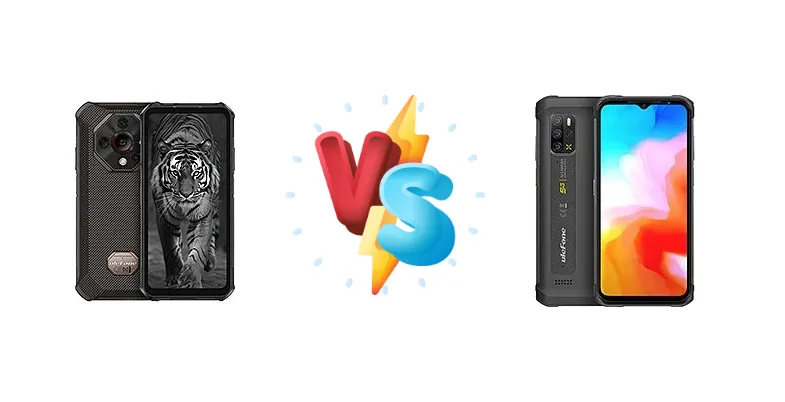
|
🏆 Quick Verdict
For the average user prioritizing longevity and consistent performance, the Ulefone Armor X16 emerges as the winner. Its significantly superior battery endurance (116:54h) and efficient Helio G91 chipset provide a reliable experience, even if it lacks the 5G capabilities of the Armor 12 5G.
| PHONES | ||
|---|---|---|
| Phone Names | Ulefone Armor X16 | Ulefone Armor 12 5G |
| Network | ||
|---|---|---|
| 2G bands | GSM 850 / 900 / 1800 / 1900 | GSM 850 / 900 / 1800 / 1900 |
| 3G bands | HSDPA 800 / 850 / 900 / 1700(AWS) / 1900 / 2100 | HSDPA 850 / 900 / 1700(AWS) / 1900 / 2100 |
| 4G bands | 1, 2, 3, 4, 5, 7, 8, 12, 13, 17, 18, 19, 20, 25, 26, 28, 32, 34, 38, 39, 40, 41, 66, 71 | 1, 2, 3, 4, 5, 7, 8, 12, 13, 17, 18, 19, 20, 25, 26, 28, 34, 38, 39, 40, 41, 66 |
| 5G bands | - | 1, 3, 28, 38, 41, 77, 78 SA/NSA |
| Speed | HSPA, LTE | HSPA, LTE, 5G |
| Technology | GSM / CDMA / HSPA / LTE | GSM / CDMA / HSPA / EVDO / LTE / 5G |
| - | CDMA2000 1xEV-DO | |
| Launch | ||
|---|---|---|
| Announced | 2025, July | 2021, August 14 |
| Status | Available. Released 2025, July | Available. Released 2021, August 23 |
| Body | ||
|---|---|---|
| Build | - | Front glass, aluminum back with rubber, aluminum frame |
| Dimensions | 173.8 x 83.4 x 18 mm (6.84 x 3.28 x 0.71 in) | 175.9 x 82.5 x 14.3 mm (6.93 x 3.25 x 0.56 in) |
| SIM | Nano-SIM + Nano-SIM | Nano-SIM + Nano-SIM |
| Weight | 395.4 g (13.93 oz) | 296 g (10.44 oz) |
| - | IP68 dust/water resistant (up to 1.5m for 30 min) Drop-to-concrete resistance from up to 1.2m MIL-STD-810G compliant | |
| Display | ||
|---|---|---|
| Protection | Corning Gorilla Glass 5, Mohs level 5 | - |
| Resolution | 720 x 1612 pixels, 20:9 ratio (~269 ppi density) | 720 x 1560 pixels, 19.5:9 ratio (~264 ppi density) |
| Size | 6.56 inches, 103.4 cm2 (~71.3% screen-to-body ratio) | 6.52 inches, 104.4 cm2 (~71.9% screen-to-body ratio) |
| Type | IPS LCD, 120Hz, 910 nits (peak) | IPS LCD |
| Platform | ||
|---|---|---|
| CPU | Octa-core (2x2.0 GHz Cortex-A75 & 6x1.8 GHz Cortex-A55) | Octa-core (2x2.2 GHz Cortex-A76 & 6x2.0 GHz Cortex-A55) |
| Chipset | Mediatek Helio G91 (12 nm) | Mediatek Dimensity 700 (7 nm) |
| GPU | Mali-G52 MC2 | Mali-G57 MC2 |
| OS | Android 15 | Android 11 |
| Memory | ||
|---|---|---|
| Card slot | microSDXC (dedicated slot) | microSDXC |
| Internal | 128GB 6GB RAM | 128GB 8GB RAM |
| Main Camera | ||
|---|---|---|
| Features | LED flash, HDR, panorama | Dual-LED flash, HDR, panorama |
| Quad | - | 48 MP, f/1.8, 26mm (wide), 1/2.0", 0.8µm, PDAF 8 MP, f/2.2, (ultrawide) 2 MP (macro) Auxiliary lens |
| Single | - | 16 MP, f/2.2 |
| Triple | 48 MP, f/1.8, (wide), 0.8µm, PDAF 20 MP, f/1.8, (night vision), 2 infrared lights 2 MP (macro) | - |
| Video | 1080p@30fps | 1440p@30fps |
| Selfie camera | ||
|---|---|---|
| Features | - | HDR, panorama |
| Single | 16 MP, f/2.3, (wide), 1.0µm | 16 MP, f/2.2 |
| Video | 1080p@30fps | 1080p@30fps |
| Sound | ||
|---|---|---|
| 3.5mm jack | - | No |
| 35mm jack | Yes | No |
| Loudspeaker | Yes | Yes, with dual speakers |
| Comms | ||
|---|---|---|
| Bluetooth | 5.0, A2DP, LE | 5.1, A2DP, LE |
| Infrared port | Yes | - |
| NFC | Yes | Yes |
| Positioning | GPS, GALILEO, GLONASS, BDS, QZSS | GPS, GLONASS, GALILEO, BDS |
| Radio | Wireless FM radio | Wireless FM radio, RDS |
| USB | USB Type-C 2.0, OTG | USB Type-C 2.0, OTG |
| WLAN | Wi-Fi 802.11 a/b/g/n/ac, dual-band | Wi-Fi 802.11 a/b/g/n/ac, Wi-Fi Direct |
| Features | ||
|---|---|---|
| Sensors | Fingerprint (side-mounted), accelerometer, gyro, proximity, compass | Fingerprint (side-mounted), accelerometer, gyro, proximity, compass, coulombmeter |
| Battery | ||
|---|---|---|
| Charging | 33W wired 5W reverse wired | 18W wired 15W wireless |
| Type | Li-Ion 10360 mAh | Li-Po 5180 mAh |
| Misc | ||
|---|---|---|
| Colors | Wasteland Shadow/Sand Dune | Black/Orange, Gray/Black |
| Price | - | About 370 EUR |
| EU LABEL | ||
|---|---|---|
| Battery | 116:54h endurance, 1000 cycles | - |
| Energy | Class A | - |
| Free fall | Class A (270 falls) | - |
| Repairability | Class C | - |
Ulefone Armor X16
- Exceptional battery life (116:54h endurance)
- Faster 33W wired charging
- Proven and reliable Helio G91 chipset
- Lacks 5G connectivity
- Older chipset architecture
Ulefone Armor 12 5G
- 5G connectivity for faster data speeds
- More modern Mediatek Dimensity 700 chipset
- Wireless charging support
- Shorter battery life (estimated)
- Slower 18W wired charging
Display Comparison
Neither Ulefone provides display specs beyond resolution, so a direct comparison is limited. However, the Armor 12 5G’s Dimensity 700 chipset *could* support higher refresh rate panels, a feature absent in the X16. The Armor X16’s focus is clearly on durability, and the display is likely optimized for visibility in direct sunlight, while the Armor 12 5G may lean towards a more color-accurate panel to take advantage of its processing power.
Camera Comparison
Without detailed camera specifications, a precise comparison is difficult. However, the Armor 12 5G’s more powerful chipset allows for more sophisticated image processing algorithms, potentially resulting in better low-light performance and dynamic range. Both phones likely feature a primary camera, but the Armor 12 5G’s processing capabilities suggest it can extract more detail and clarity from the sensor. The inclusion of 5G also facilitates faster uploads of high-resolution photos and videos.
Performance
The Armor 12 5G’s Mediatek Dimensity 700 (7nm) represents a significant architectural leap over the Armor X16’s Helio G91 (12nm). The Dimensity 700 utilizes Cortex-A76 cores clocked at 2.2 GHz, offering a noticeable performance advantage over the X16’s 2.0 GHz Cortex-A75 cores. The smaller 7nm process also translates to improved thermal efficiency, potentially reducing throttling during sustained workloads. While the X16’s octa-core CPU is capable, the Armor 12 5G is better equipped for demanding tasks like gaming and video editing.
Battery Life
The Ulefone Armor X16 dominates in battery endurance with a remarkable 116:54 hours of usage, supported by 1000 charge cycles. This is a substantial advantage over the Armor 12 5G, which lacks comparable endurance data. While the Armor 12 5G offers the convenience of 15W wireless charging, the X16’s 33W wired charging is faster, and the 5W reverse wired charging adds utility for topping up accessories. The Armor X16’s battery life is a key differentiator for users who prioritize uninterrupted operation.
Buying Guide
Buy the Ulefone Armor X16 if you need a phone that will reliably last through multi-day expeditions, construction work, or any scenario where access to a charger is limited. Its focus on battery life and a stable processor makes it ideal for users who value practicality over cutting-edge features. Buy the Ulefone Armor 12 5G if you prioritize 5G connectivity for faster data speeds and are willing to trade some battery life for a more modern chipset and wireless charging convenience.