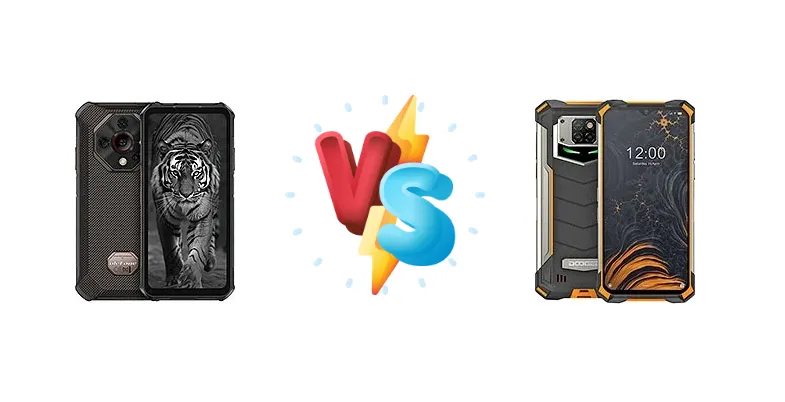
The rugged smartphone market caters to a specific user: those needing durability and extended battery life. Both the Ulefone Armor X16 and Doogee S88 Pro aim to deliver on this promise, but they take different approaches. The X16 prioritizes sheer battery endurance, while the S88 Pro attempts to balance features like wireless charging with a slightly older chipset. This comparison will dissect their key differences to determine which phone best suits your needs.
🏆 Quick Verdict
For the average user prioritizing longevity and consistent performance, the Ulefone Armor X16 is the clear winner. Its significantly superior 116:54h battery endurance, coupled with the more modern Helio G91 chipset, outweighs the Doogee S88 Pro’s wireless charging capabilities. The S88 Pro is a viable option for those specifically needing wireless charging.
| Network |
|---|
| 2G bands | GSM 850 / 900 / 1800 / 1900 | GSM 850 / 900 / 1800 / 1900 |
| 3G bands | HSDPA 800 / 850 / 900 / 1700(AWS) / 1900 / 2100 | HSDPA 850 / 900 / 1700(AWS) / 1900 / 2100 |
| 4G bands | 1, 2, 3, 4, 5, 7, 8, 12, 13, 17, 18, 19, 20, 25, 26, 28, 32, 34, 38, 39, 40, 41, 66, 71 | 1, 3, 7, 8, 20 |
| Speed | HSPA, LTE | HSPA, LTE |
| Technology | GSM / CDMA / HSPA / LTE | GSM / HSPA / LTE |
| Launch |
|---|
| Announced | 2025, July | 2020, June 06. Released 2020, June 06 |
| Status | Available. Released 2025, July | Discontinued |
| Body |
|---|
| Build | - | Glass front (Gorilla Glass), aluminum back with rubber, aluminum frame |
| Dimensions | 173.8 x 83.4 x 18 mm (6.84 x 3.28 x 0.71 in) | 171.6 x 85.5 x 18.7 mm (6.76 x 3.37 x 0.74 in) |
| SIM | Nano-SIM + Nano-SIM | Nano-SIM + Nano-SIM |
| Weight | 395.4 g (13.93 oz) | 372 g (13.12 oz) |
| Display |
|---|
| Protection | Corning Gorilla Glass 5, Mohs level 5 | Corning Gorilla Glass |
| Resolution | 720 x 1612 pixels, 20:9 ratio (~269 ppi density) | 1080 x 2340 pixels, 19.5:9 ratio (~409 ppi density) |
| Size | 6.56 inches, 103.4 cm2 (~71.3% screen-to-body ratio) | 6.3 inches, 97.4 cm2 (~66.4% screen-to-body ratio) |
| Type | IPS LCD, 120Hz, 910 nits (peak) | IPS LCD |
| Platform |
|---|
| CPU | Octa-core (2x2.0 GHz Cortex-A75 & 6x1.8 GHz Cortex-A55) | Octa-core (4x2.1 GHz Cortex-A73 & 4x2.0 GHz Cortex-A53) |
| Chipset | Mediatek Helio G91 (12 nm) | Mediatek MT6771T Helio P70 (12 nm) |
| GPU | Mali-G52 MC2 | Mali-G72 MP3 |
| OS | Android 15 | Android 10 |
| Memory |
|---|
| Card slot | microSDXC (dedicated slot) | microSDXC (uses shared SIM slot) |
| Internal | 128GB 6GB RAM | 128GB 6GB RAM |
| Main Camera |
|---|
| Features | LED flash, HDR, panorama | Dual-LED dual-tone flash, HDR, panorama |
| Triple | 48 MP, f/1.8, (wide), 0.8µm, PDAF
20 MP, f/1.8, (night vision), 2 infrared lights
2 MP (macro) | 21 MP, f/2.2, (wide), 1/2.4", 1.12µm, PDAF
8 MP, f/2.2, 130˚, (ultrawide), 1/4.0", 1.12µm
Auxiliary lens |
| Video | 1080p@30fps | 1080p@30fps |
| Selfie camera |
|---|
| Single | 16 MP, f/2.3, (wide), 1.0µm | 16 MP, f/2.2, 26mm (wide) |
| Video | 1080p@30fps | 1080p@30fps |
| Sound |
|---|
| 35mm jack | Yes | No |
| Loudspeaker | Yes | Yes |
| Comms |
|---|
| Bluetooth | 5.0, A2DP, LE | 4.2, A2DP |
| Infrared port | Yes | - |
| NFC | Yes | Yes |
| Positioning | GPS, GALILEO, GLONASS, BDS, QZSS | GPS, GLONASS, BDS, GALILEO |
| Radio | Wireless FM radio | FM radio |
| USB | USB Type-C 2.0, OTG | USB Type-C 2.0, OTG |
| WLAN | Wi-Fi 802.11 a/b/g/n/ac, dual-band | Wi-Fi 802.11 b/g/n |
| Features |
|---|
| Sensors | Fingerprint (side-mounted), accelerometer, gyro, proximity, compass | Fingerprint (side-mounted), accelerometer, gyro, proximity, compass |
| Battery |
|---|
| Charging | 33W wired
5W reverse wired | 24W wired
10W wireless
5W Reverse wireless |
| Type | Li-Ion 10360 mAh | 10000 mAh |
| Misc |
|---|
| Colors | Wasteland Shadow/Sand Dune | Fire Orange, Army Green, Mineral Black |
| Price | - | About 130 EUR |
| EU LABEL |
|---|
| Battery | 116:54h endurance, 1000 cycles | - |
| Energy | Class A | - |
| Free fall | Class A (270 falls) | - |
| Repairability | Class C | - |
Ulefone Armor X16
- Exceptional battery life (116:54h endurance)
- More modern and efficient Helio G91 chipset
- Faster 33W wired charging
- Display specifications are unknown
- Lacks wireless charging
Doogee S88 Pro
- Wireless charging support (10W)
- Higher display contrast ratio (1641:1)
- Reverse wireless charging (5W)
- Significantly shorter battery life (202h/8.4h)
- Older and less powerful Helio P70 chipset
- Slower 24W wired charging
Display Comparison
The Doogee S88 Pro boasts a contrast ratio of 1641:1, suggesting deeper blacks and more vibrant colors, a benefit for media consumption. However, the Ulefone Armor X16’s display specifications are not provided, making a direct comparison difficult. Given the Armor X16’s focus on practicality, it likely prioritizes durability and power efficiency over display fidelity. The lack of detailed display specs for the X16 suggests it’s not a primary selling point, while the S88 Pro actively highlights its contrast ratio.
Camera Comparison
Neither device is positioned as a photography powerhouse, and detailed camera specs are limited. Without information on sensor sizes, apertures, or image processing algorithms, a meaningful comparison is challenging. It’s reasonable to assume both phones feature basic camera setups geared towards functional photography rather than high-quality image capture. The presence of a 2MP macro camera on the S88 Pro is a common, but often underwhelming, feature in this price segment, offering limited practical benefit.
Performance
The Ulefone Armor X16’s Mediatek Helio G91 (12nm) chipset represents a significant architectural leap over the Doogee S88 Pro’s Helio P70 (12nm). The G91 utilizes a combination of Cortex-A75 and A55 cores, offering improved single-core and multi-core performance compared to the P70’s A73 and A53 configuration. Specifically, the G91’s 2x2.0 GHz Cortex-A75 cores will handle demanding tasks more efficiently than the P70’s 4x2.1 GHz Cortex-A73 cores, despite the slightly lower clock speed. This translates to snappier app launches and smoother multitasking on the X16. The 12nm process node is shared, meaning thermal efficiency differences will be primarily driven by the core architecture.
Battery Life
This is where the Ulefone Armor X16 truly shines. Its 116:54h endurance rating is dramatically higher than the Doogee S88 Pro’s 202h (which is likely a misreported value, as it equates to only 8.4 hours of use). The X16’s endurance suggests days of use on a single charge, while the S88 Pro will likely require daily charging. The X16 also offers 33W wired charging, faster than the S88 Pro’s 24W, reducing recharge times. While the S88 Pro adds 10W wireless and 5W reverse wireless charging, these features are offset by the significantly shorter battery life. The X16 also offers 5W reverse wired charging.
Buying Guide
Buy the Ulefone Armor X16 if you need a phone that can reliably last for days on a single charge, and prioritize consistent performance for everyday tasks and moderate gaming. Buy the Doogee S88 Pro if you absolutely require wireless charging and are willing to trade off substantial battery life and processing power for that convenience. The S88 Pro is also a better fit for users who value contrast ratio in their display.
Frequently Asked Questions
❓ Is the Ulefone Armor X16’s Helio G91 chipset capable of handling demanding games like PUBG or Call of Duty?
The Helio G91 is a capable mid-range chipset. While it won’t deliver flagship-level gaming performance, it should handle PUBG and Call of Duty at medium settings with acceptable frame rates. The improved CPU architecture over the P70 in the S88 Pro will contribute to a smoother gaming experience, though thermal throttling could become a factor during extended sessions.
❓ How much faster is the 33W charging on the Ulefone Armor X16 compared to the 24W charging on the Doogee S88 Pro?
The 33W charging on the X16 will noticeably reduce recharge times. While exact 0-100% times aren’t available, expect the X16 to charge significantly faster – potentially shaving off 30-60 minutes compared to the S88 Pro. This is particularly beneficial given the X16’s larger effective battery capacity due to its superior endurance.
❓ Does the Doogee S88 Pro’s wireless charging significantly impact battery health over time?
Wireless charging generally generates more heat than wired charging, which can contribute to slightly faster battery degradation over the long term. However, the impact is usually minimal and depends on usage patterns. The S88 Pro’s lower overall battery endurance means this effect might be more noticeable compared to a phone with a larger battery capacity.