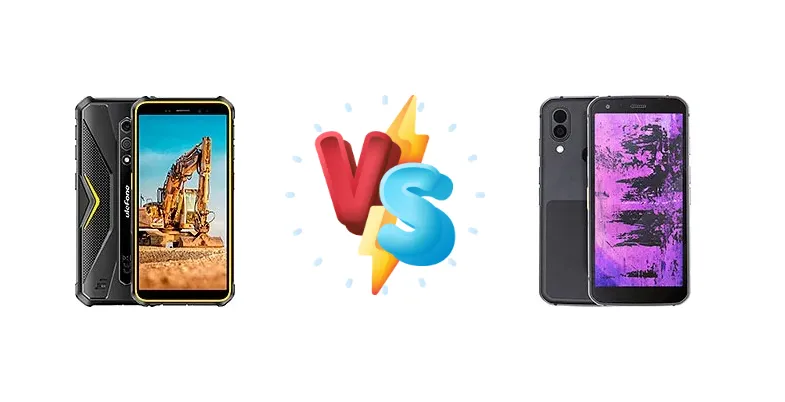
The rugged smartphone market caters to a specific need: durability. Both the Ulefone Armor X12 and the Cat S62 Pro aim to deliver on that promise, but they approach it with significantly different internal hardware. This comparison dissects their core components to determine which device offers the best balance of performance, battery life, and value for users who demand a phone that can withstand harsh conditions.
🏆 Quick Verdict
For the average user prioritizing long-term battery endurance and affordability, the Ulefone Armor X12 is the better choice. However, the Cat S62 Pro’s Snapdragon 660 chipset provides a noticeable performance boost for multitasking and more demanding applications, justifying its higher price point for power users.
| Network |
|---|
| 2G bands | GSM 850 / 900 / 1800 / 1900 | GSM 850 / 900 / 1800 / 1900 |
| 3G bands | HSDPA 850 / 900 / 1700(AWS) / 1900 / 2100 | HSDPA 850 / 900 / 1700(AWS) / 1900 / 2100 |
| 4G bands | 1, 2, 3, 4, 5, 7, 8, 12, 17, 19, 20, 28 | 1, 2, 3, 4, 5, 7, 8, 20, 28, 38, 40 |
| Speed | HSPA, LTE | HSPA 42.2/5.76 Mbps, LTE (2CA) Cat13 400/150 Mbps |
| Technology | GSM / HSPA / LTE | GSM / HSPA / LTE |
| Launch |
|---|
| Announced | 2023, September | 2020, June 28. Released 2020, August 17 |
| Status | Available. Released 2023, September | Discontinued |
| Body |
|---|
| Build | - | Glass front (Gorilla Glass 6), plastic back, aluminum frame |
| Dimensions | 157.2 x 76.8 x 14.3 mm (6.19 x 3.02 x 0.56 in) | 158.5 x 76.7 x 11.9 mm (6.24 x 3.02 x 0.47 in) |
| SIM | Nano-SIM + Nano-SIM | · Nano-SIM· Nano-SIM + Nano-SIM |
| Weight | 257 g (9.07 oz) | 248 g (8.75 oz) |
| | - | IP68/IP69 dust/water resistant (up to 1.5m for 35 mins)
Drop-to-concrete resistance from up to 1.8m
MIL-STD-810H compliant |
| Display |
|---|
| Protection | Mohs level 4 | Corning Gorilla Glass 6 |
| Resolution | 720 x 1440 pixels, 18:9 ratio (~295 ppi density) | 1080 x 2160 pixels, 18:9 ratio (~424 ppi density) |
| Size | 5.45 inches, 76.7 cm2 (~63.5% screen-to-body ratio) | 5.7 inches, 83.8 cm2 (~69.0% screen-to-body ratio) |
| Type | IPS LCD | IPS LCD |
| Platform |
|---|
| CPU | Quad-core 2.0 GHz Cortex-A53 | Octa-core (4x2.2 GHz Kryo 260 Gold & 4x1.8 GHz Kryo 260 Silver) |
| Chipset | Mediatek MT6761V/WAB Helio A22 (12 nm) | Qualcomm SDM660 Snapdragon 660 (14 nm) |
| GPU | PowerVR GE8320 | Adreno 512 |
| OS | Android 13 (Go edition) | Android 10 |
| Memory |
|---|
| Card slot | microSDXC (dedicated slot) | microSDXC (dedicated slot) |
| Internal | 32GB 3GB RAM | 128GB 6GB RAM |
| Main Camera |
|---|
| Dual | - | 12 MP, f/1.8, (wide), 1/2.55", 1.4µm, dual pixel PDAF
FLIR thermal camera (Lepton 3.5 module) |
| Features | LED flash | Thermal imaging, heat palettes, temp. spot meter, LED flash |
| Single | 13 MP, f/2.2, (wide), 1.12µm, PDAF | - |
| Video | 1080p@30fps | 1080p@30fps, gyro-EIS |
| Selfie camera |
|---|
| Single | 8 MP, f/2.0, (wide), 1.4µm | 8 MP |
| Video | Yes | 1080p@30fps |
| Sound |
|---|
| 3.5mm jack | - | No |
| 35mm jack | Yes | No |
| Loudspeaker | Yes | Yes |
| Comms |
|---|
| Bluetooth | 5.0, A2DP, LE | 5.0, A2DP, LE |
| NFC | Yes | Yes |
| Positioning | GPS, GLONASS, GALILEO, BDS | GPS, GLONASS, GALILEO, BDS |
| Radio | Wireless FM radio, RDS, recording | FM radio |
| USB | USB Type-C 2.0 | USB Type-C 2.0, OTG |
| WLAN | Wi-Fi 802.11 a/b/g/n/ac, dual-band | Wi-Fi 802.11 a/b/g/n/ac, dual-band, Wi-Fi Direct |
| Features |
|---|
| Sensors | Accelerometer, proximity | Fingerprint (rear-mounted), accelerometer, gyro, proximity, compass |
| Battery |
|---|
| Type | Li-Po 4860 mAh | Li-Ion 4000 mAh |
| Misc |
|---|
| Colors | Black, Black/Orange, Black/Green | Black |
| Price | - | About 530 EUR |
| EU LABEL |
|---|
| Battery | 47:39h endurance, 1000 cycles | - |
| Energy | Class B | - |
| Free fall | Class A (270 falls) | - |
| Repairability | Class C | - |
Ulefone Armor X12
- Exceptional battery endurance (47:39h)
- High battery cycle count (1000 cycles)
- More affordable price point
- Lower processing power
- Potentially limited multitasking capabilities
Cat S62 Pro
- Significantly faster processor (Snapdragon 660)
- Smoother multitasking experience
- Potentially better camera performance
- Shorter battery life compared to Ulefone
- Higher price
Display Comparison
Neither device’s display specifications are provided, but given their market positioning, we can infer differences. The Cat S62 Pro, being a higher-tier device, likely features a brighter panel with better color accuracy. The Ulefone Armor X12 will likely prioritize durability and cost-effectiveness, potentially sacrificing some display quality. The absence of details necessitates assuming the Cat S62 Pro offers a more visually pleasing experience, though both will likely feature ruggedized glass for impact resistance.
Camera Comparison
Without specific camera details, a direct comparison is difficult. However, the Cat S62 Pro’s higher price point suggests a more sophisticated camera system. While both phones likely feature a rear camera, the Snapdragon 660’s image signal processor (ISP) offers superior image processing capabilities, potentially resulting in better dynamic range and low-light performance. It’s reasonable to assume the Cat S62 Pro will deliver more detailed and vibrant photos, though rugged phone cameras generally prioritize functionality over photographic excellence.
Performance
The core difference lies in the chipsets. The Ulefone Armor X12 utilizes the Mediatek MT6761V/WAB Helio A22, a quad-core processor built on a 12nm process. This is an entry-level chipset designed for efficiency. Conversely, the Cat S62 Pro boasts the Qualcomm Snapdragon 660, an octa-core processor fabricated on a 14nm node. The Snapdragon 660’s eight cores (four Kryo 260 Gold at 2.2 GHz and four Kryo 260 Silver at 1.8 GHz) provide significantly more processing power, enabling smoother multitasking and faster app loading times. The architectural advantage of the Snapdragon 660 translates to a more responsive user experience, particularly for users running multiple applications simultaneously or utilizing resource-intensive apps.
Battery Life
The Ulefone Armor X12 claims an impressive 47:39h endurance and 1000 charge cycles. This suggests a focus on maximizing battery life, likely achieved through the efficient Helio A22 chipset and optimized software. While the Cat S62 Pro’s battery capacity is unknown, the more powerful Snapdragon 660 will inevitably consume more power. The Ulefone’s longevity is a key advantage for users who require extended operation without access to charging facilities. The 1000 cycle claim also suggests a more durable battery over the long term.
Buying Guide
Buy the Ulefone Armor X12 if you need a supremely long-lasting phone for basic communication, navigation, and occasional photography, and value extended battery life over raw processing power. It’s ideal for those working in remote locations or needing a reliable backup device. Buy the Cat S62 Pro if you prefer a smoother, more responsive experience for running multiple apps, using complex tools, or enjoying occasional gaming, and are willing to trade some battery endurance for increased performance.
Frequently Asked Questions
❓ Is the Ulefone Armor X12’s Helio A22 chipset sufficient for running navigation apps like Google Maps offline?
Yes, the Helio A22 is capable of running basic navigation apps like Google Maps, even offline. While it won’t offer the fastest performance, it’s sufficient for displaying maps and providing turn-by-turn directions. However, expect longer loading times for map data compared to the Cat S62 Pro.
❓ Will the Cat S62 Pro’s Snapdragon 660 experience throttling during prolonged use of GPS and other demanding apps simultaneously?
The Snapdragon 660 is more capable of handling sustained workloads than the Helio A22. However, given the rugged design, passive cooling is likely limited. Prolonged use of GPS, data connectivity, and demanding apps *could* lead to some thermal throttling, reducing performance slightly. It won't be a complete shutdown, but a temporary reduction in clock speed is possible.
❓ How does the Ulefone Armor X12’s battery cycle count of 1000 impact its long-term usability?
A 1000 charge cycle rating suggests the battery will retain a significant portion of its original capacity even after being fully charged and discharged 1000 times. This is a substantial benefit for users who frequently use their phone and recharge it daily, as it indicates a longer lifespan before noticeable battery degradation.