
Ulefone Armor X12 vs Blackview BV9900E: A Deep Dive into Rugged Smartphone Performance
| Phones Images | |||||
|---|---|---|---|---|---|
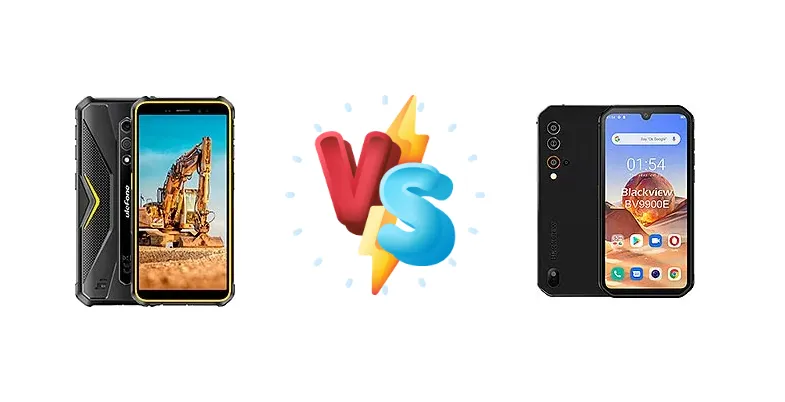
|
🏆 Quick Verdict
For the average user prioritizing responsiveness and multitasking, the Blackview BV9900E is the clear winner. Its Helio P90 chipset delivers a significantly more fluid experience than the Ulefone Armor X12’s Helio A22. However, the X12’s exceptional 47:39h battery endurance makes it ideal for those who value longevity above all else.
| PHONES | ||
|---|---|---|
| Phone Names | Ulefone Armor X12 | Blackview BV9900E |
| Network | ||
|---|---|---|
| 2G bands | GSM 850 / 900 / 1800 / 1900 | GSM 850 / 900 / 1800 / 1900 |
| 3G bands | HSDPA 850 / 900 / 1700(AWS) / 1900 / 2100 | HSDPA 800 / 850 / 900 / 1700(AWS) / 1900 / 2100 |
| 4G bands | 1, 2, 3, 4, 5, 7, 8, 12, 17, 19, 20, 28 | 1, 2, 3, 4, 5, 7, 8, 12, 13, 17, 18, 19, 20, 25, 26, 28, 34, 38, 39, 40, 41, 66 |
| Speed | HSPA, LTE | HSPA, LTE |
| Technology | GSM / HSPA / LTE | GSM / CDMA / HSPA / CDMA2000 / LTE |
| Launch | ||
|---|---|---|
| Announced | 2023, September | 2020, September 10. Released 2020, September |
| Status | Available. Released 2023, September | Discontinued |
| Body | ||
|---|---|---|
| Dimensions | 157.2 x 76.8 x 14.3 mm (6.19 x 3.02 x 0.56 in) | 156.5 x 78.3 x 14.2 mm (6.16 x 3.08 x 0.56 in) |
| SIM | Nano-SIM + Nano-SIM | Nano-SIM + Nano-SIM |
| Weight | 257 g (9.07 oz) | 273 g (9.63 oz) |
| Display | ||
|---|---|---|
| Protection | Mohs level 4 | Corning Gorilla Glass 5 |
| Resolution | 720 x 1440 pixels, 18:9 ratio (~295 ppi density) | 1080 x 2280 pixels, 19:9 ratio (~432 ppi density) |
| Size | 5.45 inches, 76.7 cm2 (~63.5% screen-to-body ratio) | 5.84 inches, 85.1 cm2 (~69.5% screen-to-body ratio) |
| Type | IPS LCD | IPS LCD |
| Platform | ||
|---|---|---|
| CPU | Quad-core 2.0 GHz Cortex-A53 | Octa-core (2x2.2 GHz Cortex-A75 & 6x2.0 GHz Cortex-A55) |
| Chipset | Mediatek MT6761V/WAB Helio A22 (12 nm) | Mediatek MT6779V/CE Helio P90 (12 nm) |
| GPU | PowerVR GE8320 | PowerVR GM9446 |
| OS | Android 13 (Go edition) | Android 10 |
| Memory | ||
|---|---|---|
| Card slot | microSDXC (dedicated slot) | microSDXC |
| Internal | 32GB 3GB RAM | 128GB 6GB RAM |
| Main Camera | ||
|---|---|---|
| Features | LED flash | LED flash, HDR, panorama |
| Quad | - | 48 MP, f/1.8, (wide), PDAF 16 MP, 120˚ (ultrawide) 2 MP (macro) Auxiliary lens |
| Single | 13 MP, f/2.2, (wide), 1.12µm, PDAF | - |
| Video | 1080p@30fps | 4K@30fps, 1080p@60fps |
| Selfie camera | ||
|---|---|---|
| Single | 8 MP, f/2.0, (wide), 1.4µm | 16 MP, f/2.0, (wide) |
| Video | Yes | 1080p@30fps |
| Sound | ||
|---|---|---|
| 35mm jack | Yes | No |
| Loudspeaker | Yes | Yes |
| Comms | ||
|---|---|---|
| Bluetooth | 5.0, A2DP, LE | 5.0, A2DP, LE |
| NFC | Yes | Yes |
| Positioning | GPS, GLONASS, GALILEO, BDS | GPS, GLONASS, GALILEO, BDS |
| Radio | Wireless FM radio, RDS, recording | FM radio |
| USB | USB Type-C 2.0 | USB Type-C 2.0, OTG |
| WLAN | Wi-Fi 802.11 a/b/g/n/ac, dual-band | Wi-Fi 802.11 a/b/g/n/ac |
| Features | ||
|---|---|---|
| Sensors | Accelerometer, proximity | Fingerprint (side-mounted), accelerometer, gyro, proximity, compass, barometer |
| Battery | ||
|---|---|---|
| Charging | - | 15W wired 18W wireless |
| Type | Li-Po 4860 mAh | 4380 mAh |
| Misc | ||
|---|---|---|
| Colors | Black, Black/Orange, Black/Green | Black, Silver |
| Price | - | About 260 EUR |
| EU LABEL | ||
|---|---|---|
| Battery | 47:39h endurance, 1000 cycles | - |
| Energy | Class B | - |
| Free fall | Class A (270 falls) | - |
| Repairability | Class C | - |
Ulefone Armor X12
- Exceptional battery life (47:39h endurance)
- Long-lasting battery health (1000 charge cycles)
- Affordable price point
- Limited processing power
- Slow performance for demanding tasks
- Likely lower-quality display
Blackview BV9900E
- Significantly faster performance (Helio P90)
- Wireless charging support (18W)
- Potentially better camera image processing
- Shorter battery life compared to X12
- Higher price point
- May experience more heat under heavy load
Display Comparison
Neither device’s display specifications are provided, so a direct comparison is limited. However, given the price points, both likely utilize IPS LCD panels. The BV9900E’s more powerful chipset suggests it *could* support a higher resolution or refresh rate, but this is speculative. The X12’s focus on endurance implies a potentially more power-efficient panel, even if lower in resolution.
Camera Comparison
Without detailed camera specifications, a comprehensive comparison is impossible. However, the BV9900E’s more powerful ISP (Image Signal Processor) within the Helio P90 chipset suggests superior image processing capabilities. While both phones likely feature multiple rear cameras, the X12’s lower processing power may limit its ability to effectively utilize features like HDR or night mode. The presence of a 2MP macro camera on either device is likely a marketing gimmick, offering minimal practical benefit.
Performance
The core difference lies in the chipsets. The Blackview BV9900E’s MediaTek Helio P90 is a substantial upgrade over the Ulefone Armor X12’s Helio A22. The P90 features an octa-core configuration (2x2.2 GHz Cortex-A75 & 6x2.0 GHz Cortex-A55) compared to the X12’s quad-core 2.0 GHz Cortex-A53. This translates to significantly faster application loading times, smoother multitasking, and a better gaming experience on the BV9900E. The P90’s architecture, utilizing Cortex-A75 cores, provides a noticeable performance boost over the A53 cores in the A22. The 12nm process node is shared by both, meaning thermal efficiency differences will be primarily driven by workload and chipset architecture.
Battery Life
The Ulefone Armor X12 boasts an impressive 47:39h endurance rating, indicating exceptional battery life. While the BV9900E’s battery capacity isn’t specified, its more powerful chipset will inevitably consume more power. However, the BV9900E compensates with 15W wired and 18W wireless charging, offering greater convenience and faster top-ups. The X12’s 1000 charge cycles suggest a focus on long-term battery health, while the BV9900E’s wireless charging adds a modern convenience factor.
Buying Guide
Buy the Ulefone Armor X12 if you need a phone that can genuinely last for days on a single charge, and your usage is limited to basic tasks like calls, texts, and light app use. You’ll appreciate its affordability and robust build. Buy the Blackview BV9900E if you prefer a smoother, more responsive experience for demanding apps, occasional gaming, and multitasking, and are willing to charge the device more frequently. The wireless charging capability adds convenience.