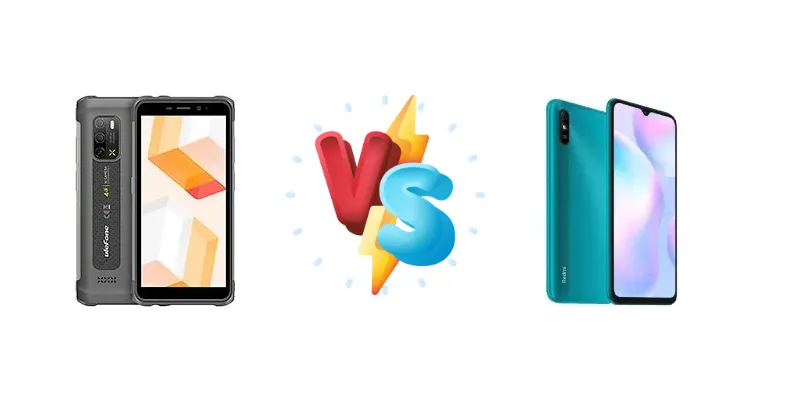
Looking for an affordable smartphone that can handle your daily grind? The Ulefone Armor X10 offers rugged durability, while the Xiaomi Redmi 9A focuses on delivering solid value. But which one is right for you? Let's dive into a detailed comparison.
🏆 Quick Verdict
The Xiaomi Redmi 9A edges out the Ulefone Armor X10 thanks to its slightly more powerful chipset and generally better software experience. However, the Armor X10's rugged design and water resistance make it a clear winner for those needing a tough phone.
| Network |
|---|
| 2G bands | GSM 850 / 900 / 1800 / 1900 | GSM 850 / 900 / 1800 / 1900 |
| 3G bands | HSDPA 850 / 900 / 1700(AWS) / 1900 / 2100 | HSDPA 850 / 900 / 1700(AWS) / 1900 / 2100 - International |
| 4G bands | 1, 2, 3, 4, 5, 7, 8, 12, 13, 17, 18, 19, 20, 25, 26, 28 | 1, 2, 3, 4, 5, 7, 8, 20, 28, 38, 40, 41 - International |
| Speed | HSPA 21/5.76 Mbps, LTE Cat6 300/150 Mbps | HSPA, LTE |
| Technology | GSM / HSPA / LTE | GSM / HSPA / LTE |
| | - | 1, 3, 5, 8, 40, 41 - India |
| Launch |
|---|
| Announced | 2021, December 24 | 2020, June 30. Released 2020, July 07 |
| Status | Available. Released 2021, December 24 | Discontinued |
| Body |
|---|
| Dimensions | 158.2 x 76.7 x 14.6 mm (6.23 x 3.02 x 0.57 in) | 164.9 x 77.1 x 9 mm (6.49 x 3.04 x 0.35 in) |
| SIM | Nano-SIM + Nano-SIM | Nano-SIM + Nano-SIM |
| Weight | 256 g (9.03 oz) | 196 g (6.91 oz) |
| | IP68/IP69K dust/water resistant (up to 1.5m for 30 min)
Drop-to-concrete resistance from up to 1.2m
MIL-STD-810G compliant | - |
| Display |
|---|
| Resolution | 720 x 1440 pixels, 18:9 ratio (~295 ppi density) | 720 x 1600 pixels, 20:9 ratio (~269 ppi density) |
| Size | 5.45 inches, 76.7 cm2 (~63.2% screen-to-body ratio) | 6.53 inches, 102.9 cm2 (~81.0% screen-to-body ratio) |
| Type | IPS LCD | IPS LCD, 400 nits (typ) |
| Platform |
|---|
| CPU | Quad-core 2.0 GHz Cortex-A53 | Octa-core (4x2.0 GHz Cortex-A53 & 4x1.5 GHz Cortex-A53) |
| Chipset | Mediatek MT6761 Helio A22 (12 nm) | Mediatek MT6762G Helio G25 (12 nm) |
| GPU | PowerVR GE8320 | PowerVR GE8320 |
| OS | Android 11 | Android 10, upgradable to Android 11, MIUI 12 |
| Memory |
|---|
| Card slot | microSDXC (dedicated slot) | microSDXC (dedicated slot) |
| Internal | 32GB 4GB RAM | 32GB 2GB RAM, 32GB 3GB RAM, 64GB 4GB RAM, 128GB 4GB RAM, 128GB 6GB RAM |
| | eMMC 5.1 | eMMC 5.1 |
| Main Camera |
|---|
| Dual | 13 MP, f/2.2, (wide), AF
Auxiliary lens | - |
| Features | Dual-LED flash | LED flash, HDR |
| Single | 5 MP, f/2.2 | 13 MP, f/2.2, 28mm (wide), 1.0µm, PDAF |
| Video | 1080p@30fps | 1080p@30/60fps |
| Selfie camera |
|---|
| Features | HDR | HDR |
| Single | 5 MP, f/2.2 | 5 MP, f/2.2, (wide), 1.12µm |
| Video | 1080p@30fps | 1080p@30fps |
| Sound |
|---|
| 3.5mm jack | Yes | Yes |
| 35mm jack | Yes | Yes |
| Loudspeaker | Yes | Yes |
| Comms |
|---|
| Bluetooth | 5.0, A2DP, LE | 5.0, A2DP, LE |
| NFC | Yes | No |
| Positioning | GPS, GLONASS, GALILEO, BDS | GPS, GLONASS, BDS |
| Radio | FM radio, RDS, recording | FM radio |
| USB | USB Type-C 2.0, OTG | microUSB 2.0, OTG |
| WLAN | Wi-Fi 802.11 a/b/g/n/ac, Wi-Fi Direct | Wi-Fi 802.11 b/g/n, Wi-Fi Direct |
| Features |
|---|
| Sensors | Accelerometer, proximity, compass | Accelerometer, proximity |
| Battery |
|---|
| Charging | 10W wired | 10W wired |
| Type | Li-Po 5180 mAh | Li-Po 5000 mAh |
| Misc |
|---|
| Colors | Black/Gray | Carbon Gray (Midnight Black), Sky Blue (Sea Blue), Ocean Green (Nature Green) |
| Models | - | M2006C3LG, M2006C3LI, M2006C3LC, M2004C3L |
| Price | About 130 EUR | € 64.30 / $ 56.50 / £ 95.56 |
| SAR | - | 0.90 W/kg (head) 0.65 W/kg (body) |
| SAR EU | - | 0.40 W/kg (head) 1.19 W/kg (body) |
Ulefone Armor X10
- Rugged and durable design
- Water and dust resistant (IP68/IP69K)
- Large 5000mAh battery
- Loudspeaker
- Lower performance chipset
- Less refined software
- Potentially lower camera quality
- 10W charging is slow
Xiaomi Redmi 9A
- Better performance (Helio G25)
- Slightly better camera
- More refined MIUI software
- Good value for money
- Less durable design
- No water or dust resistance
- 10W charging is slow
Display Comparison
Both phones feature a 6.21-inch HD+ display. While the resolution is similar, the Redmi 9A's display might offer slightly better color accuracy and viewing angles due to Xiaomi's generally better display calibration. The Armor X10's screen is likely more durable due to its ruggedized construction.
Camera Comparison
The Redmi 9A typically features a 13MP main camera, often accompanied by a depth sensor, offering better image quality and more features than the Armor X10's likely 8MP or 13MP main camera. Low-light performance is also expected to be better on the Redmi 9A. Both phones likely have a basic front-facing camera (5MP).
Performance
The Redmi 9A's MT6762G Helio G25 chipset, with its octa-core processor, provides a noticeable performance boost over the Armor X10's MT6761 Helio A22. Expect smoother multitasking and faster app loading times on the Redmi 9A. Gaming performance will also be better on the Redmi 9A.
Battery Life
Both phones offer a 5000mAh battery, suggesting similar battery life under moderate usage. However, the Redmi 9A's more efficient chipset might give it a slight edge in overall endurance.
Buying Guide
The Ulefone Armor X10 is ideal for outdoor enthusiasts, construction workers, or anyone needing a phone that can withstand drops, dust, and water. The Xiaomi Redmi 9A is a great choice for budget-conscious users who prioritize performance and a smoother user experience in a more conventional design.
Frequently Asked Questions
❓ Is the Ulefone Armor X10 waterproof?
Yes, the Ulefone Armor X10 is typically IP68/IP69K certified, meaning it's water and dust resistant.
❓ Which phone is better for gaming?
The Xiaomi Redmi 9A is significantly better for gaming due to its more powerful Helio G25 chipset.
❓ Does the Redmi 9A have NFC?
Some variants of the Redmi 9A include NFC, but it's not a universal feature. Check the specific model you're purchasing.
❓ What type of charging do both phones use?
Both phones utilize 10W wired charging, which is relatively slow compared to modern standards.