
Ulefone Armor X10 vs. Power Armor X11 Pro: Which Rugged Phone Reigns Supreme?
| Phones Images | |||||
|---|---|---|---|---|---|
|
🏆 Quick Verdict
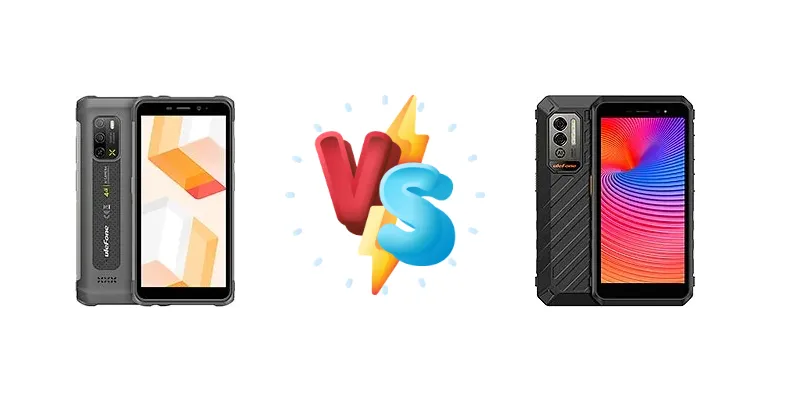
The Ulefone Power Armor X11 Pro edges out the X10 thanks to its octa-core processor, offering noticeably better performance for multitasking and gaming. While both are rugged, the X11 Pro's improved chipset makes it the more compelling choice for most users.
| PHONES | ||
|---|---|---|
| Phone Names | Ulefone Armor X10 | Ulefone Power Armor X11 Pro |
| Network | ||
|---|---|---|
| 2G bands | GSM 850 / 900 / 1800 / 1900 | GSM 850 / 900 / 1800 / 1900 |
| 3G bands | HSDPA 850 / 900 / 1700(AWS) / 1900 / 2100 | HSDPA 850 / 900 / 1700(AWS) / 1900 / 2100 |
| 4G bands | 1, 2, 3, 4, 5, 7, 8, 12, 13, 17, 18, 19, 20, 25, 26, 28 | 1, 2, 3, 4, 5, 7, 8, 12, 13, 17, 18, 19, 20, 25, 26, 28 |
| Speed | HSPA 21/5.76 Mbps, LTE Cat6 300/150 Mbps | HSPA, LTE |
| Technology | GSM / HSPA / LTE | GSM / HSPA / LTE |
| - | eMMC 5.1 | |
| Launch | ||
|---|---|---|
| Announced | 2021, December 24 | 2022, September 16 |
| Status | Available. Released 2021, December 24 | Available. Released 2022, September 16 |
| Body | ||
|---|---|---|
| Dimensions | 158.2 x 76.7 x 14.6 mm (6.23 x 3.02 x 0.57 in) | 158.2 x 76.7 x 19.3 mm (6.23 x 3.02 x 0.76 in) |
| SIM | Nano-SIM + Nano-SIM | Nano-SIM + Nano-SIM |
| Weight | 256 g (9.03 oz) | 330 g (11.64 oz) |
| IP68/IP69K dust/water resistant (up to 1.5m for 30 min) Drop-to-concrete resistance from up to 1.2m MIL-STD-810G compliant | IP68 dust/water resistant (up to 1.5m for 30 min) Drop-to-concrete resistance from up to 1.5m MIL-STD-810G compliant | |
| Display | ||
|---|---|---|
| Resolution | 720 x 1440 pixels, 18:9 ratio (~295 ppi density) | 720 x 1440 pixels, 18:9 ratio (~295 ppi density) |
| Size | 5.45 inches, 76.7 cm2 (~63.2% screen-to-body ratio) | 5.45 inches, 76.7 cm2 (~63.2% screen-to-body ratio) |
| Type | IPS LCD | IPS LCD |
| Platform | ||
|---|---|---|
| CPU | Quad-core 2.0 GHz Cortex-A53 | Octa-core (4x2.0 GHz Cortex-A53 & 4x1.5 GHz Cortex-A53) |
| Chipset | Mediatek MT6761 Helio A22 (12 nm) | Mediatek MT6762G Helio G25 (12 nm) |
| GPU | PowerVR GE8320 | PowerVR GE8320 |
| OS | Android 11 | Android 12 |
| Memory | ||
|---|---|---|
| Card slot | microSDXC (dedicated slot) | microSDXC (dedicated slot) |
| Internal | 32GB 4GB RAM | 64GB 4GB RAM |
| eMMC 5.1 | - | |
| Main Camera | ||
|---|---|---|
| Dual | 13 MP, f/2.2, (wide), AF Auxiliary lens | 16 MP, f/1.8, (wide), 1.12µm, PDAF Auxiliary lens |
| Features | Dual-LED flash | Dual-LED flash, HDR, panorama |
| Single | 5 MP, f/2.2 | 5 MP, f/2.2 |
| Video | 1080p@30fps | 1080p@30fps |
| Selfie camera | ||
|---|---|---|
| Features | HDR | - |
| Single | 5 MP, f/2.2 | 5 MP, f/2.2 |
| Video | 1080p@30fps | 1080p@30fps |
| Sound | ||
|---|---|---|
| 3.5mm jack | Yes | Yes |
| 35mm jack | Yes | Yes |
| Loudspeaker | Yes | Yes |
| Comms | ||
|---|---|---|
| Bluetooth | 5.0, A2DP, LE | 5.0, A2DP, LE |
| NFC | Yes | Yes |
| Positioning | GPS, GLONASS, GALILEO, BDS | GPS, GLONASS, GALILEO, BDS |
| Radio | FM radio, RDS, recording | FM radio, RDS, recording |
| USB | USB Type-C 2.0, OTG | USB Type-C 2.0, OTG |
| WLAN | Wi-Fi 802.11 a/b/g/n/ac, Wi-Fi Direct | Wi-Fi 802.11 a/b/g/n/ac, dual-band |
| Features | ||
|---|---|---|
| Sensors | Accelerometer, proximity, compass | Accelerometer, proximity, compass |
| Battery | ||
|---|---|---|
| Charging | 10W wired | - |
| Type | Li-Po 5180 mAh | Li-Po 8150 mAh |
| Misc | ||
|---|---|---|
| Colors | Black/Gray | Black |
| Price | About 130 EUR | About 170 EUR |
Ulefone Armor X10
- Affordable
- Rugged and durable
- Decent battery life (for its size)
- Water and dust resistant
- Lower performance
- Outdated chipset
- Limited camera capabilities
- Smaller screen
Ulefone Power Armor X11 Pro
- Better performance (octa-core processor)
- Longer battery life
- Larger screen (potentially)
- Rugged and durable
- Water and dust resistant
- Slightly more expensive
- Camera still not exceptional
- Design can be bulky
Display Comparison
Both phones feature similar display technology (likely IPS LCD) and resolution (likely 720 x 1520 pixels). The X11 Pro may have a slightly larger screen size (potentially 6.2 inches vs. 5.7 inches on the X10), offering a more immersive viewing experience. However, brightness and color accuracy are likely comparable and not exceptional.
Camera Comparison
Camera specs are likely similar, with both phones featuring a primary rear camera around 13MP. Image quality will depend more on software optimization than hardware differences. Expect decent photos in good lighting conditions, but limited low-light performance. The X11 Pro might offer slightly better image processing due to its more powerful chipset.
Performance
This is where the X11 Pro shines. The Helio G25 octa-core processor is a significant upgrade over the X10's Helio A22 quad-core. Expect smoother multitasking, faster app loading times, and better gaming performance on the X11 Pro. The X10 will handle basic tasks adequately, but will struggle with more demanding applications.
Battery Life
The Power Armor X11 Pro typically boasts a larger battery capacity (likely 5000mAh or higher) compared to the X10 (likely around 4000mAh). This translates to longer battery life on the X11 Pro, easily lasting a full day of heavy use, while the X10 might require charging before the end of the day with similar usage.
Buying Guide
The Ulefone Armor X10 is ideal for users prioritizing affordability and basic functionality in a rugged package. The Power Armor X11 Pro is better suited for those needing more processing power for apps, games, and demanding tasks, and who appreciate a slightly larger battery.