
Ulefone Armor X10 vs. Armor 12 5G: A Deep Dive into Rugged Performance
| Phones Images | |||||
|---|---|---|---|---|---|
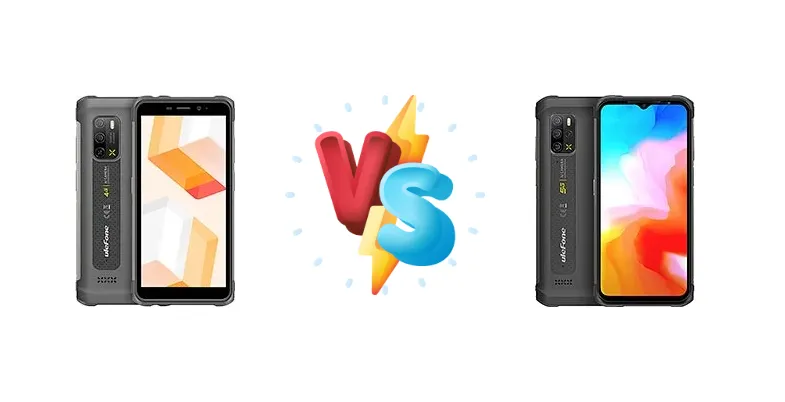
|
🏆 Quick Verdict
For most users, the Ulefone Armor 12 5G is the superior choice. The Dimensity 700 chipset delivers a substantial performance boost over the Helio A22, enabling smoother multitasking and a more responsive user experience. The addition of 5G and faster, wireless charging further solidify its position as the more future-proof option, despite a likely higher price.
| PHONES | ||
|---|---|---|
| Phone Names | Ulefone Armor X10 | Ulefone Armor 12 5G |
| Network | ||
|---|---|---|
| 2G bands | GSM 850 / 900 / 1800 / 1900 | GSM 850 / 900 / 1800 / 1900 |
| 3G bands | HSDPA 850 / 900 / 1700(AWS) / 1900 / 2100 | HSDPA 850 / 900 / 1700(AWS) / 1900 / 2100 |
| 4G bands | 1, 2, 3, 4, 5, 7, 8, 12, 13, 17, 18, 19, 20, 25, 26, 28 | 1, 2, 3, 4, 5, 7, 8, 12, 13, 17, 18, 19, 20, 25, 26, 28, 34, 38, 39, 40, 41, 66 |
| 5G bands | - | 1, 3, 28, 38, 41, 77, 78 SA/NSA |
| Speed | HSPA 21/5.76 Mbps, LTE Cat6 300/150 Mbps | HSPA, LTE, 5G |
| Technology | GSM / HSPA / LTE | GSM / CDMA / HSPA / EVDO / LTE / 5G |
| - | CDMA2000 1xEV-DO | |
| Launch | ||
|---|---|---|
| Announced | 2021, December 24 | 2021, August 14 |
| Status | Available. Released 2021, December 24 | Available. Released 2021, August 23 |
| Body | ||
|---|---|---|
| Build | - | Front glass, aluminum back with rubber, aluminum frame |
| Dimensions | 158.2 x 76.7 x 14.6 mm (6.23 x 3.02 x 0.57 in) | 175.9 x 82.5 x 14.3 mm (6.93 x 3.25 x 0.56 in) |
| SIM | Nano-SIM + Nano-SIM | Nano-SIM + Nano-SIM |
| Weight | 256 g (9.03 oz) | 296 g (10.44 oz) |
| IP68/IP69K dust/water resistant (up to 1.5m for 30 min) Drop-to-concrete resistance from up to 1.2m MIL-STD-810G compliant | IP68 dust/water resistant (up to 1.5m for 30 min) Drop-to-concrete resistance from up to 1.2m MIL-STD-810G compliant | |
| Display | ||
|---|---|---|
| Resolution | 720 x 1440 pixels, 18:9 ratio (~295 ppi density) | 720 x 1560 pixels, 19.5:9 ratio (~264 ppi density) |
| Size | 5.45 inches, 76.7 cm2 (~63.2% screen-to-body ratio) | 6.52 inches, 104.4 cm2 (~71.9% screen-to-body ratio) |
| Type | IPS LCD | IPS LCD |
| Platform | ||
|---|---|---|
| CPU | Quad-core 2.0 GHz Cortex-A53 | Octa-core (2x2.2 GHz Cortex-A76 & 6x2.0 GHz Cortex-A55) |
| Chipset | Mediatek MT6761 Helio A22 (12 nm) | Mediatek Dimensity 700 (7 nm) |
| GPU | PowerVR GE8320 | Mali-G57 MC2 |
| OS | Android 11 | Android 11 |
| Memory | ||
|---|---|---|
| Card slot | microSDXC (dedicated slot) | microSDXC |
| Internal | 32GB 4GB RAM | 128GB 8GB RAM |
| eMMC 5.1 | - | |
| Main Camera | ||
|---|---|---|
| Dual | 13 MP, f/2.2, (wide), AF Auxiliary lens | - |
| Features | Dual-LED flash | Dual-LED flash, HDR, panorama |
| Quad | - | 48 MP, f/1.8, 26mm (wide), 1/2.0", 0.8µm, PDAF 8 MP, f/2.2, (ultrawide) 2 MP (macro) Auxiliary lens |
| Single | 5 MP, f/2.2 | 16 MP, f/2.2 |
| Video | 1080p@30fps | 1440p@30fps |
| Selfie camera | ||
|---|---|---|
| Features | HDR | HDR, panorama |
| Single | 5 MP, f/2.2 | 16 MP, f/2.2 |
| Video | 1080p@30fps | 1080p@30fps |
| Sound | ||
|---|---|---|
| 3.5mm jack | Yes | No |
| 35mm jack | Yes | No |
| Loudspeaker | Yes | Yes, with dual speakers |
| Comms | ||
|---|---|---|
| Bluetooth | 5.0, A2DP, LE | 5.1, A2DP, LE |
| NFC | Yes | Yes |
| Positioning | GPS, GLONASS, GALILEO, BDS | GPS, GLONASS, GALILEO, BDS |
| Radio | FM radio, RDS, recording | Wireless FM radio, RDS |
| USB | USB Type-C 2.0, OTG | USB Type-C 2.0, OTG |
| WLAN | Wi-Fi 802.11 a/b/g/n/ac, Wi-Fi Direct | Wi-Fi 802.11 a/b/g/n/ac, Wi-Fi Direct |
| Features | ||
|---|---|---|
| Sensors | Accelerometer, proximity, compass | Fingerprint (side-mounted), accelerometer, gyro, proximity, compass, coulombmeter |
| Battery | ||
|---|---|---|
| Charging | 10W wired | 18W wired 15W wireless |
| Type | Li-Po 5180 mAh | Li-Po 5180 mAh |
| Misc | ||
|---|---|---|
| Colors | Black/Gray | Black/Orange, Gray/Black |
| Price | About 130 EUR | About 370 EUR |
Ulefone Armor X10
- Most affordable option in the Ulefone Armor lineup.
- Rugged build quality for durability.
- Simple and easy-to-use interface.
- Outdated Helio A22 chipset offers limited performance.
- Slow 10W charging.
- Lacks 5G connectivity.
Ulefone Armor 12 5G
- Significantly faster Dimensity 700 chipset.
- 5G connectivity for faster data speeds.
- 18W wired and 15W wireless charging.
- Higher price point than the Armor X10.
- May experience slightly reduced battery life due to 5G usage.
- Rugged design adds bulk.
Display Comparison
While both phones likely feature durable, laminated displays typical of the Armor series, the core difference lies in the processing power driving them. Display specs beyond resolution are not provided, but the chipset difference will heavily influence UI responsiveness. The Armor 12 5G’s Dimensity 700 will provide a smoother scrolling experience and faster app loading times, even with a similar panel.
Camera Comparison
Without detailed camera specifications, a direct comparison is limited. However, the Armor 12 5G’s more powerful ISP (Image Signal Processor) integrated within the Dimensity 700 chipset will likely result in better image processing, improved dynamic range, and faster image capture speeds. While both phones may include similar auxiliary lenses (likely a depth or macro sensor), the primary sensor’s performance will be the key differentiator, and the Armor 12 5G has the processing power to maximize its potential.
Performance
The performance gap between the Mediatek Helio A22 in the Armor X10 and the Dimensity 700 in the Armor 12 5G is substantial. The Helio A22’s quad-core Cortex-A53 architecture, built on a 12nm process, is geared towards basic tasks. In contrast, the Dimensity 700’s octa-core configuration (2x2.2 GHz Cortex-A76 & 6x2.0 GHz Cortex-A55) on a more efficient 7nm node offers significantly improved CPU and GPU performance. This translates to faster app launches, smoother multitasking, and the ability to handle more demanding applications. The Armor 12 5G is demonstrably better suited for gaming and resource-intensive tasks.
Battery Life
Both phones likely feature large batteries, common in rugged devices. However, the Armor 12 5G’s 18W wired charging and 15W wireless charging provide a significant advantage over the X10’s 10W wired charging. While battery capacity isn’t specified, the faster charging speeds of the 12 5G mean less downtime and greater convenience. The 7nm Dimensity 700 is also more power-efficient, potentially offsetting any capacity difference with improved battery life during typical use.
Buying Guide
Buy the Ulefone Armor X10 if you need a highly affordable, basic rugged phone for essential tasks like calls, texts, and light app usage, and 5G connectivity isn't a priority. Buy the Ulefone Armor 12 5G if you prioritize performance, faster data speeds, and the convenience of wireless charging, and are willing to invest a bit more for a more capable and future-proof device.