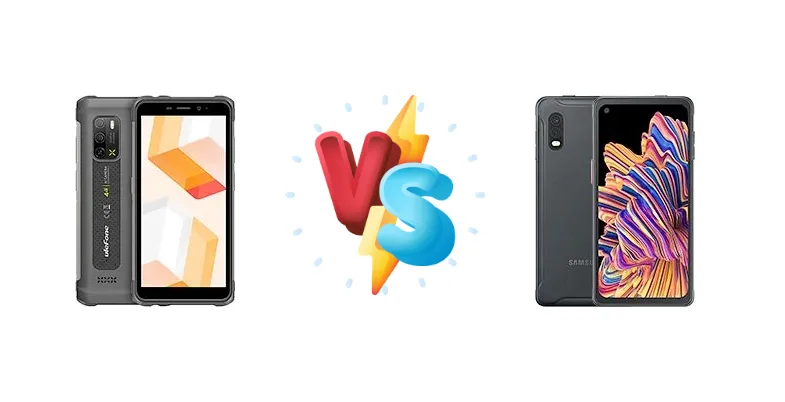
The rugged smartphone market caters to a specific need: durability. But within that niche, price and performance vary wildly. We pit the Ulefone Armor X10, a budget-focused option, against the Samsung Galaxy XCover Pro, a more established and feature-rich device, to determine which offers the best blend of toughness and usability.
🏆 Quick Verdict
For most users needing a reliable, durable phone for demanding work, the Samsung Galaxy XCover Pro is the superior choice. Its Exynos 9611 chipset delivers significantly better performance than the Ulefone's Helio A22, justifying the price difference for those who need multitasking and app responsiveness.
| Network |
|---|
| 2G bands | GSM 850 / 900 / 1800 / 1900 | GSM 850 / 900 / 1800 / 1900 |
| 3G bands | HSDPA 850 / 900 / 1700(AWS) / 1900 / 2100 | HSDPA 850 / 900 / 1900 / 2100 - International |
| 4G bands | 1, 2, 3, 4, 5, 7, 8, 12, 13, 17, 18, 19, 20, 25, 26, 28 | 1, 2, 3, 5, 7, 8, 20, 28, 38, 40, 41 - International |
| Speed | HSPA 21/5.76 Mbps, LTE Cat6 300/150 Mbps | HSPA 42.2/5.76 Mbps, LTE (3CA) Cat11 600/50 Mbps |
| Technology | GSM / HSPA / LTE | GSM / HSPA / LTE |
| | - | 1, 2, 3, 4, 5, 7, 12, 13, 14, 20, 29, 38, 40, 41, 66 - Canada |
| Launch |
|---|
| Announced | 2021, December 24 | 2020, January |
| Status | Available. Released 2021, December 24 | Available. Released 2020, January |
| Body |
|---|
| Dimensions | 158.2 x 76.7 x 14.6 mm (6.23 x 3.02 x 0.57 in) | 159.9 x 76.7 x 10 mm (6.30 x 3.02 x 0.39 in) |
| SIM | Nano-SIM + Nano-SIM | · Nano-SIM· Nano-SIM + Nano-SIM |
| Weight | 256 g (9.03 oz) | 218 g (7.69 oz) |
| | IP68/IP69K dust/water resistant (up to 1.5m for 30 min)
Drop-to-concrete resistance from up to 1.2m
MIL-STD-810G compliant | IP68 dust/water resistant (up to 1.5m for 35 min)
Drop-to-concrete resistance from up to 1.5m
MIL-STD-810G compliant*
*does not guarantee ruggedness or use in extreme conditions |
| Display |
|---|
| Protection | - | Corning Gorilla Glass 5 |
| Resolution | 720 x 1440 pixels, 18:9 ratio (~295 ppi density) | 1080 x 2340 pixels, 19.5:9 ratio (~409 ppi density) |
| Size | 5.45 inches, 76.7 cm2 (~63.2% screen-to-body ratio) | 6.3 inches, 97.4 cm2 (~79.4% screen-to-body ratio) |
| Type | IPS LCD | IPS LCD |
| Platform |
|---|
| CPU | Quad-core 2.0 GHz Cortex-A53 | Octa-core (4x2.3 GHz Cortex-A73 & 4x1.7 GHz Cortex-A53) |
| Chipset | Mediatek MT6761 Helio A22 (12 nm) | Exynos 9611 (10 nm) |
| GPU | PowerVR GE8320 | Mali-G72 MP3 |
| OS | Android 11 | Android 10, upgradable to Android 13, One UI 5 |
| Memory |
|---|
| Card slot | microSDXC (dedicated slot) | microSDXC (dedicated slot) |
| Internal | 32GB 4GB RAM | 64GB 4GB RAM |
| | eMMC 5.1 | - |
| Main Camera |
|---|
| Dual | 13 MP, f/2.2, (wide), AF
Auxiliary lens | 25 MP, f/1.7, 26mm (wide), PDAF
8 MP, f/2.2, 123˚ (ultrawide), 1/4.0", 1.12µm |
| Features | Dual-LED flash | Dual-LED flash, HDR, panorama |
| Single | 5 MP, f/2.2 | - |
| Video | 1080p@30fps | 1080p@30fps |
| Selfie camera |
|---|
| Features | HDR | HDR |
| Single | 5 MP, f/2.2 | 13 MP, f/2.0, (wide), 1/3.1", 1.12µm |
| Video | 1080p@30fps | 1080p@30fps |
| Sound |
|---|
| 3.5mm jack | Yes | Yes |
| 35mm jack | Yes | Yes |
| Loudspeaker | Yes | Yes |
| Comms |
|---|
| Bluetooth | 5.0, A2DP, LE | 5.0, A2DP, LE |
| NFC | Yes | Yes |
| Positioning | GPS, GLONASS, GALILEO, BDS | GPS, GLONASS, GALILEO, BDS |
| Radio | FM radio, RDS, recording | FM radio (market/region dependent) |
| USB | USB Type-C 2.0, OTG | USB Type-C 2.0 |
| WLAN | Wi-Fi 802.11 a/b/g/n/ac, Wi-Fi Direct | Wi-Fi 802.11 a/b/g/n/ac/k/v/r, dual-band, Wi-Fi Direct |
| Features |
|---|
| Sensors | Accelerometer, proximity, compass | Fingerprint (side-mounted), accelerometer, gyro, proximity, compass |
| | - | ANT+ |
| Battery |
|---|
| Charging | 10W wired | 15W wired |
| Type | Li-Po 5180 mAh | Li-Po 4050 mAh, removable |
| Misc |
|---|
| Colors | Black/Gray | Black |
| Models | - | SM-G715FN/DS, SM-G715FN, SM-G715F, SM-G715W, SM-G715U, SM-G715U1 |
| Price | About 130 EUR | About 120 EUR |
| SAR EU | - | 0.47 W/kg (head) 1.23 W/kg (body) |
Ulefone Armor X10
- Significantly lower price point
- Rugged design for durability
- Basic functionality for essential tasks
- Weak processor performance
- Slow charging speed
- Likely limited software support
Samsung Galaxy XCover Pro
- Powerful Exynos 9611 processor
- Faster 15W charging
- Samsung’s software and support ecosystem
- Higher price compared to Ulefone
- Still a mid-range processor, not flagship-level
- Rugged design may add bulk
Display Comparison
Neither device boasts a cutting-edge display. Details on panel type and resolution are missing for the Ulefone, suggesting a basic LCD. The Samsung XCover Pro, while also likely LCD, benefits from Samsung’s display expertise, potentially offering better color accuracy and viewing angles. The real difference lies in processing power impacting UI smoothness, not display quality itself. Both are likely to prioritize durability over visual fidelity.
Camera Comparison
Camera details are sparse for both devices, but the XCover Pro likely holds an advantage due to Samsung’s image processing capabilities. While both may feature multiple lenses, the Ulefone’s likely relies on software enhancements to compensate for a less capable sensor. The XCover Pro’s Exynos 9611 ISP (Image Signal Processor) will deliver superior image quality, especially in low-light conditions. Expect the XCover Pro to handle video recording with more stability and detail.
Performance
The performance gap is substantial. The Ulefone Armor X10’s MediaTek Helio A22, a quad-core processor built on a 12nm process, is geared towards basic tasks. The Samsung Galaxy XCover Pro’s Exynos 9611, an octa-core chip fabricated on a more efficient 10nm node, offers a significant leap in processing power. The Exynos’s Cortex-A73 cores provide a much faster experience for multitasking, running demanding apps, and handling complex operations. This translates to a smoother user experience and better long-term usability for the XCover Pro.
Battery Life
Battery capacity isn’t specified for the Ulefone, but rugged phones generally prioritize long battery life. The Samsung Galaxy XCover Pro supports 15W wired charging, a noticeable improvement over the Ulefone’s 10W charging. While a larger battery capacity doesn’t guarantee longer runtime (efficiency matters), the faster charging on the XCover Pro minimizes downtime, crucial for users relying on their phone throughout the day. The Exynos 9611’s 10nm process also contributes to better power efficiency.
Buying Guide
Buy the Ulefone Armor X10 if you need an extremely affordable, basic rugged phone for occasional use or as a backup device where performance isn't critical. It's ideal for situations where the phone might be dropped or exposed to harsh conditions, but you don't require demanding applications. Buy the Samsung Galaxy XCover Pro if you prioritize performance, a more refined user experience, and features like faster charging and a more capable processor for running work-related apps, navigation, and communication tools reliably.
Frequently Asked Questions
❓ Is the Exynos 9611 in the Galaxy XCover Pro prone to overheating during prolonged use?
While not a flagship chip, the Exynos 9611 is generally well-managed in the XCover Pro. The 10nm process and Samsung’s thermal design prevent significant overheating during typical use, including navigation, communication, and moderate app usage. However, extended gaming sessions or demanding tasks may lead to some warmth.
❓ How effective is the ruggedization on the Ulefone Armor X10 compared to the Samsung Galaxy XCover Pro?
Both phones are built to withstand drops and harsh environments. However, the XCover Pro benefits from Samsung’s quality control and certification standards (MIL-STD-810H). While the Ulefone likely meets basic ruggedness requirements, the XCover Pro offers a more robust and reliable level of protection, particularly against water and dust ingress.
❓ Can the Ulefone Armor X10 handle basic work apps like email, messaging, and a simple task manager?
Yes, the Ulefone Armor X10 can handle basic work apps, but expect slower loading times and potential lag when multitasking. The Helio A22 processor is sufficient for these core functions, but it will struggle with more demanding applications or running multiple apps simultaneously.
❓ Does the Samsung Galaxy XCover Pro support NFC for mobile payments?
Yes, the Samsung Galaxy XCover Pro does support NFC, allowing for contactless payments and other NFC-enabled features. This is a valuable addition for users who rely on mobile payment solutions in the field.