
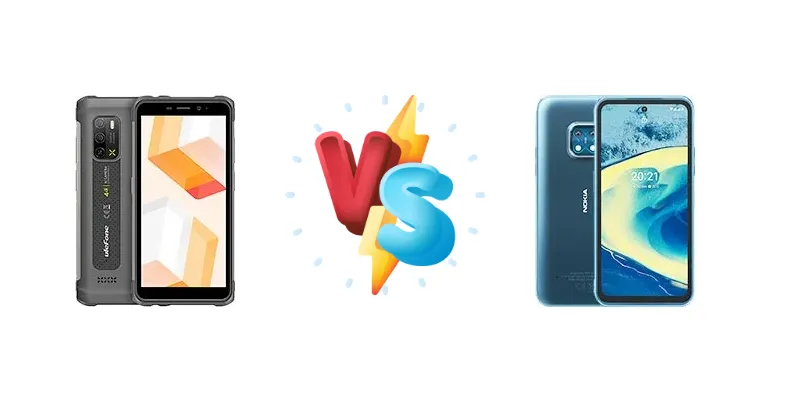
Ulefone Armor X10 vs. Nokia XR20: A Deep Dive into Rugged Smartphone Performance
| Phones Images | |||||
|---|---|---|---|---|---|
|
🏆 Quick Verdict
For the average user prioritizing future-proofing and smoother performance, the Nokia XR20 is the clear winner. Its Snapdragon 480 5G chipset offers a significant leap in processing power and connectivity compared to the Ulefone Armor X10’s Helio A22. While the X10 is cheaper, the XR20’s added features and performance justify the price difference.
| PHONES | ||
|---|---|---|
| Phone Names | Ulefone Armor X10 | Nokia XR20 |
| Network | ||
|---|---|---|
| 2G bands | GSM 850 / 900 / 1800 / 1900 | GSM 850 / 900 / 1800 / 1900 |
| 3G bands | HSDPA 850 / 900 / 1700(AWS) / 1900 / 2100 | HSDPA 850 / 900 / 1700(AWS) / 1900 / 2100 |
| 4G bands | 1, 2, 3, 4, 5, 7, 8, 12, 13, 17, 18, 19, 20, 25, 26, 28 | 1, 2, 3, 4, 5, 7, 8, 12, 13, 14, 20, 25, 26, 28, 30, 38, 40, 41, 48, 66, 71 |
| 5G bands | - | 2, 5, 25, 38, 41, 48, 66, 77, 78 SA/NSA |
| Speed | HSPA 21/5.76 Mbps, LTE Cat6 300/150 Mbps | HSPA, LTE, 5G |
| Technology | GSM / HSPA / LTE | GSM / CDMA / HSPA / EVDO / LTE / 5G |
| - | CDMA2000 1xEV-DO | |
| Launch | ||
|---|---|---|
| Announced | 2021, December 24 | 2021, July 27 |
| Status | Available. Released 2021, December 24 | Available. Released 2021, August 04 |
| Body | ||
|---|---|---|
| Dimensions | 158.2 x 76.7 x 14.6 mm (6.23 x 3.02 x 0.57 in) | 171.6 x 81.5 x 10.6 mm (6.76 x 3.21 x 0.42 in) |
| SIM | Nano-SIM + Nano-SIM | · Nano-SIM· Nano-SIM + Nano-SIM |
| Weight | 256 g (9.03 oz) | 248 g (8.75 oz) |
| IP68/IP69K dust/water resistant (up to 1.5m for 30 min) Drop-to-concrete resistance from up to 1.2m MIL-STD-810G compliant | IP68 dust/water resistant (up to 1.5m for 60 min) Drop-to-concrete resistance from up to 1.8m MIL-STD-810H compliant | |
| Display | ||
|---|---|---|
| Protection | - | Corning Gorilla Glass Victus |
| Resolution | 720 x 1440 pixels, 18:9 ratio (~295 ppi density) | 1080 x 2400 pixels, 20:9 ratio (~395 ppi density) |
| Size | 5.45 inches, 76.7 cm2 (~63.2% screen-to-body ratio) | 6.67 inches, 107.4 cm2 (~76.8% screen-to-body ratio) |
| Type | IPS LCD | IPS LCD, 550 nits |
| Platform | ||
|---|---|---|
| CPU | Quad-core 2.0 GHz Cortex-A53 | Octa-core (2x2.0 GHz Kryo 460 & 6x1.8 GHz Kryo 460) |
| Chipset | Mediatek MT6761 Helio A22 (12 nm) | Qualcomm SM4350 Snapdragon 480 5G (8 nm) |
| GPU | PowerVR GE8320 | Adreno 619 |
| OS | Android 11 | Android 11, upgradable to Android 13 |
| Memory | ||
|---|---|---|
| Card slot | microSDXC (dedicated slot) | microSDXC (uses shared SIM slot) |
| Internal | 32GB 4GB RAM | 64GB 4GB RAM, 128GB 6GB RAM |
| eMMC 5.1 | - | |
| Main Camera | ||
|---|---|---|
| Dual | 13 MP, f/2.2, (wide), AF Auxiliary lens | 48 MP, f/1.8, (wide), 1/2.25", 0.8µm, PDAF 13 MP, f/2.4, 123˚ (ultrawide), 1/3.0", 1.12µm |
| Features | Dual-LED flash | Zeiss optics, Dual-LED dual-tone flash, second LED flash, HDR, panorama |
| Single | 5 MP, f/2.2 | 8 MP, f/2.0 (wide), 1/4.0", 1.12µm |
| Video | 1080p@30fps | 1080p@30fps |
| Selfie camera | ||
|---|---|---|
| Features | HDR | - |
| Single | 5 MP, f/2.2 | 8 MP, f/2.0 (wide), 1/4.0", 1.12µm |
| Video | 1080p@30fps | 1080p@30fps |
| Sound | ||
|---|---|---|
| 3.5mm jack | Yes | Yes |
| 35mm jack | Yes | Yes |
| Loudspeaker | Yes | Yes, with stereo speakers |
| Comms | ||
|---|---|---|
| Bluetooth | 5.0, A2DP, LE | 5.1, A2DP, LE, aptX Adaptive |
| NFC | Yes | Yes |
| Positioning | GPS, GLONASS, GALILEO, BDS | GPS (L1+L5), GLONASS, BDS, GALILEO, QZSS, NavIC |
| Radio | FM radio, RDS, recording | Unspecified |
| USB | USB Type-C 2.0, OTG | USB Type-C 3.0 |
| WLAN | Wi-Fi 802.11 a/b/g/n/ac, Wi-Fi Direct | Wi-Fi 802.11 a/b/g/n/ac/6, dual-band, Wi-Fi Direct |
| Features | ||
|---|---|---|
| Sensors | Accelerometer, proximity, compass | Fingerprint (side-mounted), accelerometer, gyro, proximity, compass, barometer |
| Battery | ||
|---|---|---|
| Charging | 10W wired | 18W wired 15W wireless |
| Type | Li-Po 5180 mAh | Li-Po 4630 mAh |
| Misc | ||
|---|---|---|
| Colors | Black/Gray | Ultra Blue, Granite Gray |
| Models | - | TA-1368, TA-1362 |
| Price | About 130 EUR | About 270 EUR |
| SAR EU | - | 1.13 W/kg (head) 1.43 W/kg (body) |
Ulefone Armor X10
- Significantly lower price point
- Rugged design for durability
- Basic functionality for essential tasks
- Outdated and slow processor
- Limited features and connectivity
- Slow charging speed
Nokia XR20
- 5G connectivity for faster data speeds
- More powerful and efficient processor
- Wireless charging for added convenience
- Higher price compared to the Ulefone X10
- May not be as compact as the X10
- Rugged design adds bulk
Display Comparison
Neither device boasts a cutting-edge display. Details on panel type and resolution are missing for both, but the focus here is on durability. The XR20’s Gorilla Glass Victus provides superior scratch and drop resistance compared to the unspecified glass on the X10. While both are likely to have adequate outdoor visibility, the XR20’s more powerful processor could potentially drive a higher brightness panel, though this is unconfirmed. The X10’s lower price point likely means a less refined display experience overall.
Camera Comparison
Camera details beyond sensor existence are limited. However, the XR20’s more powerful processor allows for more sophisticated image processing, potentially resulting in better image quality, especially in low-light conditions. While both phones likely feature basic camera setups, the XR20’s chipset can handle more complex algorithms for noise reduction and dynamic range optimization. The X10’s camera is likely adequate for basic snapshots, but will struggle with more challenging scenarios.
Performance
The performance gap is substantial. The Ulefone Armor X10’s MediaTek Helio A22, a quad-core processor built on a 12nm process, is geared towards basic functionality. The Nokia XR20, however, utilizes the Qualcomm Snapdragon 480 5G, an octa-core chip fabricated on a more efficient 8nm node. This translates to significantly faster app loading times, smoother multitasking, and the ability to handle more demanding applications on the XR20. The XR20’s CPU architecture (Kryo 460) is also more modern and efficient than the Cortex-A53 cores in the X10. The 5G modem in the XR20 is a key differentiator, offering access to faster mobile data speeds where available.
Battery Life
Battery capacity is not specified for either device, but the XR20’s 18W wired and 15W wireless charging capabilities provide a significant advantage over the X10’s 10W wired charging. Faster charging means less downtime and greater convenience. While the X10 might have a slightly larger battery, the XR20’s more efficient processor and charging options will likely result in a comparable or even better real-world battery life experience.
Buying Guide
Buy the Ulefone Armor X10 if you need an extremely budget-friendly, basic rugged phone for essential tasks like calls, texts, and light app usage in harsh environments. It’s ideal for construction workers or outdoor enthusiasts who prioritize minimal cost over performance. Buy the Nokia XR20 if you prefer a more capable device with 5G connectivity, faster processing speeds for multitasking and media consumption, and the convenience of wireless charging – all within a ruggedized package. This is the better choice for users who want a phone that can keep up with their active lifestyle without compromising on functionality.