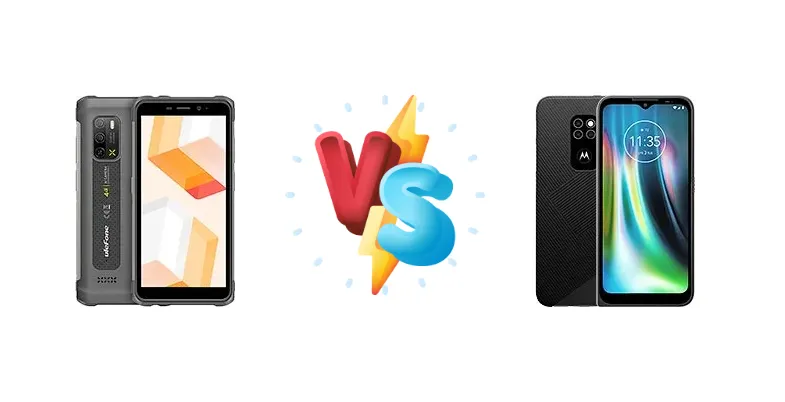
Need a phone that can withstand drops, dust, and water? The Ulefone Armor X10 and Motorola Defy (2021) are both built tough, but which one offers the best overall package? We're diving deep into a head-to-head comparison to help you decide.
🏆 Quick Verdict
The Motorola Defy (2021) takes the crown. While the Armor X10 is a budget-friendly option, the Defy's superior chipset, brighter display, faster charging, and overall build quality make it the more compelling choice for those needing a truly rugged and reliable device.
| Network |
|---|
| 2G bands | GSM 850 / 900 / 1800 / 1900 | GSM 850 / 900 / 1800 / 1900 |
| 3G bands | HSDPA 850 / 900 / 1700(AWS) / 1900 / 2100 | HSDPA 850 / 900 / 1700(AWS) / 1900 / 2100 - LATAM |
| 4G bands | 1, 2, 3, 4, 5, 7, 8, 12, 13, 17, 18, 19, 20, 25, 26, 28 | 1, 2, 3, 5, 7, 8, 18, 19, 20, 26, 28, 38, 40, 41 - EMEA |
| Speed | HSPA 21/5.76 Mbps, LTE Cat6 300/150 Mbps | HSPA 42.2/5.76 Mbps, LTE Cat4 150/50 Mbps |
| Technology | GSM / HSPA / LTE | GSM / HSPA / LTE |
| | - | 1, 2, 3, 4, 5, 7, 8, 19, 28, 66 - LATAM |
| Launch |
|---|
| Announced | 2021, December 24 | 2021, June 17 |
| Status | Available. Released 2021, December 24 | Available. Released 2021, July 25 |
| Body |
|---|
| Build | - | Glass front (Gorilla Glass Victus), plastic frame, plastic back |
| Dimensions | 158.2 x 76.7 x 14.6 mm (6.23 x 3.02 x 0.57 in) | 169.8 x 78.2 x 10.9 mm (6.69 x 3.08 x 0.43 in) |
| SIM | Nano-SIM + Nano-SIM | · Nano-SIM· Nano-SIM + Nano-SIM |
| Weight | 256 g (9.03 oz) | 232 g (8.18 oz) |
| | IP68/IP69K dust/water resistant (up to 1.5m for 30 min)
Drop-to-concrete resistance from up to 1.2m
MIL-STD-810G compliant | IP68 dust/water resistant (up to 1.5m for 35 min)
Drop-to-concrete resistance from up to 1.8m
MIL-SPEC 810H compliant |
| Display |
|---|
| Protection | - | Corning Gorilla Glass Victus |
| Resolution | 720 x 1440 pixels, 18:9 ratio (~295 ppi density) | 720 x 1600 pixels, 20:9 ratio (~270 ppi density) |
| Size | 5.45 inches, 76.7 cm2 (~63.2% screen-to-body ratio) | 6.5 inches, 102.0 cm2 (~76.8% screen-to-body ratio) |
| Type | IPS LCD | IPS LCD |
| Platform |
|---|
| CPU | Quad-core 2.0 GHz Cortex-A53 | Octa-core (4x2.0 GHz Kryo 260 Gold & 4x1.8 GHz Kryo 260 Silver) |
| Chipset | Mediatek MT6761 Helio A22 (12 nm) | Qualcomm SM6115 Snapdragon 662 (11 nm) |
| GPU | PowerVR GE8320 | Adreno 610 |
| OS | Android 11 | Android 10 |
| Memory |
|---|
| Card slot | microSDXC (dedicated slot) | microSDXC (uses shared SIM slot) |
| Internal | 32GB 4GB RAM | 64GB 4GB RAM |
| | eMMC 5.1 | - |
| Main Camera |
|---|
| Dual | 13 MP, f/2.2, (wide), AF
Auxiliary lens | - |
| Features | Dual-LED flash | LED flash, HDR, panorama |
| Single | 5 MP, f/2.2 | - |
| Triple | - | 48 MP, f/1.8, (wide), PDAF
2 MP (macro)
Auxiliary lens |
| Video | 1080p@30fps | 1080p@30fps |
| Selfie camera |
|---|
| Features | HDR | - |
| Single | 5 MP, f/2.2 | 8 MP, f/2.2, 1.12µm |
| Video | 1080p@30fps | 1080p@30fps |
| Sound |
|---|
| 3.5mm jack | Yes | Yes |
| 35mm jack | Yes | Yes |
| Loudspeaker | Yes | Yes |
| Comms |
|---|
| Bluetooth | 5.0, A2DP, LE | 5.0, A2DP, LE |
| NFC | Yes | Yes |
| Positioning | GPS, GLONASS, GALILEO, BDS | GPS |
| Radio | FM radio, RDS, recording | FM radio |
| USB | USB Type-C 2.0, OTG | USB Type-C 2.0 |
| WLAN | Wi-Fi 802.11 a/b/g/n/ac, Wi-Fi Direct | Wi-Fi 802.11 a/b/g/n/ac, dual-band, Wi-Fi Direct |
| Features |
|---|
| Sensors | Accelerometer, proximity, compass | Fingerprint (rear-mounted), accelerometer, gyro, proximity, compass |
| Battery |
|---|
| Charging | 10W wired | 20W wired |
| Type | Li-Po 5180 mAh | Li-Po 5000 mAh |
| Misc |
|---|
| Colors | Black/Gray | Black, Green |
| Models | - | XT2083-9 |
| Price | About 130 EUR | About 280 EUR |
| Tests |
|---|
| Battery life | - |
Endurance rating 129h
|
| Camera | - |
Photo / Video |
| Display | - |
Contrast ratio: 1896:1 (nominal) |
| Loudspeaker | - |
-29.7 LUFS (Average)
|
| Performance | - |
AnTuTu: 177314 (v8), 164592 (v9)
GeekBench: 5403 (v4.4), 1511 (v5.1)
GFXBench: 13fps (ES 3.1 onscreen) |
Ulefone Armor X10
- Affordable
- Rugged design
- Decent battery life (claimed)
- Slow performance
- Low brightness display (likely)
- Slow charging
- Basic camera
Motorola Defy (2021)
- Durable and waterproof
- Faster performance
- Brighter display
- Faster charging
- Good battery life (claimed)
- Higher price
- Design can be bulky
Display Comparison
The Motorola Defy (2021) boasts a significantly brighter display at 436 nits compared to the Armor X10's likely lower brightness (spec not provided, but typical for budget rugged phones). Both offer a high contrast ratio (1896:1), but the Defy's brightness advantage makes it easier to see in direct sunlight. The Defy also likely has better color accuracy.
Camera Comparison
While both phones offer 'Photo / Video' capabilities, the Motorola Defy (2021) is expected to have a superior camera system due to its more powerful chipset and likely better image processing. The Armor X10's camera is likely adequate for basic snapshots, but don't expect high-quality images.
Performance
The Motorola Defy (2021)'s Snapdragon 662 chipset is a clear winner over the Armor X10's Helio A22. The Defy's octa-core processor and 11nm manufacturing process provide noticeably faster performance for everyday tasks, gaming, and multitasking. The Armor X10's quad-core processor will feel sluggish by comparison.
Battery Life
Both phones claim impressive endurance ratings (129h), suggesting excellent battery life. However, the Motorola Defy (2021)'s 20W charging is significantly faster than the Armor X10's 10W charging, allowing for quicker top-ups.
Buying Guide
The Ulefone Armor X10 is ideal for users on a tight budget who prioritize affordability and basic functionality in a rugged package. The Motorola Defy (2021) is perfect for outdoor enthusiasts, construction workers, or anyone needing a durable phone with better performance, a brighter screen, and faster charging.
Frequently Asked Questions
❓ Is the Ulefone Armor X10 waterproof?
Yes, the Ulefone Armor X10 is IP68 and IP69K certified, meaning it's waterproof and dustproof.
❓ How durable is the Motorola Defy (2021)?
The Motorola Defy (2021) is built to MIL-STD-810H standards, making it resistant to drops, dust, water, and extreme temperatures.
❓ Which phone has better software support?
Motorola generally provides better and more timely software updates than Ulefone, so the Defy (2021) is likely to receive longer software support.