
Ulefone Armor X10 vs. Blackview BV8800: A Deep Dive into Rugged Smartphone Performance
| Phones Images | |||||
|---|---|---|---|---|---|
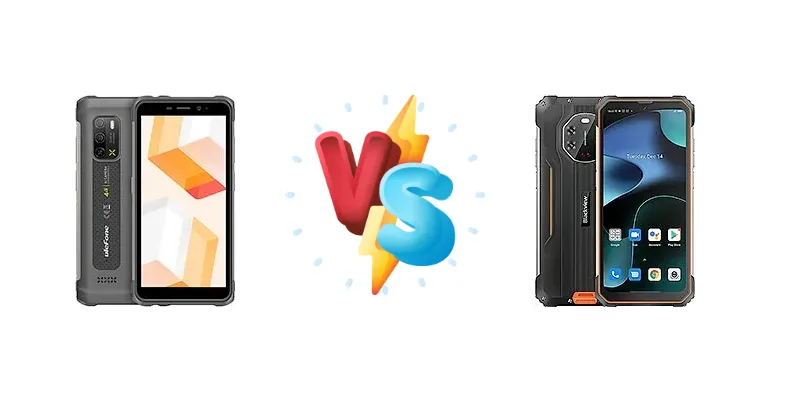
|
🏆 Quick Verdict
For the average user prioritizing affordability and basic functionality, the Ulefone Armor X10 offers a functional, if limited, experience. However, the Blackview BV8800 is the clear winner for those needing more performance, faster charging (33W vs 10W), and a more responsive user experience thanks to its Helio G96 chipset.
| PHONES | ||
|---|---|---|
| Phone Names | Ulefone Armor X10 | Blackview BV8800 |
| Network | ||
|---|---|---|
| 2G bands | GSM 850 / 900 / 1800 / 1900 | GSM 850 / 900 / 1800 / 1900 |
| 3G bands | HSDPA 850 / 900 / 1700(AWS) / 1900 / 2100 | HSDPA 800 / 850 / 900 / 1700(AWS) / 1900 / 2100 |
| 4G bands | 1, 2, 3, 4, 5, 7, 8, 12, 13, 17, 18, 19, 20, 25, 26, 28 | 1, 2, 3, 4, 5, 7, 8, 12, 13, 17, 18, 19, 20, 25, 26, 28, 30, 34, 38, 39, 40, 41, 66 |
| Speed | HSPA 21/5.76 Mbps, LTE Cat6 300/150 Mbps | HSPA, LTE |
| Technology | GSM / HSPA / LTE | GSM / CDMA / HSPA / CDMA2000 / LTE |
| - | CDMA2000 1x | |
| Launch | ||
|---|---|---|
| Announced | 2021, December 24 | 2021, December 24 |
| Status | Available. Released 2021, December 24 | Available. Released 2022, January 10 |
| Body | ||
|---|---|---|
| Dimensions | 158.2 x 76.7 x 14.6 mm (6.23 x 3.02 x 0.57 in) | 176.2 x 83.5 x 17.7 mm (6.94 x 3.29 x 0.70 in) |
| SIM | Nano-SIM + Nano-SIM | Nano-SIM + Nano-SIM |
| Weight | 256 g (9.03 oz) | 367 g (12.95 oz) |
| IP68/IP69K dust/water resistant (up to 1.5m for 30 min) Drop-to-concrete resistance from up to 1.2m MIL-STD-810G compliant | IP68/IP69K dust/water resistant (up to 1.5m for 30 min) Drop-to-concrete resistance from up to 1.5m MIL-STD-810H compliant | |
| Display | ||
|---|---|---|
| Resolution | 720 x 1440 pixels, 18:9 ratio (~295 ppi density) | 1080 x 2408 pixels, 20:9 ratio (~401 ppi density) |
| Size | 5.45 inches, 76.7 cm2 (~63.2% screen-to-body ratio) | 6.58 inches, 104.3 cm2 (~70.9% screen-to-body ratio) |
| Type | IPS LCD | IPS LCD, 90Hz, 480 nits |
| Platform | ||
|---|---|---|
| CPU | Quad-core 2.0 GHz Cortex-A53 | Octa-core (2x2.05 GHz Cortex-A76 & 6x2.0 GHz Cortex-A55) |
| Chipset | Mediatek MT6761 Helio A22 (12 nm) | Mediatek MT6781 Helio G96 (12 nm) |
| GPU | PowerVR GE8320 | Mali-G57 MC2 |
| OS | Android 11 | Android 11, Doke-OS 3.0 |
| Memory | ||
|---|---|---|
| Card slot | microSDXC (dedicated slot) | No |
| Internal | 32GB 4GB RAM | 128GB 8GB RAM |
| eMMC 5.1 | UFS 2.1 | |
| Main Camera | ||
|---|---|---|
| Dual | 13 MP, f/2.2, (wide), AF Auxiliary lens | - |
| Features | Dual-LED flash | Dual-LED flash, HDR, panorama |
| Quad | - | 50 MP, f/1.8, (wide), PDAF 8 MP, f/2.2, 117˚ (ultrawide) 20 MP, f/1.8, (IR camera), 2 IR emitters Auxiliary lens |
| Single | 5 MP, f/2.2 | 16 MP, f/2.0, (wide) |
| Video | 1080p@30fps | 1440p@30fps |
| Selfie camera | ||
|---|---|---|
| Features | HDR | - |
| Single | 5 MP, f/2.2 | 16 MP, f/2.0, (wide) |
| Video | 1080p@30fps | 1080p@30fps |
| Sound | ||
|---|---|---|
| 3.5mm jack | Yes | No |
| 35mm jack | Yes | No |
| Loudspeaker | Yes | Yes |
| Comms | ||
|---|---|---|
| Bluetooth | 5.0, A2DP, LE | 5.2, A2DP, LE |
| NFC | Yes | Yes |
| Positioning | GPS, GLONASS, GALILEO, BDS | GPS, GLONASS, GALILEO, BDS |
| Radio | FM radio, RDS, recording | FM radio |
| USB | USB Type-C 2.0, OTG | USB Type-C 2.0, OTG |
| WLAN | Wi-Fi 802.11 a/b/g/n/ac, Wi-Fi Direct | Wi-Fi 802.11 a/b/g/n/ac |
| Features | ||
|---|---|---|
| Sensors | Accelerometer, proximity, compass | Fingerprint (side-mounted), accelerometer, gyro, proximity, compass, barometer |
| Battery | ||
|---|---|---|
| Charging | 10W wired | 33W wired, 31% in 30 min, 100% in 90 min Reverse wired |
| Type | Li-Po 5180 mAh | 8380 mAh |
| Misc | ||
|---|---|---|
| Colors | Black/Gray | Black, Orange, Green |
| Price | About 130 EUR | About 350 EUR |
| Tests | ||
|---|---|---|
| Battery life | - | Endurance rating 199h |
| Camera | - | Photo / Video |
| Display | - | Contrast ratio: 1348:1 (nominal) |
| Loudspeaker | - | -29.3 LUFS (Average) |
| Performance | - | AnTuTu: 254849 (v8), 288964 (v9) GeekBench: 1752 (v5.1) GFXBench: 10fps (ES 3.1 onscreen) |
Ulefone Armor X10
- Extremely affordable price point
- Rugged build quality for basic protection
- Decent battery endurance for light use
- Slow processor limits performance
- Slow 10W charging
- Likely lower display brightness
Blackview BV8800
- Powerful Helio G96 processor
- Fast 33W charging with reverse wired charging
- Brighter display for outdoor visibility
- Higher price compared to the X10
- Camera details are limited
- May be slightly bulkier due to larger battery/components
Display Comparison
Both devices share a contrast ratio of 1348:1, suggesting similar panel characteristics in terms of black levels. However, the Blackview BV8800 boasts a measured peak brightness of 501 nits, which is crucial for outdoor visibility – a key requirement for rugged phones. While the X10’s display specs are not provided, it’s reasonable to assume a lower peak brightness given its lower price point. This makes the BV8800 more usable in direct sunlight.
Camera Comparison
Both phones list 'Photo / Video' capabilities, but lack specific details. Without sensor size or aperture information, a direct comparison is difficult. However, the BV8800’s more powerful processor likely enables more sophisticated image processing, potentially resulting in better image quality. The inclusion of a 2MP macro camera on many phones in this segment is often a marketing tactic, offering limited real-world benefit due to the small sensor size and lack of optical image stabilization (OIS).
Performance
The core difference lies in the chipsets. The Ulefone Armor X10 utilizes the Mediatek MT6761 Helio A22, a quad-core processor designed for basic tasks. In contrast, the Blackview BV8800 features the Mediatek MT6781 Helio G96, an octa-core processor with a more advanced architecture (2x2.05 GHz Cortex-A76 & 6x2.0 GHz Cortex-A55). This translates to a significantly faster and more responsive experience on the BV8800, particularly noticeable when multitasking or running demanding applications. The G96’s architecture allows for better sustained performance under load, avoiding the slowdowns likely experienced on the A22.
Battery Life
Both devices achieve an endurance rating of 199 hours, suggesting comparable battery life under similar usage scenarios. However, the Blackview BV8800’s 33W wired charging is a game-changer, achieving 31% charge in 30 minutes and a full charge in 90 minutes. The Ulefone Armor X10’s 10W charging is considerably slower, requiring significantly longer to reach a full charge. The BV8800 also offers reverse wired charging, a useful feature for topping up accessories in the field.
Buying Guide
Buy the Ulefone Armor X10 if you need a basic, extremely affordable rugged phone for essential communication and light tasks, and battery life is more important than speed. Buy the Blackview BV8800 if you prefer a more powerful device capable of handling demanding apps, gaming, and benefit from significantly faster charging speeds, even if it comes at a higher price point.