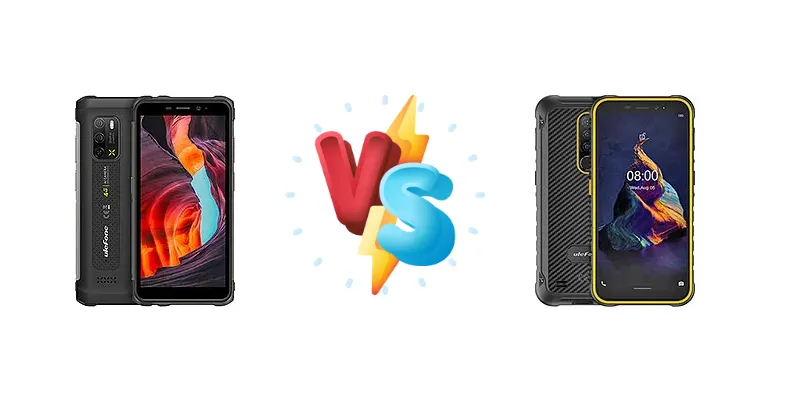
Looking for a tough phone that can withstand drops, dust, and water? Ulefone's Armor series is known for its durability. But which model is right for you – the newer Armor X10 Pro or the established Armor X8? This detailed comparison will help you decide.
🏆 Quick Verdict
The Ulefone Armor X10 Pro edges out the X8 thanks to its slightly more powerful Helio P22 chipset, offering a noticeable performance boost. Both are rugged champions, but the X10 Pro provides a smoother experience for everyday tasks and light gaming.
| Network |
|---|
| 2G bands | GSM 850 / 900 / 1800 / 1900 | GSM 850 / 900 / 1800 / 1900 |
| 3G bands | HSDPA 850 / 900 / 1700(AWS) / 1900 / 2100 | HSDPA 850 / 900 / 1700(AWS) / 1900 / 2100 |
| 4G bands | 1, 2, 3, 4, 5, 7, 8, 12, 13, 17, 18, 19, 20, 25, 26, 28 | 1, 2, 3, 4, 5, 7, 8, 12, 17, 19, 20, 28 |
| Speed | HSPA 21/5.76 Mbps, LTE Cat6 300/150 Mbps | HSPA 42.2/11.5 Mbps, LTE Cat6 300/150 Mbps |
| Technology | GSM / HSPA / LTE | GSM / HSPA / LTE |
| Launch |
|---|
| Announced | 2022, March 10 | 2020, October 06. Released 2020, October 06 |
| Status | Available. Released 2022, March 10 | Discontinued |
| Body |
|---|
| Dimensions | 158.2 x 76.7 x 14.6 mm (6.23 x 3.02 x 0.57 in) | 160.3 x 79 x 13.8 mm (6.31 x 3.11 x 0.54 in) |
| SIM | Nano-SIM + Nano-SIM | Nano-SIM + Nano-SIM |
| Weight | 256 g (9.03 oz) | 256.3 g (9.03 oz) |
| | IP68/IP69K dust/water resistant (up to 1.5m for 30 min)
Drop-to-concrete resistance from up to 1.2m
MIL-STD-810G compliant | IP68/IP69K dust/water resistant (up to 1.5m for 30 mins)
Drop-to-concrete resistance from up to 1.2 m
MIL-STD-810G compliant |
| Display |
|---|
| Resolution | 720 x 1440 pixels, 18:9 ratio (~295 ppi density) | 720 x 1440 pixels, 18:9 ratio (~282 ppi density) |
| Size | 5.45 inches, 76.7 cm2 (~63.2% screen-to-body ratio) | 5.7 inches, 83.8 cm2 (~66.2% screen-to-body ratio) |
| Type | IPS LCD | IPS LCD |
| Platform |
|---|
| CPU | Octa-core 2.0 GHz Cortex-A53 | Octa-core (4x1.8 GHz Cortex-A53 & 4x1.5 GHz Cortex-A53) |
| Chipset | Mediatek MT6762 Helio P22 (12 nm) | Mediatek MT6762D Helio A25 (12 nm) |
| GPU | PowerVR GE8320 | PowerVR GE8320 |
| OS | Android 11 | Android 10 |
| Memory |
|---|
| Card slot | microSDXC (dedicated slot) | microSDXC (uses shared SIM slot) |
| Internal | 64GB 4GB RAM | 64GB 4GB RAM |
| | eMMC 5.1 | eMMC 5.1 |
| Main Camera |
|---|
| Dual | 20 MP, f/1.8, 26mm (wide), 1/2.78", 1.0µm, PDAF
Auxiliary lens | - |
| Features | Dual-LED flash | Dual-LED flash, HDR, panorama |
| Single | 5 MP, f/2.2 | - |
| Triple | - | 13 MP, f/2.2, (wide), AF
Auxiliary lenses |
| Video | 1080p@30fps | 1080p@30fps |
| Selfie camera |
|---|
| Features | HDR | - |
| Single | 5 MP, f/2.2 | 8 MP, f/2.4 |
| Video | 1080p@30fps | 1080p@30fps |
| Sound |
|---|
| 3.5mm jack | Yes | Yes |
| 35mm jack | Yes | Yes |
| Loudspeaker | Yes | Yes |
| Comms |
|---|
| Bluetooth | 5.0, A2DP, LE | 5.0, A2DP, LE |
| NFC | Yes | Yes |
| Positioning | GPS, GLONASS, GALILEO, BDS | GPS, GLONASS, GALILEO, BDS |
| Radio | FM radio, RDS, recording | - |
| USB | USB Type-C 2.0, OTG | USB Type-C 2.0 |
| WLAN | Wi-Fi 802.11 a/b/g/n/ac, dual-band, Wi-Fi Direct | Wi-Fi 802.11 a/b/g/n/ac, Wi-Fi Direct |
| Features |
|---|
| Sensors | Accelerometer, proximity, compass | Fingerprint (rear-mounted), accelerometer, proximity, compass |
| Battery |
|---|
| Charging | 10W wired | - |
| Type | Li-Po 5180 mAh | Li-Po 5080 mAh |
| Misc |
|---|
| Colors | Black/Gray | Black, Orange |
| Price | About 170 EUR | About 130 EUR |
Ulefone Armor X10 Pro
- More powerful chipset (Helio P22)
- Potentially brighter display
- Slightly improved camera (likely)
- Rugged design and durability
- 10W charging is slow
- Camera quality still limited
- Price is higher than X8
Ulefone Armor X8
- More affordable
- Rugged design and durability
- Large battery capacity
- Decent for basic tasks
- Less powerful chipset (Helio A25)
- Camera quality is basic
- Slower performance
- 10W charging is slow
Display Comparison
Both phones feature similar display technology (likely IPS LCD) and resolution (likely 720 x 1520 pixels). The X10 Pro *may* have a slightly brighter display, but this is not definitively confirmed. Screen size is likely around 6.21 inches for both.
Camera Comparison
Camera specs are often a weak point in budget rugged phones. The X10 Pro likely has a slightly improved main camera sensor (potentially 13MP vs. 8MP on the X8), but image quality will still be modest. Both likely feature a secondary depth sensor. Low-light performance will be similar on both.
Performance
The Armor X10 Pro's Helio P22 chipset is a clear winner here. While both use Cortex-A53 cores, the P22 generally offers better single-core and multi-core performance compared to the A25. Expect smoother app loading, multitasking, and potentially better gaming performance on the X10 Pro.
Battery Life
Both phones likely have a battery capacity around 5000mAh. However, the X10 Pro's more efficient chipset *could* translate to slightly better battery life in real-world usage, though this is marginal.
Buying Guide
The Ulefone Armor X10 Pro is ideal for users who prioritize performance and a slightly more modern experience, even within the rugged phone category. The Armor X8 remains a great value option for those on a tighter budget who need reliable durability above all else.
Frequently Asked Questions
❓ Is the Ulefone Armor X10 Pro waterproof?
Yes, both the Armor X10 Pro and X8 are IP68 and IP69K certified, meaning they are waterproof, dustproof, and shockproof.
❓ What kind of storage do these phones have?
Both typically come with 32GB or 64GB of internal storage, expandable via microSD card.
❓ Do these phones support NFC?
The Ulefone Armor X10 Pro typically includes NFC for contactless payments, while the X8 may not. Check the specific model's specifications before purchasing.