
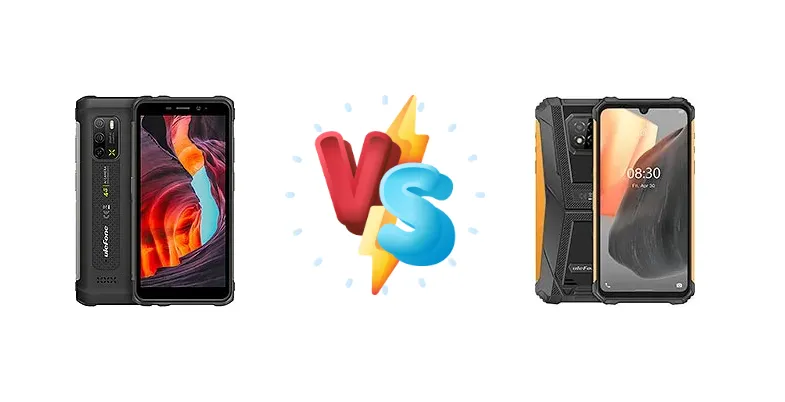
Ulefone Armor X10 Pro vs Armor 8 Pro: The Ultimate Rugged Phone Comparison
| Phones Images | |||||
|---|---|---|---|---|---|
|
🏆 Quick Verdict
The Ulefone Armor 8 Pro offers a noticeable performance upgrade thanks to its Helio P60 chipset and improved CPU architecture. While both are rugged, the 8 Pro’s faster processor, slightly better camera, and quicker charging make it the overall winner, justifying its likely higher price.
| PHONES | ||
|---|---|---|
| Phone Names | Ulefone Armor X10 Pro | Ulefone Armor 8 Pro |
| Network | ||
|---|---|---|
| 2G bands | GSM 850 / 900 / 1800 / 1900 | GSM 850 / 900 / 1800 / 1900 |
| 3G bands | HSDPA 850 / 900 / 1700(AWS) / 1900 / 2100 | HSDPA 850 / 900 / 1700(AWS) / 1900 / 2100 |
| 4G bands | 1, 2, 3, 4, 5, 7, 8, 12, 13, 17, 18, 19, 20, 25, 26, 28 | 1, 2, 3, 4, 5, 7, 8, 12, 13, 17, 18, 19, 20, 25, 26, 28, 66 |
| Speed | HSPA 21/5.76 Mbps, LTE Cat6 300/150 Mbps | HSPA 42.2/11.5 Mbps, LTE Cat7 300/150 Mbps |
| Technology | GSM / HSPA / LTE | GSM / HSPA / LTE |
| Launch | ||
|---|---|---|
| Announced | 2022, March 10 | 2021, April 28 |
| Status | Available. Released 2022, March 10 | Available. Released 2021, April 28 |
| Body | ||
|---|---|---|
| Build | - | Front glass, aluminum back with rubber, aluminum frame |
| Dimensions | 158.2 x 76.7 x 14.6 mm (6.23 x 3.02 x 0.57 in) | 166 x 81.8 x 15 mm (6.54 x 3.22 x 0.59 in) |
| SIM | Nano-SIM + Nano-SIM | Nano-SIM + Nano-SIM |
| Weight | 256 g (9.03 oz) | 282 g (9.95 oz) |
| IP68/IP69K dust/water resistant (up to 1.5m for 30 min) Drop-to-concrete resistance from up to 1.2m MIL-STD-810G compliant | IP68 dust/water resistant (up to 1.5m for 30 min) Drop-to-concrete resistance from up to 1.2m MIL-STD-810G compliant | |
| Display | ||
|---|---|---|
| Protection | - | Scratch-resistant glass, oleophobic coating |
| Resolution | 720 x 1440 pixels, 18:9 ratio (~295 ppi density) | 720 x 1560 pixels, 19.5:9 ratio (~282 ppi density) |
| Size | 5.45 inches, 76.7 cm2 (~63.2% screen-to-body ratio) | 6.1 inches, 91.3 cm2 (~67.3% screen-to-body ratio) |
| Type | IPS LCD | IPS LCD |
| Platform | ||
|---|---|---|
| CPU | Octa-core 2.0 GHz Cortex-A53 | Octa-core (4x2.0 GHz Cortex-A73 & 4x2.0 GHz Cortex-A53) |
| Chipset | Mediatek MT6762 Helio P22 (12 nm) | Mediatek MT6771 Helio P60 (12 nm) |
| GPU | PowerVR GE8320 | Mali-G72 MP3 |
| OS | Android 11 | Android 11 |
| Memory | ||
|---|---|---|
| Card slot | microSDXC (dedicated slot) | microSDXC (uses shared SIM slot) |
| Internal | 64GB 4GB RAM | 128GB 6GB RAM, 128GB 8GB RAM |
| eMMC 5.1 | - | |
| Main Camera | ||
|---|---|---|
| Dual | 20 MP, f/1.8, 26mm (wide), 1/2.78", 1.0µm, PDAF Auxiliary lens | - |
| Features | Dual-LED flash | LED flash, Panorama, HDR |
| Single | 5 MP, f/2.2 | 8 MP, f/2.2 |
| Triple | - | 16 MP, f/2.2, (wide), PDAF 5 MP (macro) Auxiliary lens |
| Video | 1080p@30fps | 1080p@30fps |
| Selfie camera | ||
|---|---|---|
| Features | HDR | - |
| Single | 5 MP, f/2.2 | 8 MP, f/2.2 |
| Video | 1080p@30fps | 1080p@30fps |
| Sound | ||
|---|---|---|
| 3.5mm jack | Yes | Yes |
| 35mm jack | Yes | Yes |
| Loudspeaker | Yes | Yes |
| Comms | ||
|---|---|---|
| Bluetooth | 5.0, A2DP, LE | 4.2, A2DP, LE |
| NFC | Yes | Yes |
| Positioning | GPS, GLONASS, GALILEO, BDS | GPS, GLONASS, GALILEO, BDS |
| Radio | FM radio, RDS, recording | FM radio, RDS, recording |
| USB | USB Type-C 2.0, OTG | USB Type-C 2.0, OTG |
| WLAN | Wi-Fi 802.11 a/b/g/n/ac, dual-band, Wi-Fi Direct | Wi-Fi 802.11 a/b/g/n/ac, Wi-Fi Direct |
| Features | ||
|---|---|---|
| Sensors | Accelerometer, proximity, compass | Fingerprint (side-mounted), accelerometer, gyro, proximity, compass |
| Battery | ||
|---|---|---|
| Charging | 10W wired | 15W wired |
| Type | Li-Po 5180 mAh | Li-Po 5580 mAh |
| Misc | ||
|---|---|---|
| Colors | Black/Gray | Black, Orange, Red |
| Price | About 170 EUR | About 190 EUR |
Ulefone Armor X10 Pro
- Extremely durable and rugged
- Affordable price point
- Large battery capacity
- Water and dust resistant
- Lower performance chipset
- Slower charging speed
- Basic camera capabilities
- Likely lower screen quality
Ulefone Armor 8 Pro
- Improved performance with Helio P60
- Faster charging (15W)
- Slightly better camera
- Rugged and durable design
- More responsive user experience
- Likely higher price
- Battery life may be slightly shorter than X10 Pro with heavy use
- Still not a flagship phone
Display Comparison
Both phones likely feature similar ruggedized displays, probably around 6.0-6.3 inches with a standard resolution (likely HD+). The Armor 8 Pro *might* have slightly better color accuracy or brightness due to its newer chipset, but the difference will be minimal. Durability is the key factor here – both are designed to withstand drops and scratches.
Camera Comparison
While both phones likely have dual-camera setups, the Armor 8 Pro's newer chipset generally allows for better image processing. Expect slightly improved image quality, dynamic range, and low-light performance on the 8 Pro. Both will likely offer decent, but not exceptional, camera capabilities.
Performance
This is where the Armor 8 Pro shines. The Helio P60 chipset with its Cortex-A73 cores provides a significant performance boost over the Helio P22 in the X10 Pro. Expect smoother multitasking, faster app loading times, and better gaming performance on the 8 Pro. The X10 Pro is adequate for basic tasks but will struggle with demanding applications.
Battery Life
Both phones likely have large batteries (around 5000-6000mAh). The Armor 8 Pro's 15W charging is a noticeable improvement over the X10 Pro's 10W, allowing for faster top-ups. Battery life itself will likely be comparable, lasting a full day or more with moderate use.
Buying Guide
The Ulefone Armor X10 Pro is a good choice for users on a tighter budget who prioritize basic functionality and extreme durability. The Ulefone Armor 8 Pro is ideal for those needing better performance for multitasking, gaming, or photography, and who appreciate faster charging speeds.