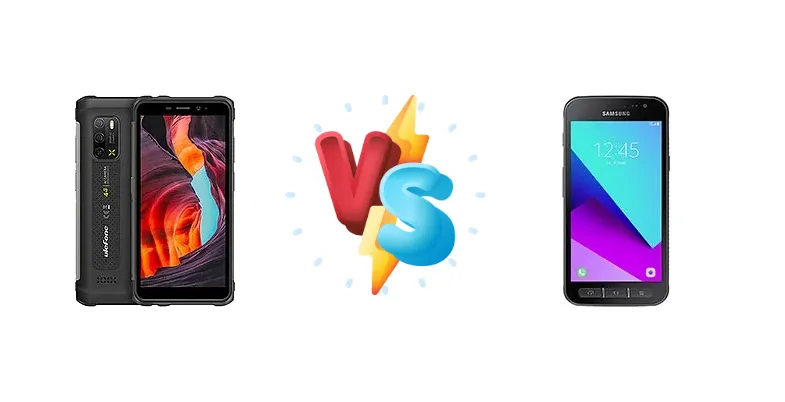
Rugged phones are built to withstand the toughest conditions, appealing to outdoor enthusiasts, construction workers, and anyone needing a durable device. Today, we're pitting two popular contenders against each other: the Ulefone Armor X10 Pro and the Samsung Galaxy XCover 4. Let's see which one comes out on top.
🏆 Quick Verdict
The Ulefone Armor X10 Pro boasts a more powerful chipset and potentially better camera, while the XCover 4 benefits from Samsung's brand recognition and potentially better software support. For raw power and value, the X10 Pro edges ahead, but the XCover 4 offers a more polished experience.
| Network |
|---|
| 2G bands | GSM 850 / 900 / 1800 / 1900 | GSM 850 / 900 / 1800 / 1900 |
| 3G bands | HSDPA 850 / 900 / 1700(AWS) / 1900 / 2100 | HSDPA 850 / 900 / 1900 / 2100 |
| 4G bands | 1, 2, 3, 4, 5, 7, 8, 12, 13, 17, 18, 19, 20, 25, 26, 28 | 1, 3, 5, 7, 8, 20, 38, 40 |
| Speed | HSPA 21/5.76 Mbps, LTE Cat6 300/150 Mbps | HSPA 42.2/5.76 Mbps, LTE Cat4 150/50 Mbps |
| Technology | GSM / HSPA / LTE | GSM / HSPA / LTE |
| Launch |
|---|
| Announced | 2022, March 10 | 2017, March. Released 2017, April |
| Status | Available. Released 2022, March 10 | Discontinued |
| Body |
|---|
| Dimensions | 158.2 x 76.7 x 14.6 mm (6.23 x 3.02 x 0.57 in) | 146.2 x 73.3 x 9.7 mm (5.76 x 2.89 x 0.38 in) |
| SIM | Nano-SIM + Nano-SIM | Micro-SIM |
| Weight | 256 g (9.03 oz) | 172 g (6.07 oz) |
| | IP68/IP69K dust/water resistant (up to 1.5m for 30 min)
Drop-to-concrete resistance from up to 1.2m
MIL-STD-810G compliant | IP68 dust/water resistant (up to 1.5m for 30 mins)
MIL-STD-810G compliant |
| Display |
|---|
| Resolution | 720 x 1440 pixels, 18:9 ratio (~295 ppi density) | 720 x 1280 pixels, 16:9 ratio (~294 ppi density) |
| Size | 5.45 inches, 76.7 cm2 (~63.2% screen-to-body ratio) | 5.0 inches, 68.9 cm2 (~64.3% screen-to-body ratio) |
| Type | IPS LCD | IPS LCD |
| Platform |
|---|
| CPU | Octa-core 2.0 GHz Cortex-A53 | Quad-core 1.4 GHz Cortex-A53 |
| Chipset | Mediatek MT6762 Helio P22 (12 nm) | Exynos 7570 Quad (14 nm) |
| GPU | PowerVR GE8320 | Mali-T720 MP2 |
| OS | Android 11 | Android 7.0 (Nougat), upgradable to Android 9.0 (Pie) |
| Memory |
|---|
| Card slot | microSDXC (dedicated slot) | microSDXC (dedicated slot) |
| Internal | 64GB 4GB RAM | 16GB 2GB RAM |
| | eMMC 5.1 | eMMC 5.0 |
| Main Camera |
|---|
| Dual | 20 MP, f/1.8, 26mm (wide), 1/2.78", 1.0µm, PDAF
Auxiliary lens | - |
| Features | Dual-LED flash | LED flash, HDR, panorama |
| Single | 5 MP, f/2.2 | 13 MP, f/1.9, AF |
| Video | 1080p@30fps | 1080p@30fps |
| Selfie camera |
|---|
| Features | HDR | - |
| Single | 5 MP, f/2.2 | 5 MP, f/2.2 |
| Video | 1080p@30fps | - |
| Sound |
|---|
| 3.5mm jack | Yes | Yes |
| 35mm jack | Yes | Yes |
| Loudspeaker | Yes | Yes |
| Comms |
|---|
| Bluetooth | 5.0, A2DP, LE | 4.2, A2DP, LE |
| NFC | Yes | Yes |
| Positioning | GPS, GLONASS, GALILEO, BDS | GPS, GLONASS, BDS |
| Radio | FM radio, RDS, recording | FM radio |
| USB | USB Type-C 2.0, OTG | microUSB 2.0 |
| WLAN | Wi-Fi 802.11 a/b/g/n/ac, dual-band, Wi-Fi Direct | Wi-Fi 802.11 a/b/g/n, dual-band, Wi-Fi Direct |
| Features |
|---|
| Sensors | Accelerometer, proximity, compass | Accelerometer, proximity, compass |
| Battery |
|---|
| Charging | 10W wired | - |
| Music play | - | Up to 77 h |
| Talk time | - | Up to 17 h (3G) |
| Type | Li-Po 5180 mAh | Li-Ion 2800 mAh, removable |
| Misc |
|---|
| Colors | Black/Gray | Gray |
| Models | - | SM-G390F, SM-G390Y, SM-G390W |
| Price | About 170 EUR | About 240 EUR |
| SAR EU | - | 0.61 W/kg (head) 1.24 W/kg (body) |
Ulefone Armor X10 Pro
- More powerful chipset
- Potentially better camera
- Larger battery capacity
- Faster charging
- Generally more affordable
- Less established brand
- Potentially less refined software
- Camera quality can be inconsistent
- Software updates may be less frequent
Samsung Galaxy XCover 4
- Samsung brand reliability
- Potentially better software support and updates
- More refined user experience
- Durable build quality
- Less powerful chipset
- Slower performance
- Smaller battery
- Slower charging
- Higher price
Display Comparison
Both phones feature relatively basic displays, likely around 5-6 inches with standard resolutions (720p). The XCover 4 might have slightly better color accuracy due to Samsung's display technology, but the X10 Pro could offer a slightly larger screen size. Expect both to be bright enough for outdoor use, but not exceptional.
Camera Comparison
The Ulefone Armor X10 Pro likely has a more capable camera setup, potentially with a higher resolution main sensor and more advanced features. While specific camera specs are often lacking in Ulefone devices, the Helio P22 chipset generally supports better camera processing. The XCover 4's camera is decent for a rugged phone, but likely won't match the X10 Pro's potential.
Performance
Here's where the X10 Pro takes a significant lead. Its Mediatek Helio P22 chipset and Octa-core CPU offer noticeably better performance than the XCover 4's Exynos 7570 Quad-core. Expect smoother multitasking, faster app loading, and better gaming performance on the X10 Pro. The XCover 4 will handle basic tasks adequately, but will struggle with more demanding applications.
Battery Life
The Ulefone Armor X10 Pro likely has a larger battery capacity (potentially 5000mAh or more) and faster charging (10W wired). The XCover 4 has a respectable battery, but the X10 Pro should offer longer battery life and quicker top-ups.
Buying Guide
The Ulefone Armor X10 Pro is ideal for users prioritizing performance and a larger battery on a budget. The Samsung Galaxy XCover 4 is a good choice for those who value brand reliability, a more refined user experience, and potentially better long-term software updates.
Frequently Asked Questions
❓ Are these phones waterproof?
Both phones are IP68 rated, meaning they are dustproof and waterproof up to a certain depth for a specific duration. However, it's always best to avoid prolonged submersion.
❓ Which phone has better software support?
The Samsung Galaxy XCover 4 is likely to receive more consistent software updates and security patches due to Samsung's established support system.