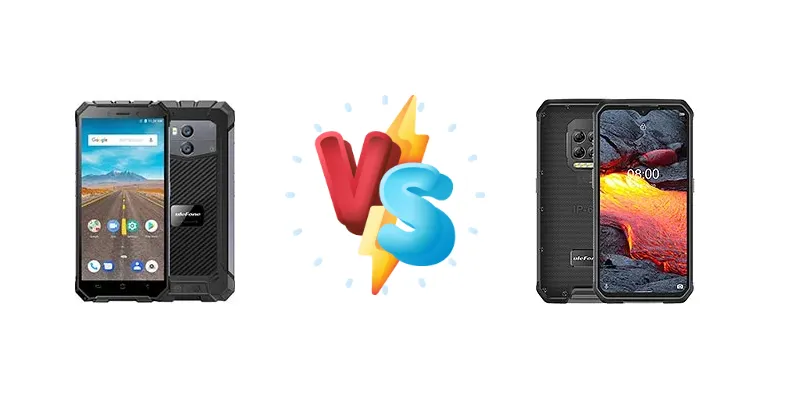
Ulefone's Armor series caters to users needing durable, weatherproof smartphones. The Armor X represents an entry point into this market, while the Armor 9E aims for a more substantial performance boost. This comparison dissects the core differences between these two models, focusing on how their chipsets and charging capabilities impact real-world usability.
🏆 Quick Verdict
For most users, the Ulefone Armor 9E is the superior choice. Its Helio P90 chipset delivers significantly improved performance over the Armor X's MT6739, making it better suited for multitasking, demanding apps, and even light gaming. The faster 18W charging is a welcome addition, offsetting the likely similar battery capacity.
| Network |
|---|
| 2G bands | GSM 850 / 900 / 1800 / 1900 | GSM 850 / 900 / 1800 / 1900 |
| 3G bands | HSDPA 850 / 900 / 2100 | HSDPA 850 / 900 / 1700(AWS) / 1900 / 2100 |
| 4G bands | 1, 3, 7, 8, 20 | 1, 2, 3, 4, 5, 7, 8, 12, 13, 17, 18, 19, 20, 25, 26, 28, 34, 38, 39, 40, 41, 66 |
| Speed | HSPA 21.1/5.76 Mbps, LTE Cat4 150/75 Mbps | HSPA 42.2/11.5 Mbps, LTE Cat12 600/150 Mbps |
| Technology | GSM / HSPA / LTE | GSM / CDMA / HSPA / EVDO / LTE |
| | - | CDMA2000 1xEV-DO |
| Launch |
|---|
| Announced | 2018, April. Released 2018, April | 2020, September 08. Released 2020, September 08 |
| Status | Discontinued | Discontinued |
| Body |
|---|
| Build | - | Front glass, aluminum back with rubber, aluminum frame |
| Dimensions | 163 x 76.6 x 13.9 mm (6.42 x 3.02 x 0.55 in) | 168.2 x 82 x 15 mm (6.62 x 3.23 x 0.59 in) |
| SIM | Nano-SIM + Nano-SIM | Nano-SIM + Nano-SIM |
| Weight | 256 g (9.03 oz) | 324 g (11.43 oz) |
| | IP68 dust/water resistant (up to 1.5m for 30 mins)
Drop-to-concrete resistance from up to 1.2 m
MIL-STD-810G compliant | IP68/IP69K dust/water resistant (up to 1.5m for 30 min)
Drop-to-concrete resistance from up to 1.2m
MIL-STD-810G compliant |
| Display |
|---|
| Protection | - | Scratch-resistant glass, oleophobic coating |
| Resolution | 720 x 1440 pixels, 18:9 ratio (~293 ppi density) | 1080 x 2340 pixels, 19.5:9 ratio (~409 ppi density) |
| Size | 5.5 inches, 78.1 cm2 (~62.5% screen-to-body ratio) | 6.3 inches, 97.4 cm2 (~70.6% screen-to-body ratio) |
| Type | IPS LCD | IPS LCD |
| Platform |
|---|
| CPU | Quad-core 1.5 GHz Cortex-A53 | Octa-core (2x2.2 GHz Cortex-A75 & 6x2.0 GHz Cortex-A55) |
| Chipset | Mediatek MT6739 (28 nm) | Mediatek MT6779 Helio P90 (12 nm) |
| GPU | PowerVR GE8100 | PowerVR GM9446 |
| OS | Android 8.1 (Oreo) | Android 10 |
| Memory |
|---|
| Card slot | microSDXC (uses shared SIM slot) | microSDXC (uses shared SIM slot) |
| Internal | 16GB 2GB RAM | 128GB 8GB RAM |
| | eMMC 5.1 | UFS 2.1 |
| Main Camera |
|---|
| Dual | 8 MP, f/1.8, (wide), AF
5 MP | - |
| Features | Dual-LED flash, HDR | Quad-LED flash, HDR, panorama |
| Quad | - | 64 MP, f/1.9, 26mm (wide), 1/1.72", 0.8µm, PDAF
8 MP, f/2.4, 100˚ (ultrawide), 1/4.0", 1.12µm
2 MP (macro)
Auxiliary lens |
| Video | 720p@30fps | 4K@30fps, 1080p@30fps |
| Selfie camera |
|---|
| Features | - | HDR, panorama |
| Single | 5 MP | 8 MP, f/2.2 |
| Video | 720p@30fps | 1080p@30fps |
| Sound |
|---|
| 3.5mm jack | Yes | Yes |
| 35mm jack | Yes | Yes |
| Loudspeaker | Yes | Yes |
| Comms |
|---|
| Bluetooth | 4.1, A2DP | 5.0, A2DP, LE |
| NFC | Yes | Yes |
| Positioning | GPS | GPS, GLONASS, GALILEO, BDS |
| Radio | Stereo FM radio, RDS, recording | FM radio, RDS, recording |
| USB | microUSB 2.0 | USB Type-C 2.0, OTG, accessory connector |
| WLAN | Wi-Fi 802.11 a/b/g/n, dual-band | Wi-Fi 802.11 a/b/g/n/ac, Wi-Fi Direct |
| Features |
|---|
| Sensors | Fingerprint (side-mounted), accelerometer, proximity, compass | Fingerprint (side-mounted), accelerometer, gyro, proximity, compass, coulombmeter |
| | - | Endoscope mount (camera sold separately) |
| Battery |
|---|
| Charging | 10W wired | 18W wired |
| Type | Li-Po 5500 mAh | Li-Po 6600 mAh |
| Misc |
|---|
| Colors | Dark Gray, Rose Gold | Black |
| Price | - | About 290 EUR |
Ulefone Armor X
- Most affordable option in the Ulefone Armor series.
- Durable and rugged design.
- Simple and easy-to-use interface.
- Slow performance with the MT6739 chipset.
- Slow 10W charging.
- Limited multitasking capabilities.
Ulefone Armor 9E
- Significantly faster performance with the Helio P90.
- Faster 18W wired charging.
- More efficient power consumption.
- Higher price point than the Armor X.
- May still struggle with extremely demanding games.
- Rugged design adds bulk.
Display Comparison
Neither Ulefone provides display specifications beyond size. However, given the Armor X's positioning, it likely utilizes a lower-resolution panel compared to the Armor 9E. The Armor 9E's more powerful chipset suggests a greater capacity to drive a higher-resolution, potentially brighter display. While neither is likely to compete with flagship OLEDs, the Armor 9E will likely offer a more visually pleasing experience.
Camera Comparison
Without detailed camera specs, a direct comparison is difficult. However, the Armor 9E's more powerful ISP (Image Signal Processor) within the Helio P90 chipset will likely result in better image processing, particularly in low-light conditions. The Armor X's MT6739 ISP is comparatively limited. While both phones likely feature similar main sensor resolutions (typical for this price range), the Armor 9E will likely produce sharper, more detailed images with better dynamic range. The presence of a more capable chipset also opens the door for features like HDR processing and improved video stabilization.
Performance
The core difference lies in the chipsets. The Ulefone Armor X's Mediatek MT6739, built on a 28nm process, features a quad-core Cortex-A53 CPU clocked at 1.5 GHz. This is a relatively basic processor, suitable for light tasks. Conversely, the Armor 9E boasts the Mediatek Helio P90 (12nm), an octa-core processor with a heterogeneous architecture – two Cortex-A75 cores at 2.2 GHz for performance and six Cortex-A55 cores at 2.0 GHz for efficiency. The 12nm process node is significantly more efficient than 28nm, resulting in lower power consumption and less heat generation. This translates to a noticeably smoother user experience on the Armor 9E, especially when multitasking or running demanding applications. The architectural shift from A53 to A75 cores represents a substantial leap in single-core performance, impacting app launch times and overall responsiveness.
Battery Life
While battery capacity isn't specified, the Armor 9E's 18W wired charging is a significant advantage over the Armor X's 10W charging. This means the Armor 9E will charge considerably faster, reducing downtime. The more efficient Helio P90 chipset also contributes to better battery life, as it consumes less power during operation. Even if the Armor 9E has a similar battery capacity to the Armor X, the combination of faster charging and improved efficiency makes it the more practical choice for users who rely heavily on their phones throughout the day.
Buying Guide
Buy the Ulefone Armor X if you prioritize absolute affordability and only need a phone for basic communication – calls, texts, and light app usage. It's ideal for those who rarely use their smartphone beyond essential functions. Buy the Ulefone Armor 9E if you value responsiveness, smoother multitasking, and the ability to run more demanding applications. This is the better option for users who need a rugged phone that can keep up with a more active digital lifestyle.
Frequently Asked Questions
❓ Will the Helio P90 in the Armor 9E handle demanding games like PUBG Mobile?
While the Helio P90 isn't a flagship gaming chip, it's capable of running PUBG Mobile at medium settings with acceptable frame rates. Expect some occasional frame drops during intense action, but it's a significant improvement over the Armor X's MT6739, which would struggle even at the lowest settings.
❓ How much faster is the 18W charging on the Armor 9E compared to the 10W charging on the Armor X?
The 18W charging on the Armor 9E will reduce charging times considerably. While exact 0-100% times aren't available, expect the Armor 9E to charge approximately 40-50% faster than the Armor X, making it more convenient for users who need to quickly top up their battery.
❓ Is the Armor 9E noticeably warmer during extended use compared to the Armor X?
Despite the increased performance, the Helio P90's 12nm process is more efficient than the MT6739's 28nm process. This means the Armor 9E is likely to generate less heat during prolonged use, reducing the risk of thermal throttling and maintaining consistent performance.