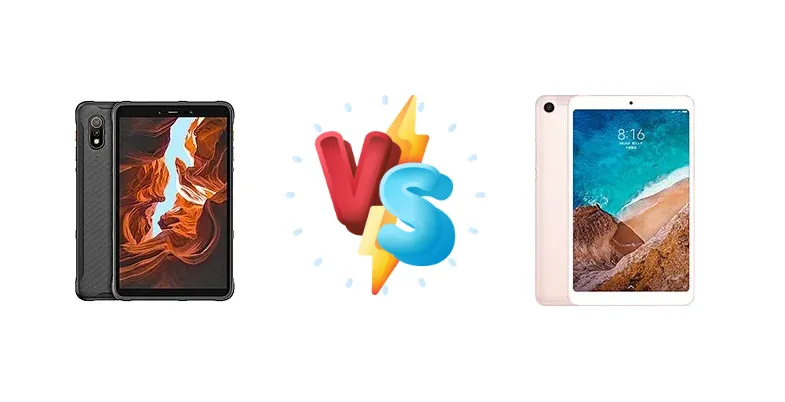
Choosing a tablet can be tough, especially with so many options available. Today, we're pitting two distinct contenders against each other: the Ulefone Armor Pad, a ruggedized tablet built for durability, and the Xiaomi Mi Pad 4, a more mainstream option focused on performance and design. Let's dive into a detailed comparison to see which one comes out on top.
🏆 Quick Verdict
The Xiaomi Mi Pad 4 offers a significantly smoother and faster experience thanks to its superior chipset. However, the Ulefone Armor Pad's incredible battery life and rugged design make it ideal for those needing a durable device for outdoor or demanding environments. It's a trade-off between performance and resilience.
| Network |
|---|
| 2G bands | GSM 850 / 900 / 1800 / 1900 | - |
| 3G bands | HSDPA 850 / 900 / 1700(AWS) / 1900 / 2100 | - |
| 4G bands | 1, 2, 3, 4, 5, 7, 8, 12, 17, 19, 20, 28, 38, 40, 41 | 1, 3, 5, 7, 8, 34, 38, 39, 40, 41 |
| EDGE | - | No |
| GPRS | - | No |
| Speed | HSPA, LTE | LTE (3CA) Cat12 600/150 Mbps |
| Technology | GSM / HSPA / LTE | LTE |
| Launch |
|---|
| Announced | 2023, March 22 | 2018, June. Released 2018, June |
| Status | Available. Released 2023, March 22 | Discontinued |
| Body |
|---|
| Build | - | Glass front, aluminum back, aluminum frame |
| Dimensions | 213 x 128.8 x 14 mm (8.39 x 5.07 x 0.55 in) | 200.2 x 120.3 x 7.9 mm (7.88 x 4.74 x 0.31 in) |
| SIM | Nano-SIM + Nano-SIM | Nano-SIM |
| Weight | 560 g (1.23 lb) | 342.5 g (12.10 oz) |
| | IP68/IP69K dust/water resistant (up to 1.5m for 30 min)
Drop-to-concrete resistance from up to 1.5m
MIL-STD-810H compliant
Accessory connector (ulefone endoscope, microscope) | - |
| Display |
|---|
| Protection | Mohs level 4 | - |
| Resolution | 800 x 1280 pixels, 16:10 ratio (~189 ppi density) | 1200 x 1920 pixels, 16:10 ratio (~283 ppi density) |
| Size | 8.0 inches, 185.6 cm2 (~67.6% screen-to-body ratio) | 8.0 inches, 185.6 cm2 (~77.1% screen-to-body ratio) |
| Type | IPS LCD | IPS LCD |
| Platform |
|---|
| CPU | Octa-core (4x2.0 GHz Cortex-A53 & 4x1.5 GHz Cortex-A53) | Octa-core (4x2.2 GHz Kryo 260 Gold & 4x1.8 GHz Kryo 260 Silver) |
| Chipset | Mediatek MT6762 Helio G25 (12 nm) | Qualcomm SDM660 Snapdragon 660 (14 nm) |
| GPU | PowerVR GE8320 | Adreno 512 |
| OS | Android 12 | Android 8.1 (Oreo), MIUI 9 |
| Memory |
|---|
| Card slot | microSDXC (dedicated slot) | microSDXC (dedicated slot) |
| Internal | 64GB 4GB RAM | 32GB 3GB RAM, 64GB 4GB RAM |
| | - | eMMC 5.1 |
| Main Camera |
|---|
| Features | LED flash, HDR, panorama | Panorama, HDR |
| Single | 13 MP, f/2.2, AF | 13 MP, f/2.0 |
| Video | 1080p@30fps | 1080p@30fps |
| Selfie camera |
|---|
| Single | 5 MP, f/2.0 | 5 MP, f/2.0 |
| Video | Yes | - |
| Sound |
|---|
| 3.5mm jack | Yes | Yes |
| 35mm jack | Yes | Yes |
| Loudspeaker | Yes, with stereo speakers | Yes, with stereo speakers |
| Comms |
|---|
| Bluetooth | 5.2, A2DP, LE | 5.0, A2DP, LE |
| NFC | No | No |
| Positioning | GPS, GLONASS, GALILEO, BDS | GPS, GLONASS, BDS (LTE model only) |
| Radio | Wireless FM radio, RDS, recording | No |
| USB | USB Type-C 2.0, OTG, magnetic connector | USB Type-C |
| WLAN | Wi-Fi 802.11 a/b/g/n/ac, dual-band | Wi-Fi 802.11 a/b/g/n/ac, dual-band, Wi-Fi Direct |
| Features |
|---|
| Sensors | Fingerprint (side-mounted), accelerometer, proximity, compass | Accelerometer, gyro, proximity, compass (LTE model only) |
| Battery |
|---|
| Charging | 18W Wired | 10W wired |
| Type | Li-Po 7650 mAh, removable | Li-Po 6000 mAh, non-removable |
| Misc |
|---|
| Colors | Black | Black, Rose Gold |
| Price | About 200 EUR | About 160 EUR |
| EU LABEL |
|---|
| Battery | 83:38h endurance, 1000 cycles | - |
| Energy | Class F | - |
| Free fall | Class A (270 falls) | - |
| Repairability | Class C | - |
Ulefone Armor Pad
- Exceptional battery life
- Rugged and durable design
- Water and dust resistant
- High cycle count
- Lower performance chipset
- Likely lower resolution display
- Potentially bulky and heavy
Xiaomi Mi Pad 4
- Faster performance
- Higher resolution display
- Sleek design
- Better overall user experience
- Less durable
- Shorter battery life
- 10W charging is slow
Display Comparison
The Xiaomi Mi Pad 4 boasts a sharper and more vibrant 2560 x 1600 resolution display, offering a better viewing experience for media and gaming. The Ulefone Armor Pad likely has a lower resolution display, prioritizing durability over visual fidelity. Expect better color accuracy and overall clarity on the Mi Pad 4.
Camera Comparison
Camera quality is generally not a priority for tablets. However, the Mi Pad 4 likely has slightly better camera sensors and image processing capabilities than the Armor Pad. Don't expect exceptional photo quality from either device.
Performance
The Xiaomi Mi Pad 4's Snapdragon 660 is noticeably faster and more efficient than the Ulefone Armor Pad's Helio G25. Expect smoother multitasking, faster app loading times, and better gaming performance on the Mi Pad 4. The Armor Pad will handle basic tasks adequately, but struggles with demanding applications.
Battery Life
The Ulefone Armor Pad shines here. Its advertised 83:38h endurance and 1000 cycles are exceptional, far surpassing the Mi Pad 4's likely shorter battery life. This makes the Armor Pad a champion for extended use without needing to recharge.
Buying Guide
The Ulefone Armor Pad is perfect for construction workers, outdoor enthusiasts, or anyone needing a tablet that can withstand drops, dust, and water. The Xiaomi Mi Pad 4 is a better choice for students, casual users, or those prioritizing performance for gaming and media consumption.
Frequently Asked Questions
❓ Is the Ulefone Armor Pad waterproof?
Yes, the Ulefone Armor Pad is designed to be waterproof and dustproof, typically with an IP68 or IP69 rating, though specific details should be confirmed on the product page.
❓ Can I play demanding games on the Xiaomi Mi Pad 4?
While the Snapdragon 660 is capable, demanding games may require lower graphics settings for smooth gameplay. It's better suited for less intensive games and casual gaming.