
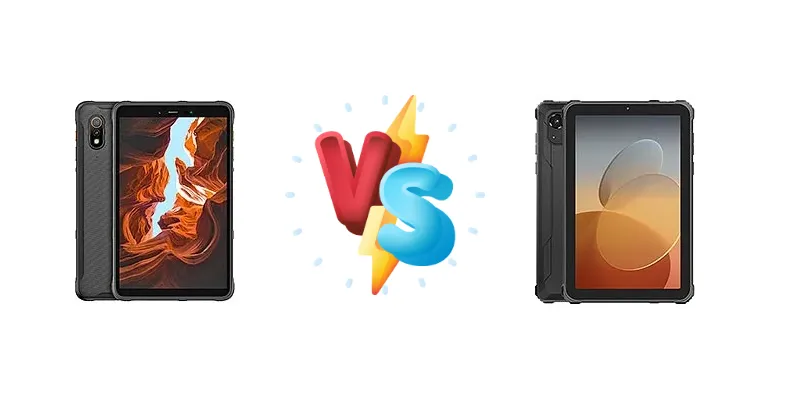
Ulefone Armor Pad vs. Oukitel RT3 Pro: A Deep Dive into Rugged Tablet Performance
| Phones Images | |||||
|---|---|---|---|---|---|
|
🏆 Quick Verdict
For users prioritizing all-day (and beyond) battery life and consistent, if not blazing-fast, performance, the Oukitel RT3 Pro is the clear winner. Its significantly longer 138:44h endurance and more capable Helio G81 chipset outweigh the Ulefone Armor Pad’s slightly lower price point for most users.
| PHONES | ||
|---|---|---|
| Phone Names | Ulefone Armor Pad | Oukitel RT3 Pro |
| Network | ||
|---|---|---|
| 2G bands | GSM 850 / 900 / 1800 / 1900 | GSM 850 / 900 / 1800 / 1900 |
| 3G bands | HSDPA 850 / 900 / 1700(AWS) / 1900 / 2100 | HSDPA 850 / 900 / 1700(AWS) / 1900 / 2100 |
| 4G bands | 1, 2, 3, 4, 5, 7, 8, 12, 17, 19, 20, 28, 38, 40, 41 | 1, 2, 3, 4, 5, 7, 8, 12, 17, 18, 19, 20, 25, 26, 28, 38, 39, 40, 41, 66 |
| Speed | HSPA, LTE | HSPA, LTE |
| Technology | GSM / HSPA / LTE | GSM / HSPA / LTE |
| Launch | ||
|---|---|---|
| Announced | 2023, March 22 | 2024, October |
| Status | Available. Released 2023, March 22 | Available. Released 2024, October |
| Body | ||
|---|---|---|
| Dimensions | 213 x 128.8 x 14 mm (8.39 x 5.07 x 0.55 in) | 207 x 134 x 13.9 mm (8.15 x 5.28 x 0.55 in) |
| SIM | Nano-SIM + Nano-SIM | Nano-SIM + Nano-SIM |
| Weight | 560 g (1.23 lb) | 538 g (1.19 lb) |
| IP68/IP69K dust/water resistant (up to 1.5m for 30 min) Drop-to-concrete resistance from up to 1.5m MIL-STD-810H compliant Accessory connector (ulefone endoscope, microscope) | - | |
| Display | ||
|---|---|---|
| Protection | Mohs level 4 | Corning Gorilla Glass 5, Mohs level 4 |
| Resolution | 800 x 1280 pixels, 16:10 ratio (~189 ppi density) | 800 x 1280 pixels, 16:10 ratio (~189 ppi density) |
| Size | 8.0 inches, 185.6 cm2 (~67.6% screen-to-body ratio) | 8.0 inches, 185.6 cm2 (~66.9% screen-to-body ratio) |
| Type | IPS LCD | IPS LCD, 600 nits |
| Platform | ||
|---|---|---|
| CPU | Octa-core (4x2.0 GHz Cortex-A53 & 4x1.5 GHz Cortex-A53) | Octa-core (2x2.0 GHz Cortex-A75 & 6x1.7 GHz Cortex-A55) |
| Chipset | Mediatek MT6762 Helio G25 (12 nm) | Mediatek Helio G81 (12 nm) |
| GPU | PowerVR GE8320 | Mali-G52 MC2 |
| OS | Android 12 | Android 14 |
| Memory | ||
|---|---|---|
| Card slot | microSDXC (dedicated slot) | microSDXC (uses shared SIM slot) |
| Internal | 64GB 4GB RAM | 128GB 4GB RAM |
| Main Camera | ||
|---|---|---|
| Dual | - | 16 MP, f/2.0, (wide), 1/3.06", PDAF Auxiliary lens |
| Features | LED flash, HDR, panorama | LED flash |
| Single | 13 MP, f/2.2, AF | - |
| Video | 1080p@30fps | 1080p@30fps |
| Selfie camera | ||
|---|---|---|
| Single | 5 MP, f/2.0 | 8 MP, f/2.0, (wide), 1/4.0" |
| Video | Yes | 720p@30fps |
| Sound | ||
|---|---|---|
| 3.5mm jack | Yes | - |
| 35mm jack | Yes | No |
| Loudspeaker | Yes, with stereo speakers | Yes, with stereo speakers |
| Comms | ||
|---|---|---|
| Bluetooth | 5.2, A2DP, LE | 5.0, A2DP, LE |
| NFC | No | Yes |
| Positioning | GPS, GLONASS, GALILEO, BDS | GPS, GLONASS, GALILEO, BDS |
| Radio | Wireless FM radio, RDS, recording | FM radio |
| USB | USB Type-C 2.0, OTG, magnetic connector | USB Type-C 2.0, OTG |
| WLAN | Wi-Fi 802.11 a/b/g/n/ac, dual-band | Wi-Fi 802.11 a/b/g/n/ac, dual-band |
| Features | ||
|---|---|---|
| Sensors | Fingerprint (side-mounted), accelerometer, proximity, compass | Accelerometer, compass |
| Battery | ||
|---|---|---|
| Charging | 18W Wired | 10W wired |
| Type | Li-Po 7650 mAh, removable | Li-Po 5150 mAh |
| Misc | ||
|---|---|---|
| Colors | Black | Black, Orange, Green |
| Price | About 200 EUR | About 180 EUR |
| EU LABEL | ||
|---|---|---|
| Battery | 83:38h endurance, 1000 cycles | 138:44h endurance, 1000 cycles |
| Energy | Class F | Class B |
| Free fall | Class A (270 falls) | Class A (208 falls) |
| Repairability | Class C | Class B |
Ulefone Armor Pad
- Long-term battery health with 1000 charge cycles
- Slightly faster 18W charging
- Potentially lower price point (market dependent)
- Significantly lower battery endurance (83:38h)
- Less powerful Mediatek Helio G25 chipset
- Slower overall performance
Oukitel RT3 Pro
- Exceptional battery endurance (138:44h)
- More powerful Mediatek Helio G81 chipset
- Improved multi-core performance for multitasking
- Slower 10W charging
- Potentially higher price point (market dependent)
- May require more frequent charging despite large battery
Display Comparison
Neither device specifies display details beyond size, leaving brightness and color accuracy as unknowns. However, the focus here is on durability, not visual fidelity. The absence of LTPO or high refresh rate panels is typical for this segment, prioritizing power efficiency and ruggedness over premium display features. Bezels are likely substantial on both to contribute to drop protection.
Camera Comparison
Given the rugged nature of these devices, camera performance isn't a primary focus. Details are lacking, so we can only assume both feature basic camera setups. The absence of information regarding sensor size or optical image stabilization suggests neither will excel in low-light conditions. Any 2MP macro or depth sensors are likely present for marketing purposes and offer minimal real-world benefit.
Performance
The Oukitel RT3 Pro’s Mediatek Helio G81 chipset represents a substantial upgrade over the Ulefone Armor Pad’s Helio G25. The G81 features a combination of 2x2.0 GHz Cortex-A75 and 6x1.7 GHz Cortex-A55 cores, offering significantly improved multi-core performance compared to the Armor Pad’s 4x2.0 GHz Cortex-A53 and 4x1.5 GHz Cortex-A53 configuration. This translates to smoother app switching, faster loading times, and a more responsive overall experience. While both are 12nm chips, the architectural improvements in the G81 are key. The Armor Pad will be adequate for basic tasks, but the RT3 Pro is better suited for more demanding applications.
Battery Life
The Oukitel RT3 Pro boasts a massive advantage in battery endurance, achieving 138:44 hours compared to the Ulefone Armor Pad’s 83:38 hours. While both are rated for 1000 charge cycles, the RT3 Pro’s superior endurance means fewer charging cycles will be needed over the device’s lifespan. The Armor Pad’s 18W wired charging is slightly faster than the RT3 Pro’s 10W, but the difference is negligible given the RT3 Pro’s significantly larger battery capacity. The RT3 Pro’s larger battery effectively mitigates the slower charging speed.
Buying Guide
Buy the Ulefone Armor Pad if you need a dependable tablet for basic tasks, extended field work where charging opportunities are limited, and value long-term battery health with its 1000 charge cycles. Buy the Oukitel RT3 Pro if you prefer a more responsive user experience, handle demanding applications, and require a faster processor for multitasking and media consumption, even if it means more frequent charging.