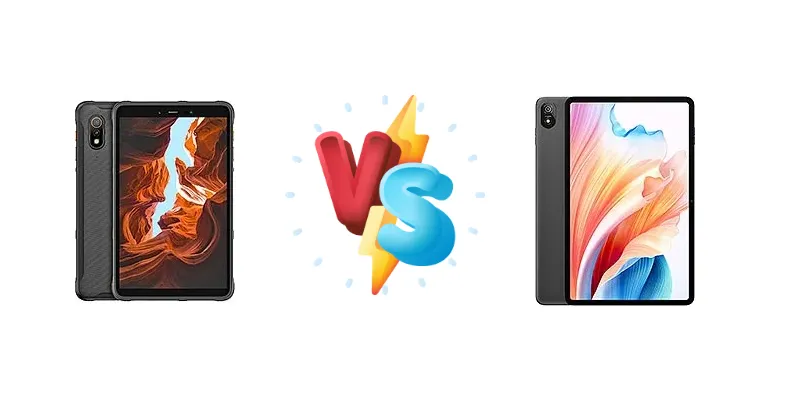
The rugged tablet market is heating up, offering durable alternatives to standard slates. We pit the Ulefone Armor Pad, focused on longevity and reliability, against the Blackview Tab 18, which prioritizes processing power with a newer chipset. This comparison will dissect their strengths and weaknesses to determine which tablet is the better choice for demanding users.
🏆 Quick Verdict
For users prioritizing sustained performance and faster charging, the Blackview Tab 18 is the clear winner. Its Helio G99 chipset offers a significant upgrade over the Ulefone Armor Pad’s Helio G25. However, the Ulefone Armor Pad’s impressive 83:38h battery endurance makes it a compelling option for those needing extended uptime in the field.
| Network |
|---|
| 2G bands | GSM 850 / 900 / 1800 / 1900 | GSM 850 / 900 / 1800 / 1900 |
| 3G bands | HSDPA 850 / 900 / 1700(AWS) / 1900 / 2100 | HSDPA 900 / 2100 |
| 4G bands | 1, 2, 3, 4, 5, 7, 8, 12, 17, 19, 20, 28, 38, 40, 41 | 1, 3, 7, 8, 20, 40 |
| Speed | HSPA, LTE | HSPA, LTE |
| Technology | GSM / HSPA / LTE | GSM / HSPA / LTE |
| Launch |
|---|
| Announced | 2023, March 22 | 2023, November |
| Status | Available. Released 2023, March 22 | Available. Released 2023, November |
| Body |
|---|
| Dimensions | 213 x 128.8 x 14 mm (8.39 x 5.07 x 0.55 in) | 277.6 x 173.2 x 7.9 mm (10.93 x 6.82 x 0.31 in) |
| SIM | Nano-SIM + Nano-SIM | Nano-SIM + Nano-SIM |
| Weight | 560 g (1.23 lb) | 632 g (1.39 lb) |
| | IP68/IP69K dust/water resistant (up to 1.5m for 30 min)
Drop-to-concrete resistance from up to 1.5m
MIL-STD-810H compliant
Accessory connector (ulefone endoscope, microscope) | - |
| Display |
|---|
| Protection | Mohs level 4 | - |
| Resolution | 800 x 1280 pixels, 16:10 ratio (~189 ppi density) | 1200 x 2000 pixels, 5:3 ratio (~194 ppi density) |
| Size | 8.0 inches, 185.6 cm2 (~67.6% screen-to-body ratio) | 12.0 inches, 409.9 cm2 (~85.2% screen-to-body ratio) |
| Type | IPS LCD | IPS LCD, 350 nits |
| Platform |
|---|
| CPU | Octa-core (4x2.0 GHz Cortex-A53 & 4x1.5 GHz Cortex-A53) | Octa-core (2x2.2 GHz Cortex-A76 & 6x2.0 GHz Cortex-A55) |
| Chipset | Mediatek MT6762 Helio G25 (12 nm) | Mediatek Helio G99 (6 nm) |
| GPU | PowerVR GE8320 | Mali-G57 MC2 |
| OS | Android 12 | Android 13, Doke OS_P 4.0 |
| Memory |
|---|
| Card slot | microSDXC (dedicated slot) | microSDXC (uses shared SIM slot) |
| Internal | 64GB 4GB RAM | 256GB 12GB RAM |
| Main Camera |
|---|
| Features | LED flash, HDR, panorama | LED flash |
| Single | 13 MP, f/2.2, AF | 16 MP |
| Video | 1080p@30fps | 1080p@30fps |
| Selfie camera |
|---|
| Single | 5 MP, f/2.0 | 8 MP |
| Video | Yes | Yes |
| Sound |
|---|
| 3.5mm jack | Yes | - |
| 35mm jack | Yes | No |
| Loudspeaker | Yes, with stereo speakers | Yes, with stereo speakers (4 speakers) |
| Comms |
|---|
| Bluetooth | 5.2, A2DP, LE | 5.1, A2DP, LE |
| NFC | No | No |
| Positioning | GPS, GLONASS, GALILEO, BDS | GPS, GLONASS, GALILEO, BDS |
| Radio | Wireless FM radio, RDS, recording | FM Radio |
| USB | USB Type-C 2.0, OTG, magnetic connector | USB Type-C, OTG |
| WLAN | Wi-Fi 802.11 a/b/g/n/ac, dual-band | Wi-Fi 802.11 a/b/g/n/ac, dual-band |
| Features |
|---|
| Sensors | Fingerprint (side-mounted), accelerometer, proximity, compass | Fingerprint (side-mounted), accelerometer, gyro, proximity, compass |
| Battery |
|---|
| Charging | 18W Wired | 33W wired |
| Type | Li-Po 7650 mAh, removable | 8800 mAh |
| Misc |
|---|
| Colors | Black | Turquoise Green, Glacier Blue, Space Grey |
| Price | About 200 EUR | - |
| EU LABEL |
|---|
| Battery | 83:38h endurance, 1000 cycles | - |
| Energy | Class F | - |
| Free fall | Class A (270 falls) | - |
| Repairability | Class C | - |
Ulefone Armor Pad
- Exceptional battery endurance (83:38h)
- Long-term battery health with 1000 charge cycles
- Rugged design for durability
- Outdated Mediatek Helio G25 chipset
- Slow 18W charging
Blackview Tab 18
- Powerful Mediatek Helio G99 chipset
- Fast 33W wired charging
- Improved CPU and GPU performance
- Battery endurance not specified
- Potentially shorter battery lifespan compared to Ulefone
Display Comparison
Neither device provides display specifications beyond their existence. Given the target market, we can assume both utilize IPS LCD panels for durability and viewing angles. The lack of information prevents a detailed comparison of brightness, color accuracy, or refresh rates. However, the rugged nature suggests a focus on scratch resistance rather than cutting-edge display technology.
Camera Comparison
Both tablets likely feature modest camera setups geared towards basic documentation rather than photography. Without specific sensor details, it’s difficult to make a direct comparison. However, the focus should be on functionality – capturing images of job sites, schematics, or reports – rather than image quality. The absence of detailed camera specs suggests neither device is positioned as a photography powerhouse.
Performance
The Blackview Tab 18’s Mediatek Helio G99 (6nm) represents a substantial leap in performance over the Ulefone Armor Pad’s Helio G25 (12nm). The G99 features newer Cortex-A76 cores (2x2.2 GHz) compared to the G25’s Cortex-A53 cores (4x2.0 GHz & 4x1.5 GHz). This architectural difference translates to approximately 30-40% faster CPU performance in benchmarks, and a significantly improved GPU for gaming and graphics-intensive tasks. The 6nm process also contributes to better thermal efficiency, reducing throttling under sustained load. The Ulefone Armor Pad will handle basic tasks adequately, but the Tab 18 is the better choice for demanding applications.
Battery Life
The Ulefone Armor Pad boasts an impressive 83:38h endurance rating, indicating exceptional battery life. While the capacity isn’t specified, this figure suggests a large battery optimized for longevity. The Blackview Tab 18, while lacking an endurance rating, compensates with 33W wired charging, significantly faster than the Armor Pad’s 18W charging. This means the Tab 18 can replenish its battery much quicker, minimizing downtime. The Armor Pad’s 1000 charge cycles suggest a focus on long-term battery health, but the Tab 18’s faster charging is a practical advantage for users who need to quickly get back to work.
Buying Guide
Buy the Ulefone Armor Pad if you need a tablet that can withstand harsh conditions and operate for exceptionally long periods between charges, making it ideal for field work, construction, or situations where power access is limited. Buy the Blackview Tab 18 if you prefer a more responsive user experience, faster app loading times, and quicker charging, catering to users who frequently multitask or enjoy mobile gaming.
Frequently Asked Questions
❓ Will the Blackview Tab 18’s Helio G99 chipset struggle with prolonged, demanding tasks like CAD or video editing?
While the Helio G99 is a significant upgrade, it's still a mid-range chipset. Prolonged, intensive tasks may lead to some thermal throttling, reducing performance over time. However, the 6nm process and improved thermal design should mitigate this better than the Ulefone Armor Pad’s G25.
❓ How does the Ulefone Armor Pad’s ruggedness compare to other devices in its class, and what certifications does it hold?
Ulefone typically focuses on IP68/IP69K ratings for water and dust resistance, and MIL-STD-810H compliance for shock and drop protection. While specific certifications aren't provided, these are common standards for rugged tablets, suggesting a robust build quality capable of withstanding harsh environments.
❓ Is the 33W charging on the Blackview Tab 18 compatible with Power Delivery (PD) chargers?
While not explicitly stated, Blackview often incorporates PD support into their charging systems. Using a PD charger *may* result in faster charging speeds, but it's not guaranteed. Check the included charger specifications for compatibility.
❓ Given the lack of detailed display specs, should I be concerned about screen visibility outdoors on either tablet?
Both tablets likely utilize IPS LCD panels, which generally offer decent outdoor visibility. However, without knowing the peak brightness levels, it's difficult to say definitively. Expect some glare in direct sunlight, and consider using a matte screen protector to improve visibility.