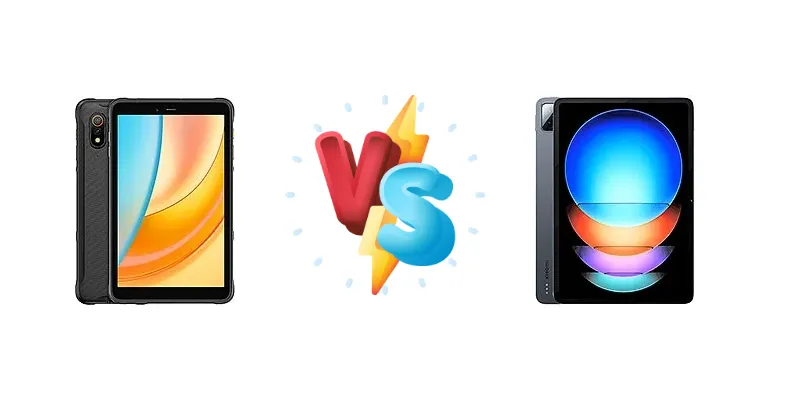
The tablet market is bifurcating: productivity-focused slates demanding power and features, and ruggedized tablets built for harsh environments. The Ulefone Armor Pad Pro caters to the latter, prioritizing durability and longevity, while the Xiaomi Pad 6S Pro 12.4 aims for the former, boasting a flagship Snapdragon processor and a vibrant display. This comparison dissects these contrasting philosophies to determine which tablet best suits your needs.
🏆 Quick Verdict
For the average user prioritizing performance and a premium experience, the Xiaomi Pad 6S Pro 12.4 is the clear winner. Its Snapdragon 8 Gen 2 chipset delivers significantly faster processing speeds and superior graphics capabilities. However, if durability and extended battery life in remote locations are paramount, the Ulefone Armor Pad Pro offers a compelling, albeit less powerful, alternative.
| Network |
|---|
| 2G bands | GSM 850 / 900 / 1800 / 1900 | N/A |
| 3G bands | HSDPA 850 / 900 / 1700(AWS) / 1900 / 2100 | N/A |
| 4G bands | 1, 2, 3, 4, 5, 7, 8, 12, 17, 19, 20, 28, 38, 40, 41 | - |
| EDGE | - | N/A |
| GPRS | - | N/A |
| Speed | HSPA, LTE | - |
| Technology | GSM / HSPA / LTE | No cellular connectivity |
| Launch |
|---|
| Announced | 2024, April | 2024, February 22 |
| Status | Available. Released 2024, April | Available. Released 2024, February 22 |
| Body |
|---|
| Build | - | Glass front (Gorilla Glass 5), aluminum frame, aluminum back |
| Dimensions | 213 x 128.8 x 14 mm (8.39 x 5.07 x 0.55 in) | 278.7 x 191.6 x 6.3 mm (10.97 x 7.54 x 0.25 in) |
| SIM | Nano-SIM + Nano-SIM | No |
| Weight | 560 g (1.23 lb) | 590 g (1.30 lb) |
| Display |
|---|
| Protection | Mohs level 4 | Corning Gorilla Glass 5 |
| Resolution | 800 x 1280 pixels, 16:10 ratio (~189 ppi density) | 2032 x 3048 pixels, 3:2 ratio (~295 ppi density) |
| Size | 8.0 inches, 185.6 cm2 (~67.6% screen-to-body ratio) | 12.4 inches, 457.8 cm2 (~85.7% screen-to-body ratio) |
| Type | IPS LCD | IPS LCD, 68B colors, 144Hz, HDR10, Dolby Vision, 900 nits (peak) |
| Platform |
|---|
| CPU | Octa-core (4x2.0 GHz Cortex-A73 & 4x2.0 GHz Cortex-A53) | Octa-core (1x3.2 GHz Cortex-X3 & 2x2.8 GHz Cortex-A715 & 2x2.8 GHz Cortex-A710 & 3x2.0 GHz Cortex-A510) |
| Chipset | Mediatek MT8788 (12 nm) | Qualcomm SM8550-AB Snapdragon 8 Gen 2 (4 nm) |
| GPU | Mali-G72 MP3 | Adreno 740 |
| OS | Android 13 | Android 14, up to 3 major Android upgrades, HyperOS |
| Memory |
|---|
| Card slot | microSDXC (dedicated slot) | No |
| Internal | 128GB 8GB RAM | 256GB 8GB RAM, 256GB 12GB RAM, 512GB 12GB RAM, 1TB 16GB RAM |
| Main Camera |
|---|
| Dual | - | 50 MP, f/1.8, (wide), 1/2.76", 0.64µm, PDAF
Auxiliary lens |
| Features | LED flash, HDR, panorama | LED flash, HDR, panorama |
| Single | 48 MP, f/1.8, (wide), 1/2.25", 0.8µm | - |
| Video | 1080p@30fps | 4K@30/60fps, 1080p@30/60fps |
| Selfie camera |
|---|
| Single | 32 MP, f/2.2, (wide), 1/2.8", 0.8µm | 32 MP, f/2.2, (wide), 1/3.6", 0.61µm |
| Video | Yes | 1080p@30fps |
| Sound |
|---|
| 35mm jack | Yes | No |
| Loudspeaker | Yes, with stereo speakers | Yes, with stereo speakers (6 speakers) |
| Comms |
|---|
| Bluetooth | 4.2, A2DP | 5.3, A2DP, LE, LHDC |
| NFC | Yes | Yes (file transfer only) |
| Positioning | GPS, GLONASS, GALILEO, BDS | No |
| Radio | Wireless FM radio, RDS, recording | No |
| USB | USB Type-C 2.0, magnetic connector | USB Type-C 3.2, accessory connector |
| WLAN | Wi-Fi 802.11 a/b/g/n/ac, dual-band | Wi-Fi 802.11 a/b/g/n/a/6/7, dual-band, Wi-Fi Direct |
| Features |
|---|
| Sensors | Fingerprint (side-mounted), accelerometer, gyro, proximity, compass | Fingerprint (side-mounted), accelerometer, gyro, proximity (accessories only), compass |
| Battery |
|---|
| Charging | 18W wired | 120W wired, PD3.0, QC4, 45% in 10 min, 100% in 35 min |
| Type | Li-Po 7650 mAh | 10000 mAh |
| Misc |
|---|
| Colors | Black | Black, Blue, Green |
| Models | - | 24018RPACG |
| Price | About 200 EUR | About 700 EUR |
| SAR EU | - | 0.99 W/kg (body) |
| EU LABEL |
|---|
| Battery | 83:38h endurance, 1000 cycles | - |
| Energy | Class F | - |
| Free fall | Class A (270 falls) | - |
| Repairability | Class C | - |
Ulefone Armor Pad Pro
- Exceptional battery endurance (83:38h)
- Ruggedized design for extreme durability
- Long battery lifespan (1000 charge cycles)
- Outdated Mediatek MT8788 chipset
- Slow 18W charging
- Display specifications are comparatively basic
Xiaomi Pad 6S Pro 12.4
- Flagship Snapdragon 8 Gen 2 performance
- Fast 120W charging (0-100% in 35 minutes)
- Bright and high-contrast 12.4-inch display
- Shorter battery endurance (11:14h)
- Less durable build quality
- Higher price point
Display Comparison
The Xiaomi Pad 6S Pro 12.4 immediately distinguishes itself with a measured peak brightness of 848 nits and a 1378:1 contrast ratio, offering a significantly more vivid and engaging viewing experience than the Ulefone Armor Pad Pro (brightness data unavailable). While the Ulefone prioritizes a robust screen, the Xiaomi’s superior contrast and brightness are crucial for outdoor visibility and content consumption. The Xiaomi likely employs an IPS LCD panel, while the Ulefone's panel type is unspecified, but likely optimized for durability rather than color accuracy.
Camera Comparison
Neither tablet is positioned as a photography powerhouse, but the Xiaomi Pad 6S Pro 12.4 likely benefits from Qualcomm’s image signal processor (ISP) within the Snapdragon 8 Gen 2. While specific camera specs are unavailable for both, the Xiaomi’s chipset provides a foundation for better image processing and potentially superior low-light performance. The Ulefone’s camera system is likely focused on basic functionality, sufficient for documentation but not for serious photography.
Performance
The performance gap is substantial. The Xiaomi Pad 6S Pro 12.4’s Qualcomm Snapdragon 8 Gen 2 (4nm) is a generational leap ahead of the Ulefone Armor Pad Pro’s Mediatek MT8788 (12nm). The Snapdragon 8 Gen 2 features a prime Cortex-X3 core clocked at 3.2 GHz, alongside high-performance A715 and A710 cores, versus the Ulefone’s older Cortex-A73 and A53 architecture. This translates to significantly faster app loading times, smoother multitasking, and a far superior gaming experience on the Xiaomi. The 4nm process node of the Snapdragon also contributes to better thermal efficiency, minimizing throttling during sustained workloads.
Battery Life
The Ulefone Armor Pad Pro boasts an impressive 83:38h endurance score, suggesting exceptional battery life. However, the Xiaomi Pad 6S Pro 12.4, despite a shorter active use score of 11:14h, compensates with incredibly fast 120W wired charging, achieving 45% charge in just 10 minutes and a full charge in 35 minutes. This rapid charging capability mitigates the impact of a potentially smaller battery capacity. Furthermore, the Ulefone’s advertised 1000 charge cycles suggest a longer lifespan for the battery itself, reducing the need for replacement over time.
Buying Guide
Buy the Ulefone Armor Pad Pro if you need a tablet that can withstand drops, dust, and water, and if long-term battery health is a priority due to its 1000 cycle rating. This is ideal for field workers, construction professionals, or anyone frequently operating in challenging conditions. Buy the Xiaomi Pad 6S Pro 12.4 if you prioritize raw processing power for demanding tasks like video editing, gaming, or running complex applications, and if you value a stunning display and incredibly fast charging speeds.
Frequently Asked Questions
❓ Is the Ulefone Armor Pad Pro truly waterproof and dustproof? What certifications does it hold?
The Ulefone Armor Pad Pro is marketed as a rugged tablet, but specific IP ratings (e.g., IP68) are crucial for verifying its water and dust resistance. Users should confirm the exact certification level to understand the extent of its protection against ingress. This is a key differentiator for its target audience.
❓ How well does the Xiaomi Pad 6S Pro 12.4 handle sustained gaming sessions? Will the Snapdragon 8 Gen 2 throttle under load?
The Snapdragon 8 Gen 2 is designed for sustained performance, and its 4nm process node contributes to better thermal efficiency. However, throttling can still occur during extended, graphically intensive gaming. The Xiaomi Pad 6S Pro 12.4 likely incorporates thermal management solutions, but real-world performance will depend on ambient temperature and game settings.
❓ Can the Ulefone Armor Pad Pro be easily repaired if the screen is damaged, given its ruggedized construction?
Repairing a ruggedized tablet like the Ulefone Armor Pad Pro can be more complex and potentially expensive than repairing a standard tablet. The reinforced construction and specialized seals may require professional repair services and specialized parts. Users should factor in potential repair costs when considering this device.