
Ulefone Armor Pad Pro vs. Samsung Galaxy Tab Active5 Pro: A Rugged Tablet Showdown
| Phones Images | |||||
|---|---|---|---|---|---|
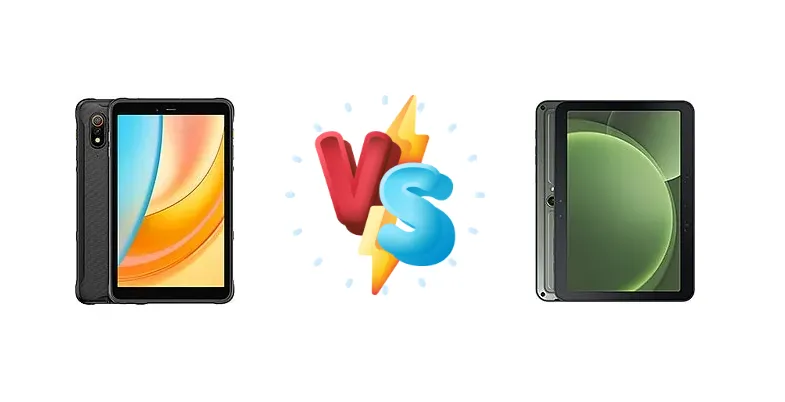
|
🏆 Quick Verdict
For users prioritizing absolute battery life and a lower price point, the Ulefone Armor Pad Pro is the clear winner. However, the Samsung Galaxy Tab Active5 Pro delivers significantly better performance and a longer-term battery health promise thanks to its superior chipset and cycle count, making it the better investment for professionals relying on consistent speed.
| PHONES | ||
|---|---|---|
| Phone Names | Ulefone Armor Pad Pro | Samsung Galaxy Tab Active5 Pro |
| Network | ||
|---|---|---|
| 2G bands | GSM 850 / 900 / 1800 / 1900 | GSM 850 / 900 / 1800 / 1900 |
| 3G bands | HSDPA 850 / 900 / 1700(AWS) / 1900 / 2100 | HSDPA 850 / 900 / 1700(AWS) / 1900 / 2100 |
| 4G bands | 1, 2, 3, 4, 5, 7, 8, 12, 17, 19, 20, 28, 38, 40, 41 | 1, 2, 3, 4, 5, 7, 8, 12, 13, 17, 20, 25, 26, 28, 32, 38, 40, 41, 66, 68 |
| 5G bands | - | 1, 3, 5, 7, 8, 20, 26, 28, 38, 40, 41, 66, 71, 77, 78 SA/NSA/Sub6 |
| Speed | HSPA, LTE | HSPA, LTE, 5G - cellular model only |
| Technology | GSM / HSPA / LTE | GSM / HSPA / LTE / 5G |
| Launch | ||
|---|---|---|
| Announced | 2024, April | 2025, April 14 |
| Status | Available. Released 2024, April | Available. Released 2025, May 07 |
| Body | ||
|---|---|---|
| Dimensions | 213 x 128.8 x 14 mm (8.39 x 5.07 x 0.55 in) | 242.9 x 170.2 x 10.2 mm (9.56 x 6.70 x 0.40 in) |
| SIM | Nano-SIM + Nano-SIM | Nano-SIM + eSIM (cellular model only) |
| Weight | 560 g (1.23 lb) | 680 g or 683 g (1.50 lb) |
| Display | ||
|---|---|---|
| Protection | Mohs level 4 | Corning Gorilla Glass Victus+, Mohs level 5 |
| Resolution | 800 x 1280 pixels, 16:10 ratio (~189 ppi density) | 1920 x 1200 pixels, 16:10 ratio (~224 ppi density) |
| Size | 8.0 inches, 185.6 cm2 (~67.6% screen-to-body ratio) | 10.1 inches, 295.8 cm2 (~71.5% screen-to-body ratio) |
| Type | IPS LCD | TFT LCD, 120Hz |
| Platform | ||
|---|---|---|
| CPU | Octa-core (4x2.0 GHz Cortex-A73 & 4x2.0 GHz Cortex-A53) | Octa-core (1x2.5 GHz Cortex-A720 & 3x2.4 GHz Cortex-A720 & 4x1.8 GHz Cortex-A520) |
| Chipset | Mediatek MT8788 (12 nm) | Qualcomm SM7635 Snapdragon 7s Gen 3 (4 nm) |
| GPU | Mali-G72 MP3 | Adreno 810 |
| OS | Android 13 | Android 15, One UI 7 |
| Memory | ||
|---|---|---|
| Card slot | microSDXC (dedicated slot) | microSDXC (dedicated slot) |
| Internal | 128GB 8GB RAM | 128GB 6GB RAM, 256GB 8GB RAM |
| Main Camera | ||
|---|---|---|
| Features | LED flash, HDR, panorama | LED flash, HDR, panorama |
| Single | 48 MP, f/1.8, (wide), 1/2.25", 0.8µm | 12 MP, f/1.8, AF |
| Video | 1080p@30fps | 4K@30fps, 1080p@30fps |
| Selfie camera | ||
|---|---|---|
| Single | 32 MP, f/2.2, (wide), 1/2.8", 0.8µm | 8 MP, f/2.0 |
| Video | Yes | 1080p@30fps |
| Sound | ||
|---|---|---|
| 35mm jack | Yes | Yes |
| Loudspeaker | Yes, with stereo speakers | Yes, with stereo speakers (with Dolby Atmos) |
| Comms | ||
|---|---|---|
| Bluetooth | 4.2, A2DP | 5.4, A2DP, LE |
| NFC | Yes | Yes |
| Positioning | GPS, GLONASS, GALILEO, BDS | GPS, GLONASS, BDS, GALILEO, QZSS - cellular model only |
| Radio | Wireless FM radio, RDS, recording | No |
| USB | USB Type-C 2.0, magnetic connector | USB Type-C 3.2, charging/accessories connector pins |
| WLAN | Wi-Fi 802.11 a/b/g/n/ac, dual-band | Wi-Fi 802.11 a/b/g/n/ac/6e, tri-band, Wi-Fi Direct |
| Features | ||
|---|---|---|
| Sensors | Fingerprint (side-mounted), accelerometer, gyro, proximity, compass | Fingerprint (front-mounted), accelerometer, proximity, gyro, compass, proximity (accessories only) |
| Battery | ||
|---|---|---|
| Charging | 18W wired | - |
| Type | Li-Po 7650 mAh | Li-Po 10100 mAh, removable |
| Misc | ||
|---|---|---|
| Colors | Black | Green |
| Models | - | SM-X356B, SM-X350 |
| Price | About 200 EUR | About 900 EUR |
| SAR EU | - | 1.31 W/kg (body) |
| EU LABEL | ||
|---|---|---|
| Battery | 83:38h endurance, 1000 cycles | 142:50h endurance, 2000 cycles |
| Energy | Class F | Class E |
| Free fall | Class A (270 falls) | Class E (0 falls) |
| Repairability | Class C | Class B |
Ulefone Armor Pad Pro
- Exceptional battery endurance (83:38h)
- Lower price point
- Ruggedized design for harsh environments
- Older, less powerful chipset
- Limited battery cycle count (1000)
- Slower charging speed (18W)
Samsung Galaxy Tab Active5 Pro
- Significantly faster and more efficient Snapdragon 7s Gen 3 chipset
- Double the battery cycle count (2000)
- Likely faster charging support
- Higher price
- Shorter battery endurance compared to Ulefone (though still excellent)
- May require more frequent charging
Display Comparison
Neither device boasts a cutting-edge display. Details on panel type (IPS, TFT) and resolution are missing, but both are likely geared towards practicality over visual fidelity. The focus is on readability in harsh conditions. However, the Samsung’s chipset allows for potentially better image processing and color calibration. The Ulefone’s display is likely optimized for power efficiency, contributing to its longer battery life.
Camera Comparison
Camera performance is unlikely to be a primary concern for these devices, but the Samsung likely holds an advantage. While specific sensor details are missing, Samsung generally employs more sophisticated image processing algorithms. The Ulefone’s camera is likely a basic module for quick documentation. Given the target audience, both tablets likely prioritize functionality over photographic quality.
Performance
The performance gap is substantial. The Samsung Galaxy Tab Active5 Pro’s Qualcomm SM7635 Snapdragon 7s Gen 3 (4nm) is a significant leap forward from the Ulefone’s Mediatek MT8788 (12nm). The Snapdragon’s newer architecture (Cortex-A720 cores) and smaller fabrication node translate to greater processing power and improved thermal efficiency. This means the Samsung will handle multitasking, demanding apps, and graphics-intensive tasks with ease, while the Ulefone may exhibit slowdowns under heavy load. The Snapdragon’s Adreno GPU also provides a superior graphics experience. The Ulefone’s older Cortex-A73/A53 cores are adequate for basic tasks but will struggle with modern workloads.
Battery Life
Battery life is where the Ulefone truly shines, boasting an impressive 83:38h endurance. However, the Samsung counters with a substantial 142:50h endurance. This difference is partially attributable to the more efficient Snapdragon chipset. Crucially, the Samsung also offers 2000 battery cycles compared to the Ulefone’s 1000, indicating a longer lifespan and sustained performance over time. While the Ulefone offers faster initial usage, the Samsung provides greater long-term reliability. The Ulefone’s 18W charging is slower than what the Samsung likely supports (details missing), further emphasizing the Samsung’s convenience.
Buying Guide
Buy the Ulefone Armor Pad Pro if you need a tablet primarily for tasks like reading schematics, basic data entry, or long shifts where access to power is limited. Its exceptional 83:38h battery endurance is unmatched. Buy the Samsung Galaxy Tab Active5 Pro if you prefer a smoother, more responsive experience for demanding applications like CAD software, video conferencing, or running multiple apps simultaneously. The Snapdragon 7s Gen 3 and 2000 battery cycles offer a more robust and future-proof solution.