
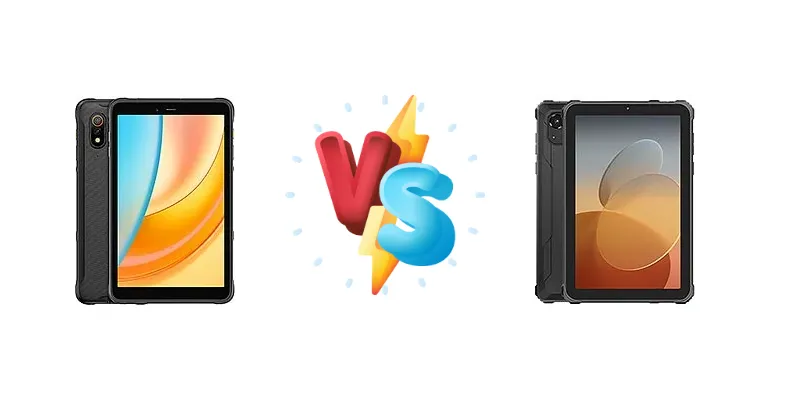
Ulefone Armor Pad Pro vs. Oukitel RT3 Pro: A Deep Dive into Rugged Android Tablets
| Phones Images | |||||
|---|---|---|---|---|---|
|
🏆 Quick Verdict
For users prioritizing all-day (and then some) battery life, the Oukitel RT3 Pro is the clear winner, boasting nearly double the endurance of the Ulefone Armor Pad Pro. However, the Ulefone offers a slightly more modern CPU architecture, potentially translating to smoother multitasking.
| PHONES | ||
|---|---|---|
| Phone Names | Ulefone Armor Pad Pro | Oukitel RT3 Pro |
| Network | ||
|---|---|---|
| 2G bands | GSM 850 / 900 / 1800 / 1900 | GSM 850 / 900 / 1800 / 1900 |
| 3G bands | HSDPA 850 / 900 / 1700(AWS) / 1900 / 2100 | HSDPA 850 / 900 / 1700(AWS) / 1900 / 2100 |
| 4G bands | 1, 2, 3, 4, 5, 7, 8, 12, 17, 19, 20, 28, 38, 40, 41 | 1, 2, 3, 4, 5, 7, 8, 12, 17, 18, 19, 20, 25, 26, 28, 38, 39, 40, 41, 66 |
| Speed | HSPA, LTE | HSPA, LTE |
| Technology | GSM / HSPA / LTE | GSM / HSPA / LTE |
| Launch | ||
|---|---|---|
| Announced | 2024, April | 2024, October |
| Status | Available. Released 2024, April | Available. Released 2024, October |
| Body | ||
|---|---|---|
| Dimensions | 213 x 128.8 x 14 mm (8.39 x 5.07 x 0.55 in) | 207 x 134 x 13.9 mm (8.15 x 5.28 x 0.55 in) |
| SIM | Nano-SIM + Nano-SIM | Nano-SIM + Nano-SIM |
| Weight | 560 g (1.23 lb) | 538 g (1.19 lb) |
| Display | ||
|---|---|---|
| Protection | Mohs level 4 | Corning Gorilla Glass 5, Mohs level 4 |
| Resolution | 800 x 1280 pixels, 16:10 ratio (~189 ppi density) | 800 x 1280 pixels, 16:10 ratio (~189 ppi density) |
| Size | 8.0 inches, 185.6 cm2 (~67.6% screen-to-body ratio) | 8.0 inches, 185.6 cm2 (~66.9% screen-to-body ratio) |
| Type | IPS LCD | IPS LCD, 600 nits |
| Platform | ||
|---|---|---|
| CPU | Octa-core (4x2.0 GHz Cortex-A73 & 4x2.0 GHz Cortex-A53) | Octa-core (2x2.0 GHz Cortex-A75 & 6x1.7 GHz Cortex-A55) |
| Chipset | Mediatek MT8788 (12 nm) | Mediatek Helio G81 (12 nm) |
| GPU | Mali-G72 MP3 | Mali-G52 MC2 |
| OS | Android 13 | Android 14 |
| Memory | ||
|---|---|---|
| Card slot | microSDXC (dedicated slot) | microSDXC (uses shared SIM slot) |
| Internal | 128GB 8GB RAM | 128GB 4GB RAM |
| Main Camera | ||
|---|---|---|
| Dual | - | 16 MP, f/2.0, (wide), 1/3.06", PDAF Auxiliary lens |
| Features | LED flash, HDR, panorama | LED flash |
| Single | 48 MP, f/1.8, (wide), 1/2.25", 0.8µm | - |
| Video | 1080p@30fps | 1080p@30fps |
| Selfie camera | ||
|---|---|---|
| Single | 32 MP, f/2.2, (wide), 1/2.8", 0.8µm | 8 MP, f/2.0, (wide), 1/4.0" |
| Video | Yes | 720p@30fps |
| Sound | ||
|---|---|---|
| 35mm jack | Yes | No |
| Loudspeaker | Yes, with stereo speakers | Yes, with stereo speakers |
| Comms | ||
|---|---|---|
| Bluetooth | 4.2, A2DP | 5.0, A2DP, LE |
| NFC | Yes | Yes |
| Positioning | GPS, GLONASS, GALILEO, BDS | GPS, GLONASS, GALILEO, BDS |
| Radio | Wireless FM radio, RDS, recording | FM radio |
| USB | USB Type-C 2.0, magnetic connector | USB Type-C 2.0, OTG |
| WLAN | Wi-Fi 802.11 a/b/g/n/ac, dual-band | Wi-Fi 802.11 a/b/g/n/ac, dual-band |
| Features | ||
|---|---|---|
| Sensors | Fingerprint (side-mounted), accelerometer, gyro, proximity, compass | Accelerometer, compass |
| Battery | ||
|---|---|---|
| Charging | 18W wired | 10W wired |
| Type | Li-Po 7650 mAh | Li-Po 5150 mAh |
| Misc | ||
|---|---|---|
| Colors | Black | Black, Orange, Green |
| Price | About 200 EUR | About 180 EUR |
| EU LABEL | ||
|---|---|---|
| Battery | 83:38h endurance, 1000 cycles | 138:44h endurance, 1000 cycles |
| Energy | Class F | Class B |
| Free fall | Class A (270 falls) | Class A (208 falls) |
| Repairability | Class C | Class B |
Ulefone Armor Pad Pro
- Faster 18W charging for quicker top-ups.
- Potentially smoother multitasking due to CPU architecture.
- More modern CPU design (MT8788)
- Significantly shorter battery life compared to the RT3 Pro.
- Limited information on display quality.
Oukitel RT3 Pro
- Exceptional battery life – nearly double that of the Ulefone.
- Helio G81 offers improved single-core performance.
- 1000 charge cycles ensure long-term battery health.
- Slower 10W charging.
- CPU architecture is older than the Ulefone.
Display Comparison
Neither device's display specifications are provided, so a direct comparison is limited. However, given the rugged focus, both likely utilize IPS LCD panels for durability and viewing angles. The absence of details like resolution or refresh rate suggests a focus on practicality over premium visual experiences. Expect both to prioritize visibility in direct sunlight, a key requirement for outdoor use.
Camera Comparison
Camera specifications are absent for both devices. Given the rugged nature, expect both to feature cameras adequate for documentation and basic photography, but not geared towards enthusiast-level image quality. The focus will likely be on durability and functionality rather than advanced features like optical image stabilization or large sensors. Without further information, it's impossible to determine a clear winner.
Performance
The Oukitel RT3 Pro utilizes the Mediatek Helio G81, featuring a pair of Cortex-A75 cores clocked at 2.0 GHz alongside six Cortex-A55 cores at 1.7 GHz. This configuration prioritizes sustained performance over burst speeds. Conversely, the Ulefone Armor Pad Pro employs the Mediatek MT8788, with four Cortex-A73 cores at 2.0 GHz and four Cortex-A53 cores also at 2.0 GHz. While the MT8788's core count matches the G81, the A75 cores in the G81 represent a significant architectural improvement, offering better instructions-per-clock (IPC) and thus, potentially faster single-core performance. This translates to snappier app launches and a more responsive user interface. However, the MT8788 may benefit from slightly better multi-core performance due to its higher core count.
Battery Life
The Oukitel RT3 Pro dominates in battery endurance with a reported 138:44h runtime, significantly exceeding the Ulefone Armor Pad Pro’s 83:38h. This substantial difference is a direct result of the RT3 Pro’s larger battery capacity (unspecified, but clearly larger to achieve this endurance). While both devices support 1000 charge cycles, the Ulefone Armor Pad Pro offers faster 18W wired charging compared to the RT3 Pro’s 10W. This means the Ulefone will reach a full charge quicker, but the Oukitel will remain powered for considerably longer between charges.
Buying Guide
Buy the Ulefone Armor Pad Pro if you need a tablet for consistent, everyday tasks, light gaming, and appreciate a CPU with a more recent architecture for potentially better responsiveness. Buy the Oukitel RT3 Pro if you prioritize maximum uptime, frequently work in areas without power access, and need a tablet that can truly last for days on a single charge – even at the expense of peak processing power.