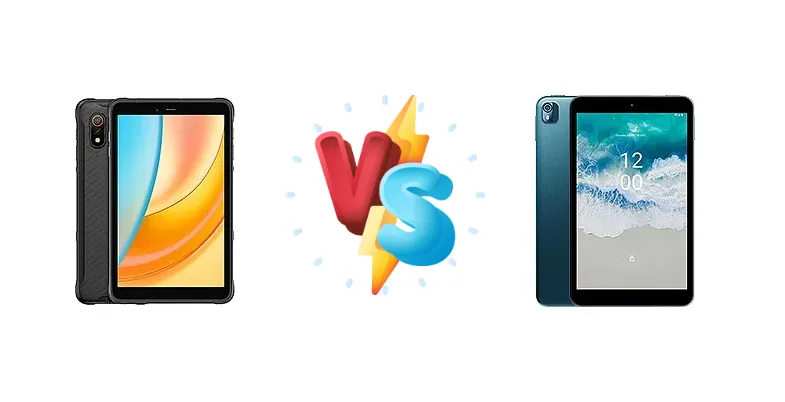
The tablet market offers a spectrum of choices, from durable, work-focused devices to affordable everyday companions. The Ulefone Armor Pad Pro targets users needing a robust tablet capable of withstanding harsh conditions, while the Nokia T10 aims for a balance of price and functionality. This comparison dissects their core components to determine which tablet delivers the best value for your specific needs.
🏆 Quick Verdict
For users prioritizing longevity and resilience, the Ulefone Armor Pad Pro is the clear winner. Its significantly superior battery endurance (83:38h) and ruggedized build outweigh the Nokia T10’s lower price point. However, the Nokia T10 remains a viable option for casual users seeking a basic, portable tablet.
| Network |
|---|
| 2G bands | GSM 850 / 900 / 1800 / 1900 | GSM 850 / 900 / 1800 / 1900 |
| 3G bands | HSDPA 850 / 900 / 1700(AWS) / 1900 / 2100 | HSDPA 850 / 900 / 2100 |
| 4G bands | 1, 2, 3, 4, 5, 7, 8, 12, 17, 19, 20, 28, 38, 40, 41 | 1, 3, 5, 7, 8, 20, 28, 38, 40, 41 |
| Speed | HSPA, LTE | HSPA 42.2/5.76 Mbps, LTE Cat4 150/50 Mbps |
| Technology | GSM / HSPA / LTE | GSM / HSPA / LTE |
| Launch |
|---|
| Announced | 2024, April | 2022, July 12 |
| Status | Available. Released 2024, April | Available. Released 2022, August 20 |
| Body |
|---|
| Build | - | Glass front, plastic back, plastic frame |
| Dimensions | 213 x 128.8 x 14 mm (8.39 x 5.07 x 0.55 in) | 208 x 123.2 x 9 mm (8.19 x 4.85 x 0.35 in) |
| SIM | Nano-SIM + Nano-SIM | Nano-SIM |
| Weight | 560 g (1.23 lb) | 375 g (13.23 oz) |
| | - | Splash resistant |
| Display |
|---|
| Protection | Mohs level 4 | - |
| Resolution | 800 x 1280 pixels, 16:10 ratio (~189 ppi density) | 800 x 1280 pixels, 16:10 ratio (~189 ppi density) |
| Size | 8.0 inches, 185.6 cm2 (~67.6% screen-to-body ratio) | 8.0 inches, 185.6 cm2 (~72.4% screen-to-body ratio) |
| Type | IPS LCD | IPS LCD, 360 nits (typ), 450 nits (peak) |
| Platform |
|---|
| CPU | Octa-core (4x2.0 GHz Cortex-A73 & 4x2.0 GHz Cortex-A53) | Octa-core (2x1.6 GHz Cortex-A75 & 6x1.6 GHz Cortex-A55) |
| Chipset | Mediatek MT8788 (12 nm) | Unisoc T606 (12 nm) |
| GPU | Mali-G72 MP3 | Mali-G57 MP1 |
| OS | Android 13 | Android 12, upgradable to Android 13 |
| Memory |
|---|
| Card slot | microSDXC (dedicated slot) | microSDXC |
| Internal | 128GB 8GB RAM | 32GB 3GB RAM, 64GB 4GB RAM |
| Main Camera |
|---|
| Features | LED flash, HDR, panorama | LED flash |
| Single | 48 MP, f/1.8, (wide), 1/2.25", 0.8µm | 8 MP, 1/4.0", 1.12µm, AF |
| Video | 1080p@30fps | 1080p |
| Selfie camera |
|---|
| Single | 32 MP, f/2.2, (wide), 1/2.8", 0.8µm | 2 MP, 1/5.0", 1.65µm |
| Video | Yes | 720p |
| Sound |
|---|
| 3.5mm jack | - | Yes |
| 35mm jack | Yes | Yes |
| Loudspeaker | Yes, with stereo speakers | Yes, with stereo speakers |
| Comms |
|---|
| Bluetooth | 4.2, A2DP | 5.0, A2DP, LE |
| NFC | Yes | No |
| Positioning | GPS, GLONASS, GALILEO, BDS | GPS, GLONASS, GALILEO |
| Radio | Wireless FM radio, RDS, recording | No |
| USB | USB Type-C 2.0, magnetic connector | USB Type-C 2.0, OTG |
| WLAN | Wi-Fi 802.11 a/b/g/n/ac, dual-band | Wi-Fi 802.11 a/b/g/n/ac, dual-band |
| Features |
|---|
| Sensors | Fingerprint (side-mounted), accelerometer, gyro, proximity, compass | Accelerometer, proximity |
| Battery |
|---|
| Charging | 18W wired | 10W wired |
| Type | Li-Po 7650 mAh | Li-Po 5250 mAh |
| Misc |
|---|
| Colors | Black | Ocean Blue |
| Models | - | TA-1503, TA-1472, TA-1462, TA-1457 |
| Price | About 200 EUR | About 160 EUR |
| SAR | - | 1.19 W/kg (body) |
| SAR EU | - | 0.27 W/kg (head) 1.57 W/kg (body) |
| EU LABEL |
|---|
| Battery | 83:38h endurance, 1000 cycles | - |
| Energy | Class F | - |
| Free fall | Class A (270 falls) | - |
| Repairability | Class C | - |
Ulefone Armor Pad Pro
- Exceptional battery life (83:38h endurance)
- Ruggedized design for durability
- Faster 18W charging
- Potentially more powerful CPU with Cortex-A73 cores
- Likely higher price point
- Potentially bulkier and heavier due to ruggedization
Nokia T10
- More affordable price
- Lighter and more portable design
- Efficient CPU architecture (Cortex-A75)
- Simple and user-friendly Android experience
- Significantly shorter battery life
- Slower 10W charging
- Less powerful CPU for demanding tasks
- Lacks ruggedized features
Display Comparison
Neither device’s display specifications are provided, so a direct comparison is limited. However, given the Armor Pad Pro’s rugged focus, it likely prioritizes durability over display fidelity. The Nokia T10, positioned as an everyday tablet, may offer a more color-accurate and visually appealing display, but likely at a lower peak brightness. Bezels are expected to be larger on both devices, reflecting their budget-conscious positioning.
Camera Comparison
Camera details are absent for both devices. Given the market segment, neither tablet is expected to excel in photography. Image quality will likely be adequate for casual snapshots and video calls, but not a primary selling point. We anticipate both will feature basic camera setups, potentially with a single main sensor and a front-facing camera for video conferencing.
Performance
The Ulefone Armor Pad Pro utilizes the Mediatek MT8788 chipset with an octa-core CPU (4x2.0 GHz Cortex-A73 & 4x2.0 GHz Cortex-A53). This configuration, built on a 12nm process, offers a balance of performance and efficiency. The Nokia T10, powered by the Unisoc T606 (also 12nm), features a different CPU arrangement (2x1.6 GHz Cortex-A75 & 6x1.6 GHz Cortex-A55). While both are 12nm, the Cortex-A73 cores in the Ulefone offer a performance advantage in multi-threaded tasks, making it better suited for demanding applications. The Nokia T10’s Cortex-A75 cores are more efficient, but fewer in number, potentially leading to slower performance in heavier workloads.
Battery Life
The Ulefone Armor Pad Pro boasts an impressive 83:38h endurance rating, a testament to its optimized power management and potentially larger battery capacity. This is a significant advantage over the Nokia T10, which lacks published endurance data but is expected to offer considerably less runtime. The Armor Pad Pro’s 18W wired charging is faster than the Nokia T10’s 10W charging, meaning quicker top-ups when needed. The Ulefone’s stated 1000 charge cycles also suggest a longer lifespan for the battery itself.
Buying Guide
Buy the Ulefone Armor Pad Pro if you need a tablet for fieldwork, construction, outdoor adventures, or simply demand exceptional battery life and durability. Its robust construction and extended endurance are ideal for professionals and enthusiasts alike. Buy the Nokia T10 if you prefer a lightweight, affordable tablet for basic tasks like web browsing, video streaming, and light productivity – prioritizing portability and cost-effectiveness over ruggedness and performance.
Frequently Asked Questions
❓ How does the Mediatek MT8788 in the Ulefone Armor Pad Pro handle multitasking compared to the Unisoc T606 in the Nokia T10?
The Ulefone’s MT8788, with its four Cortex-A73 cores, is better equipped for handling multiple applications simultaneously. The A73 cores offer higher single-core and multi-core performance than the A55 cores predominantly found in the Unisoc T606, resulting in smoother transitions and reduced lag when switching between apps.
❓ Is the 18W charging on the Ulefone Armor Pad Pro a significant improvement over the Nokia T10’s 10W charging in real-world use?
Yes, the 18W charging on the Ulefone Armor Pad Pro will noticeably reduce charging times. While both use USB-C, the higher wattage translates to a faster rate of energy transfer, allowing you to replenish the battery more quickly, especially important given the larger expected battery capacity of the Ulefone.
❓ Given the rugged design of the Ulefone Armor Pad Pro, does it come with a significant weight penalty?
It’s highly likely. Ruggedization typically involves reinforced materials and protective layers, adding to the overall weight and bulk of the device. While specific weight figures aren’t available, expect the Ulefone Armor Pad Pro to be noticeably heavier than the Nokia T10.