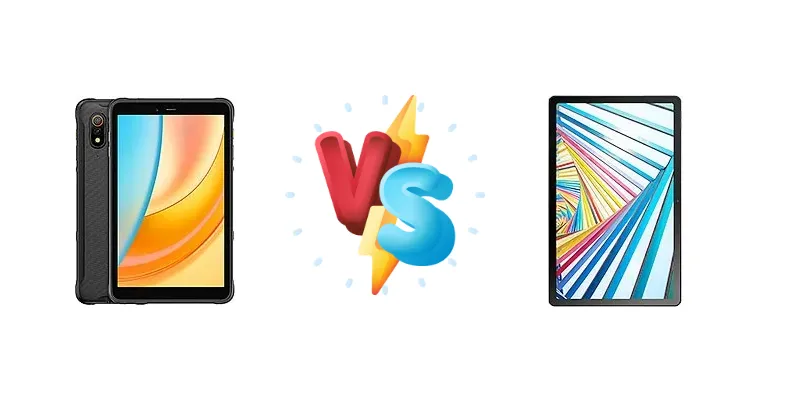
The tablet market caters to diverse needs, from robust, field-ready devices to streamlined entertainment hubs. The Ulefone Armor Pad Pro targets users demanding durability and extended battery life, while the Lenovo Tab M10 Plus (3rd Gen) prioritizes everyday usability and a more accessible price point. This comparison dissects their core components to determine which tablet best suits your requirements.
🏆 Quick Verdict
For users prioritizing longevity and resilience, the Ulefone Armor Pad Pro is the clear winner. Its exceptional 83:38h battery endurance and ruggedized build outweigh the Lenovo Tab M10 Plus’s slightly faster charging and potentially more efficient chipset. However, the Lenovo offers a better balance for casual users.
| Network |
|---|
| 2G bands | GSM 850 / 900 / 1800 / 1900 | GSM 850 / 900 / 1800 / 1900 |
| 3G bands | HSDPA 850 / 900 / 1700(AWS) / 1900 / 2100 | HSDPA 800 / 850 / 900 / 1900 / 2100 |
| 4G bands | 1, 2, 3, 4, 5, 7, 8, 12, 17, 19, 20, 28, 38, 40, 41 | 1, 2, 3, 4, 5, 7, 8, 19, 20, 26, 28, 28, 38, 40, 41 |
| Speed | HSPA, LTE | HSPA 42.2/5.76 Mbps, LTE Cat13 390/75 Mbps - cellular model only |
| Technology | GSM / HSPA / LTE | GSM / HSPA / LTE |
| Launch |
|---|
| Announced | 2024, April | 2022, May |
| Status | Available. Released 2024, April | Available. Released 2022, May |
| Body |
|---|
| Dimensions | 213 x 128.8 x 14 mm (8.39 x 5.07 x 0.55 in) | 251.2 x 158.8 x 7.5 mm (9.89 x 6.25 x 0.30 in) |
| SIM | Nano-SIM + Nano-SIM | Nano-SIM (cellular model only) |
| Weight | 560 g (1.23 lb) | 465 g (1.03 lb) |
| | - | Stylus support |
| Display |
|---|
| Protection | Mohs level 4 | - |
| Resolution | 800 x 1280 pixels, 16:10 ratio (~189 ppi density) | 1200 x 2000 pixels, 5:3 ratio (~220 ppi density) |
| Size | 8.0 inches, 185.6 cm2 (~67.6% screen-to-body ratio) | 10.61 inches, 320.4 cm2 (~80.3% screen-to-body ratio) |
| Type | IPS LCD | IPS LCD, 400 nits (typ) |
| Platform |
|---|
| CPU | Octa-core (4x2.0 GHz Cortex-A73 & 4x2.0 GHz Cortex-A53) | Octa-core (4x2.4 GHz Kryo 265 Gold & 4x1.9 GHz Kryo 265 Silver) - LTE model Octa-core (2x2.0 GHz Cortex-A75 & 6x1.8 GHz Cortex-A55) - Wi-Fi only model |
| Chipset | Mediatek MT8788 (12 nm) | Qualcomm SM6225 Snapdragon 680 4G (6 nm) - LTE model Mediatek MT6769V/CU Helio G80 (12 nm) - Wi-Fi only model |
| GPU | Mali-G72 MP3 | Adreno 610 - LTE model Mali-G52 MC2 - Wi-Fi only model |
| OS | Android 13 | Android 12 |
| Memory |
|---|
| Card slot | microSDXC (dedicated slot) | microSDXC (dedicated slot) |
| Internal | 128GB 8GB RAM | 32GB 3GB RAM, 64GB 4GB RAM, 128GB 4GB RAM, 128GB 6GB RAM |
| | - | eMCP/uMCP |
| Main Camera |
|---|
| Features | LED flash, HDR, panorama | - |
| Single | 48 MP, f/1.8, (wide), 1/2.25", 0.8µm | 8 MP, AF |
| Video | 1080p@30fps | 1080p |
| Selfie camera |
|---|
| Single | 32 MP, f/2.2, (wide), 1/2.8", 0.8µm | 8 MP |
| Video | Yes | - |
| Sound |
|---|
| 3.5mm jack | - | Yes |
| 35mm jack | Yes | Yes |
| Loudspeaker | Yes, with stereo speakers | Yes, with stereo speakers (4 speakers) |
| Comms |
|---|
| Bluetooth | 4.2, A2DP | 5.0, A2DP, LE |
| NFC | Yes | No |
| Positioning | GPS, GLONASS, GALILEO, BDS | GPS, GLONASS, BDS - cellular model only |
| Radio | Wireless FM radio, RDS, recording | FM Radio |
| USB | USB Type-C 2.0, magnetic connector | USB Type-C 2.0 |
| WLAN | Wi-Fi 802.11 a/b/g/n/ac, dual-band | Wi-Fi 802.11 a/b/g/n/ac, dual-band, Wi-Fi Direct |
| Features |
|---|
| Sensors | Fingerprint (side-mounted), accelerometer, gyro, proximity, compass | Accelerometer, proximity, gyro |
| Battery |
|---|
| Charging | 18W wired | 20W wired |
| Type | Li-Po 7650 mAh | Li-Po 7700 mAh |
| Misc |
|---|
| Colors | Black | Storm Grey, Frost Blue |
| Price | About 200 EUR | About 260 EUR |
| EU LABEL |
|---|
| Battery | 83:38h endurance, 1000 cycles | - |
| Energy | Class F | - |
| Free fall | Class A (270 falls) | - |
| Repairability | Class C | - |
Ulefone Armor Pad Pro
- Exceptional battery life (83:38h endurance)
- Ruggedized design for durability
- Long battery lifespan (1000 charge cycles)
- Older chipset (Mediatek MT8788)
- Slower charging speed (18W)
Lenovo Tab M10 Plus (3rd Gen)
- More efficient chipset (Snapdragon 680 - LTE model)
- Faster charging (20W)
- Potentially more affordable
- Significantly shorter battery life
- Less durable build quality
Display Comparison
Neither device’s display specifications are provided, so a direct comparison is limited. However, given the Armor Pad Pro’s rugged focus, it likely prioritizes durability over display fidelity. The Lenovo Tab M10 Plus, positioned as a mainstream device, likely features a more standard IPS LCD panel. The absence of details like resolution, peak brightness, or refresh rate makes a definitive assessment impossible, but the Lenovo is likely to offer a more visually appealing experience in typical indoor conditions.
Camera Comparison
Camera details are absent for both devices, making a meaningful comparison impossible. Given the target audiences, it’s safe to assume neither tablet prioritizes camera quality. Both will likely feature basic cameras suitable for video calls and occasional snapshots, but not for serious photography. The absence of information regarding sensor size, aperture, or image stabilization prevents any further analysis.
Performance
The Lenovo Tab M10 Plus (3rd Gen) offers two chipset options: the Qualcomm Snapdragon 680 (6nm) in the LTE model and the Mediatek Helio G80 (12nm) in the Wi-Fi only version. The Snapdragon 680, built on a 6nm process, provides a significant efficiency advantage over the Ulefone’s Mediatek MT8788 (12nm). While both utilize octa-core CPUs, the Snapdragon 680’s Kryo 265 Gold cores (2.4 GHz) offer a clock speed advantage over the Ulefone’s Cortex-A73 cores (2.0 GHz). This translates to snappier performance in demanding applications. The Wi-Fi only Lenovo model, with the Helio G80, is less efficient and offers lower peak performance than the Snapdragon variant. The Ulefone’s CPU architecture, while capable, is older and less power-efficient.
Battery Life
The Ulefone Armor Pad Pro boasts an impressive 83:38h endurance rating, a testament to its optimized power management and potentially larger battery capacity (though the capacity itself isn't specified). This significantly surpasses what is typically expected from a tablet in this price range. The Lenovo Tab M10 Plus (3rd Gen) offers 20W wired charging, slightly faster than the Ulefone’s 18W charging. However, the Ulefone’s exceptional endurance mitigates the charging speed difference; users will likely need to charge it less frequently. The Ulefone also claims 1000 charge cycles, suggesting a longer lifespan for the battery itself.
Buying Guide
Buy the Ulefone Armor Pad Pro if you need a tablet capable of withstanding harsh environments, require exceptionally long battery life for fieldwork or travel, and value a device built to last. Buy the Lenovo Tab M10 Plus (3rd Gen) if you prefer a lighter, more portable tablet for everyday tasks like streaming, browsing, and light productivity, and prioritize a lower upfront cost.
Frequently Asked Questions
❓ Will the Ulefone Armor Pad Pro’s battery still hold a charge after several years of heavy use, given the 1000 charge cycle claim?
The 1000 charge cycle claim suggests the battery is designed to retain a significant portion of its original capacity even after extensive charging and discharging. While battery degradation is inevitable over time, the Ulefone’s specification indicates a higher level of durability compared to tablets with standard battery designs. However, factors like charging habits and operating temperature will still influence long-term battery health.
❓ Is the Mediatek Helio G80 in the Wi-Fi only Lenovo Tab M10 Plus sufficient for gaming, or should I opt for the Snapdragon 680 LTE model?
The Mediatek Helio G80 can handle casual gaming, but the Snapdragon 680 offers a noticeable performance improvement, particularly for more demanding titles. The Snapdragon 680’s more efficient architecture also results in better thermal management, reducing the likelihood of performance throttling during extended gaming sessions. If gaming is a priority, the LTE model with the Snapdragon 680 is the recommended choice.
❓ How does the ruggedized design of the Ulefone Armor Pad Pro impact its weight and thickness compared to the Lenovo Tab M10 Plus?
The Ulefone Armor Pad Pro’s ruggedized design, incorporating reinforced materials and protective features, will inevitably result in a heavier and thicker device compared to the Lenovo Tab M10 Plus. While specific dimensions aren’t provided, users should expect a trade-off between durability and portability. The Lenovo prioritizes a slimmer profile and lighter weight for enhanced everyday usability.