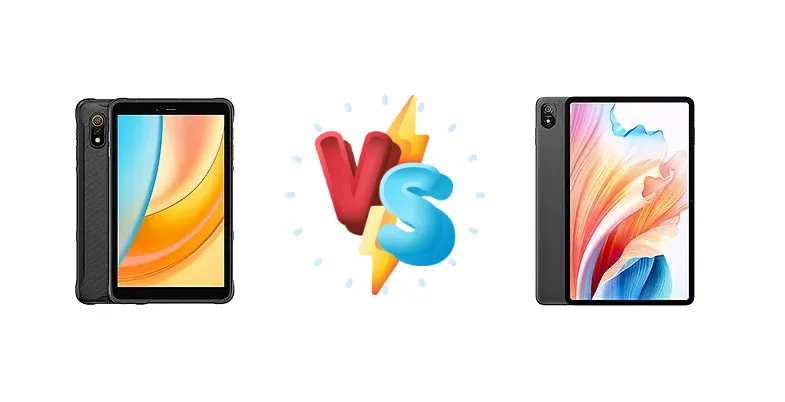
The Ulefone Armor Pad Pro and Blackview Tab 18 both target the growing market for affordable, rugged Android tablets. However, they take different approaches. The Ulefone prioritizes extreme battery endurance, while the Blackview focuses on a more modern chipset for improved performance. This comparison dissects their key differences to determine which tablet delivers the best value for your specific needs.
🏆 Quick Verdict
For users prioritizing all-day (and then some) battery life and a truly rugged build, the Ulefone Armor Pad Pro is the better choice. However, the Blackview Tab 18 offers a noticeable performance boost thanks to its Helio G99 chipset, making it ideal for users who need more processing power for gaming or demanding applications.
| Network |
|---|
| 2G bands | GSM 850 / 900 / 1800 / 1900 | GSM 850 / 900 / 1800 / 1900 |
| 3G bands | HSDPA 850 / 900 / 1700(AWS) / 1900 / 2100 | HSDPA 900 / 2100 |
| 4G bands | 1, 2, 3, 4, 5, 7, 8, 12, 17, 19, 20, 28, 38, 40, 41 | 1, 3, 7, 8, 20, 40 |
| Speed | HSPA, LTE | HSPA, LTE |
| Technology | GSM / HSPA / LTE | GSM / HSPA / LTE |
| Launch |
|---|
| Announced | 2024, April | 2023, November |
| Status | Available. Released 2024, April | Available. Released 2023, November |
| Body |
|---|
| Dimensions | 213 x 128.8 x 14 mm (8.39 x 5.07 x 0.55 in) | 277.6 x 173.2 x 7.9 mm (10.93 x 6.82 x 0.31 in) |
| SIM | Nano-SIM + Nano-SIM | Nano-SIM + Nano-SIM |
| Weight | 560 g (1.23 lb) | 632 g (1.39 lb) |
| Display |
|---|
| Protection | Mohs level 4 | - |
| Resolution | 800 x 1280 pixels, 16:10 ratio (~189 ppi density) | 1200 x 2000 pixels, 5:3 ratio (~194 ppi density) |
| Size | 8.0 inches, 185.6 cm2 (~67.6% screen-to-body ratio) | 12.0 inches, 409.9 cm2 (~85.2% screen-to-body ratio) |
| Type | IPS LCD | IPS LCD, 350 nits |
| Platform |
|---|
| CPU | Octa-core (4x2.0 GHz Cortex-A73 & 4x2.0 GHz Cortex-A53) | Octa-core (2x2.2 GHz Cortex-A76 & 6x2.0 GHz Cortex-A55) |
| Chipset | Mediatek MT8788 (12 nm) | Mediatek Helio G99 (6 nm) |
| GPU | Mali-G72 MP3 | Mali-G57 MC2 |
| OS | Android 13 | Android 13, Doke OS_P 4.0 |
| Memory |
|---|
| Card slot | microSDXC (dedicated slot) | microSDXC (uses shared SIM slot) |
| Internal | 128GB 8GB RAM | 256GB 12GB RAM |
| Main Camera |
|---|
| Features | LED flash, HDR, panorama | LED flash |
| Single | 48 MP, f/1.8, (wide), 1/2.25", 0.8µm | 16 MP |
| Video | 1080p@30fps | 1080p@30fps |
| Selfie camera |
|---|
| Single | 32 MP, f/2.2, (wide), 1/2.8", 0.8µm | 8 MP |
| Video | Yes | Yes |
| Sound |
|---|
| 35mm jack | Yes | No |
| Loudspeaker | Yes, with stereo speakers | Yes, with stereo speakers (4 speakers) |
| Comms |
|---|
| Bluetooth | 4.2, A2DP | 5.1, A2DP, LE |
| NFC | Yes | No |
| Positioning | GPS, GLONASS, GALILEO, BDS | GPS, GLONASS, GALILEO, BDS |
| Radio | Wireless FM radio, RDS, recording | FM Radio |
| USB | USB Type-C 2.0, magnetic connector | USB Type-C, OTG |
| WLAN | Wi-Fi 802.11 a/b/g/n/ac, dual-band | Wi-Fi 802.11 a/b/g/n/ac, dual-band |
| Features |
|---|
| Sensors | Fingerprint (side-mounted), accelerometer, gyro, proximity, compass | Fingerprint (side-mounted), accelerometer, gyro, proximity, compass |
| Battery |
|---|
| Charging | 18W wired | 33W wired |
| Type | Li-Po 7650 mAh | 8800 mAh |
| Misc |
|---|
| Colors | Black | Turquoise Green, Glacier Blue, Space Grey |
| Price | About 200 EUR | - |
| EU LABEL |
|---|
| Battery | 83:38h endurance, 1000 cycles | - |
| Energy | Class F | - |
| Free fall | Class A (270 falls) | - |
| Repairability | Class C | - |
Ulefone Armor Pad Pro
- Exceptional battery life (83:38h endurance)
- Ruggedized design for durability
- Long-term battery health (1000 charge cycles)
- Older, less powerful chipset (MT8788)
- Slower charging speed (18W)
Blackview Tab 18
- More powerful and efficient chipset (Helio G99)
- Faster charging (33W)
- Improved performance for gaming and multitasking
- Likely shorter battery life compared to Ulefone
- Potentially less ruggedized build quality
Display Comparison
Neither device provides display specifications, but given the rugged focus, expect IPS LCD panels. The key difference lies elsewhere. The Ulefone's longevity suggests a conservative display power draw, potentially at the expense of peak brightness. The Blackview, leveraging the more efficient Helio G99, may be able to drive a brighter panel without significantly impacting battery life. Bezels are likely to be substantial on both, prioritizing protection over a modern, edge-to-edge design.
Camera Comparison
Without detailed camera specifications, a direct comparison is difficult. However, given the price points and rugged focus, image quality is unlikely to be a primary strength of either device. Expect basic sensors suitable for documentation and casual snapshots. The absence of any mention of OIS or large sensors suggests both tablets will rely heavily on software processing to compensate for hardware limitations. Focusing on the chipset, the G99 in the Blackview Tab 18 has a more capable ISP (Image Signal Processor) which could lead to slightly better image processing.
Performance
The Blackview Tab 18’s Mediatek Helio G99 (6nm) represents a significant architectural leap over the Ulefone Armor Pad Pro’s MT8788 (12nm). The G99 utilizes two Cortex-A76 cores clocked at 2.2 GHz, offering substantially better single-core performance than the A73 cores in the Ulefone, which are capped at 2.0 GHz. The 6nm process also translates to improved power efficiency. While both are octa-core CPUs, the G99’s architecture and fabrication process provide a clear advantage in demanding tasks and gaming. The Ulefone’s MT8788 is adequate for basic productivity and media consumption, but will struggle with more intensive applications.
Battery Life
The Ulefone Armor Pad Pro boasts an impressive 83:38h endurance rating, a testament to its optimized power management and likely larger battery capacity (though not specified). This is a major selling point for users needing extended uptime. The Blackview Tab 18, while lacking a specific endurance rating, compensates with 33W wired charging. This significantly faster charging speed (compared to the Ulefone’s 18W) allows for quicker top-ups, mitigating the potential impact of a smaller battery. The Ulefone also claims 1000 charge cycles, suggesting a focus on long-term battery health.
Buying Guide
Buy the Ulefone Armor Pad Pro if you need a tablet for extended fieldwork, require exceptional battery life for travel, or work in harsh environments where durability is paramount. Buy the Blackview Tab 18 if you prefer a more responsive user experience, enjoy mobile gaming, or need a tablet capable of handling multitasking with greater ease. The Tab 18 is the better option for those who value performance over ultimate battery longevity.
Frequently Asked Questions
❓ Will the Blackview Tab 18's Helio G99 struggle with sustained gaming sessions due to thermal throttling?
While the Helio G99 is a capable chipset, its thermal performance within the Tab 18's chassis is unknown. Ruggedized designs often prioritize heat dissipation less than sleek aesthetics. Expect some throttling during extended gaming, but the G99's efficiency should mitigate it compared to older chipsets.
❓ How does the Ulefone Armor Pad Pro's ruggedization affect its weight and thickness?
Ruggedization invariably adds bulk. The Ulefone Armor Pad Pro will be noticeably heavier and thicker than standard tablets due to its reinforced chassis and protective features. This is a trade-off for increased durability, making it less comfortable for prolonged handheld use.
❓ Is the 18W charging on the Ulefone Armor Pad Pro sufficient for a tablet with such a large battery?
18W charging is relatively slow by modern standards, and fully charging the Ulefone Armor Pad Pro will take a considerable amount of time. However, the tablet's exceptional battery life means you likely won't need to charge it as frequently, lessening the impact of the slower charging speed.
❓ Can the Blackview Tab 18 handle demanding productivity tasks like video editing or running multiple apps simultaneously?
The Helio G99 and its Cortex-A76 cores provide a significant performance boost over the Ulefone's chipset, making the Blackview Tab 18 better suited for multitasking and moderately demanding productivity tasks. However, it's not a replacement for a high-end tablet with flagship-level processing power.