
Ulefone Armor Pad 5 Ultra vs. Oukitel RT3 Pro: A Deep Dive into Rugged Tablet Performance
| Phones Images | |||||
|---|---|---|---|---|---|
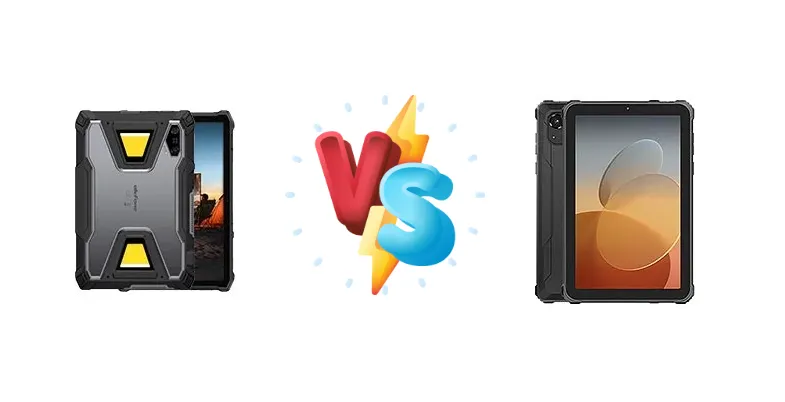
|
🏆 Quick Verdict
For users prioritizing performance and rapid charging, the Ulefone Armor Pad 5 Ultra is the clear winner. Its Dimensity 7400X chipset delivers significantly faster processing speeds, and the 120W charging drastically reduces downtime. However, the Oukitel RT3 Pro offers a compelling value proposition for those on a tighter budget.
| PHONES | ||
|---|---|---|
| Phone Names | Ulefone Armor Pad 5 Ultra | Oukitel RT3 Pro |
| Network | ||
|---|---|---|
| 2G bands | GSM 850 / 900 / 1800 / 1900 | GSM 850 / 900 / 1800 / 1900 |
| 3G bands | HSDPA 850 / 900 / 1700(AWS) / 1900 / 2100 | HSDPA 850 / 900 / 1700(AWS) / 1900 / 2100 |
| 4G bands | 1, 2, 3, 4, 5, 7, 8, 12, 13, 17, 18, 19, 20, 25, 26, 28, 32, 34, 38, 39, 40, 41, 66, 71 | 1, 2, 3, 4, 5, 7, 8, 12, 17, 18, 19, 20, 25, 26, 28, 38, 39, 40, 41, 66 |
| 5G bands | 1, 2, 3, 5, 7, 8, 20, 25, 28, 38, 40, 41, 66, 71, 77, 78, 79 SA/NSA | - |
| Speed | HSPA, LTE, 5G | HSPA, LTE |
| Technology | GSM / HSPA / LTE / 5G | GSM / HSPA / LTE |
| Launch | ||
|---|---|---|
| Announced | 2025, October | 2024, October |
| Status | Available. Released 2025, November 11 | Available. Released 2024, October |
| Body | ||
|---|---|---|
| Dimensions | 269.7 x 179.5 x 27.8 mm (10.62 x 7.07 x 1.09 in) | 207 x 134 x 13.9 mm (8.15 x 5.28 x 0.55 in) |
| SIM | Nano-SIM + Nano-SIM | Nano-SIM + Nano-SIM |
| Weight | 1600 g (3.53 lb) | 538 g (1.19 lb) |
| Display | ||
|---|---|---|
| Protection | Corning Gorilla Glass 3, Mohs level 4 | Corning Gorilla Glass 5, Mohs level 4 |
| Resolution | 1200 x 1920 pixels, 16:10 ratio (~206 ppi density) | 800 x 1280 pixels, 16:10 ratio (~189 ppi density) |
| Size | 11.0 inches, 350.9 cm2 (~72.5% screen-to-body ratio) | 8.0 inches, 185.6 cm2 (~66.9% screen-to-body ratio) |
| Type | IPS LCD, 90Hz, 600 nits | IPS LCD, 600 nits |
| Platform | ||
|---|---|---|
| CPU | Octa-core (4x2.6 GHz Cortex-A78 & 4x2.0 GHz Cortex-A55) | Octa-core (2x2.0 GHz Cortex-A75 & 6x1.7 GHz Cortex-A55) |
| Chipset | Mediatek Dimensity 7400X (4 nm) | Mediatek Helio G81 (12 nm) |
| GPU | Mali-G615 MC2 | Mali-G52 MC2 |
| OS | Android 15 | Android 14 |
| Memory | ||
|---|---|---|
| Card slot | microSDXC (dedicated slot) | microSDXC (uses shared SIM slot) |
| Internal | 512GB 12GB RAM | 128GB 4GB RAM |
| Main Camera | ||
|---|---|---|
| Dual | 64 MP, f/1.8, (wide), 0.8µm, PDAF 64 MP, f/1.8, (night vision), 0.7µm, 4 infrared lights | 16 MP, f/2.0, (wide), 1/3.06", PDAF Auxiliary lens |
| Features | LED flash, HDR, panorama | LED flash |
| Video | 4K@30fps, 1080p@30fps, gyro-EIS | 1080p@30fps |
| Selfie camera | ||
|---|---|---|
| Single | 32 MP, f/2.5, (wide), 0.8µm | 8 MP, f/2.0, (wide), 1/4.0" |
| Video | Yes | 720p@30fps |
| Sound | ||
|---|---|---|
| 35mm jack | Yes | No |
| Loudspeaker | Yes, with stereo speakers | Yes, with stereo speakers |
| Comms | ||
|---|---|---|
| Bluetooth | 5.4, A2DP, LE | 5.0, A2DP, LE |
| NFC | Yes | Yes |
| Positioning | GPS, GLONASS, GALILEO, BDS, QZSS, NavIC | GPS, GLONASS, GALILEO, BDS |
| Radio | Wireless FM radio, RDS, recording | FM radio |
| USB | USB Type-C 2.0, OTG, magnetic connector | USB Type-C 2.0, OTG |
| WLAN | Wi-Fi 802.11 a/b/g/n/ac/6e, tri-band, hotspot | Wi-Fi 802.11 a/b/g/n/ac, dual-band |
| Features | ||
|---|---|---|
| Sensors | Fingerprint (side-mounted), gyro, accelerometer, proximity, compass, barometer | Accelerometer, compass |
| Battery | ||
|---|---|---|
| Charging | 120W wired 10W reverse wired | 10W wired |
| Type | Li-Po 24200 mAh | Li-Po 5150 mAh |
| Misc | ||
|---|---|---|
| Colors | Black | Black, Orange, Green |
| Price | About 700 EUR | About 180 EUR |
| EU LABEL | ||
|---|---|---|
| Battery | 401:34h endurance, 1000 cycles | 138:44h endurance, 1000 cycles |
| Energy | Class D | Class B |
| Free fall | Class D (85 falls) | Class A (208 falls) |
| Repairability | Class C | Class B |
Ulefone Armor Pad 5 Ultra
- Significantly faster processor with the Dimensity 7400X
- Ultra-fast 120W wired charging
- Superior battery endurance (401:34h)
- Likely higher price point
- Potential for increased heat under extreme load (though 4nm helps)
Oukitel RT3 Pro
- More affordable price
- Rugged design for durability
- Acceptable battery life for basic tasks
- Slower processor (Helio G81)
- Slow 10W charging
- Lower battery endurance (138:44h)
Display Comparison
While both tablets are designed for outdoor use, details regarding display brightness and panel technology are missing. However, the core difference lies in processing power, impacting UI responsiveness. The Armor Pad 5 Ultra’s Dimensity 7400X will provide a smoother experience navigating the interface and handling graphically intensive applications, even if both share similar screen resolutions.
Camera Comparison
Without specific camera details beyond the chipsets, a direct comparison is limited. However, the processing power of the Dimensity 7400X in the Ulefone Armor Pad 5 Ultra will likely enable more sophisticated image processing algorithms, potentially leading to better image quality, especially in challenging lighting conditions. The RT3 Pro’s Helio G81 will be adequate for basic photography, but will struggle with complex scenes or low-light environments.
Performance
The Ulefone Armor Pad 5 Ultra’s Mediatek Dimensity 7400X (4nm) chipset represents a substantial leap in performance over the Oukitel RT3 Pro’s Helio G81 (12nm). The Dimensity 7400X features a more modern CPU architecture – Cortex-A78 cores clocked at 2.6 GHz versus the RT3 Pro’s Cortex-A75 cores at 2.0 GHz – resulting in significantly faster processing speeds. The 4nm fabrication process also contributes to improved thermal efficiency, meaning the Ulefone is less likely to throttle under sustained load. This translates to a smoother experience for demanding applications and multitasking.
Battery Life
The Ulefone Armor Pad 5 Ultra boasts a 401:34h endurance rating, significantly exceeding the Oukitel RT3 Pro’s 138:44h endurance. While both offer 1000 charge cycles, the Ulefone’s superior endurance suggests a larger battery capacity and more efficient power management. Crucially, the 120W wired charging on the Ulefone is a game-changer, allowing for incredibly fast top-ups, while the Oukitel is limited to a slower 10W charge. This difference in charging speed dramatically impacts usability for users who need their tablet ready to go quickly.
Buying Guide
Buy the Ulefone Armor Pad 5 Ultra if you need a tablet capable of handling demanding tasks like video editing, gaming, or running specialized field applications, and if minimizing downtime with ultra-fast charging is crucial. Buy the Oukitel RT3 Pro if you prioritize affordability and require a durable tablet for basic productivity, media consumption, and light tasks, accepting a slower processor and charging speed.