
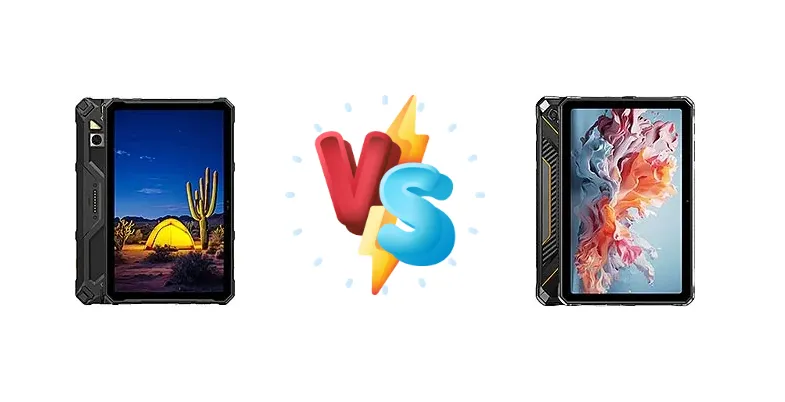
Ulefone Armor Pad 4 Ultra vs. Doogee R20: Which Rugged Device Delivers More?
| Phones Images | |||||
|---|---|---|---|---|---|
|
🏆 Quick Verdict
For users prioritizing sustained performance and extended usage, the Ulefone Armor Pad 4 Ultra emerges as the winner. Its Dimensity 6300 chipset and impressive 187:37h battery endurance offer a significant advantage over the Doogee R20, despite the latter's more compact size.
| PHONES | ||
|---|---|---|
| Phone Names | Ulefone Armor Pad 4 Ultra | Doogee R20 |
| Network | ||
|---|---|---|
| 2G bands | GSM 850 / 900 / 1800 / 1900 | GSM 850 / 900 / 1800 / 1900 |
| 3G bands | HSDPA 850 / 900 / 1700(AWS) / 1900 / 2100 | HSDPA 850 / 900 / 1700(AWS) / 1900 / 2100 |
| 4G bands | 1, 2, 3, 4, 5, 7, 8, 12, 13, 17, 18, 19, 20, 26, 28, 34, 38, 39, 40, 41, 66, 71 | 1, 2, 3, 4, 5, 7, 8, 12, 17, 18, 19, 20, 25, 26, 28, 34, 38, 39, 40, 41, 66 |
| 5G bands | 1, 2, 3, 5, 7, 8, 20, 25, 28, 38, 40, 41, 66, 71, 77, 78, 79 SA/NSA | - |
| Speed | HSPA, LTE, 5G | HSPA, LTE |
| Technology | GSM / HSPA / LTE / 5G | GSM / HSPA / LTE |
| Launch | ||
|---|---|---|
| Announced | 2024, September | 2024, January 26 |
| Status | Available. Released 2024, September | Available. Released 2024, February |
| Body | ||
|---|---|---|
| Dimensions | 261.7 x 166.8 x 14.3 mm (10.30 x 6.57 x 0.56 in) | 258.9 x 169.6 x 18 mm (10.19 x 6.68 x 0.71 in) |
| SIM | Nano-SIM + Nano-SIM | Nano-SIM + Nano-SIM |
| Weight | 834.5 g (1.84 lb) | 931 g (2.05 lb) |
| Display | ||
|---|---|---|
| Protection | Corning Gorilla Glass Victus, Mohs level 4 | Corning Gorilla Glass 5 |
| Resolution | 1200 x 2000 pixels, 5:3 ratio (~225 ppi density) | 1200 x 2000 pixels, 5:3 ratio (~224 ppi density) |
| Size | 10.36 inches, 305.5 cm2 (~70.0% screen-to-body ratio) | 10.4 inches, 307.9 cm2 (~70.1% screen-to-body ratio) |
| Type | IPS LCD | IPS LCD |
| Platform | ||
|---|---|---|
| CPU | Octa-core (2x2.4 GHz Cortex-A76 & 6x2.0 GHz Cortex-A55) | Octa-core (2x2.2 GHz Cortex-A76 & 6x2.0 GHz Cortex-A55) |
| Chipset | Mediatek Dimensity 6300 (6 nm) | Mediatek Helio G99 (6 nm) |
| GPU | Mali-G57 MC2 | Mali-G57 MC2 |
| OS | Android 14 | Android 13 |
| Memory | ||
|---|---|---|
| Card slot | microSDXC (dedicated slot) | microSDXC (uses shared SIM slot) |
| Internal | 256GB 8GB RAM | 256GB 8GB RAM |
| Main Camera | ||
|---|---|---|
| Features | LED flash, HDR, panorama | LED flash |
| Single | 50 MP, f/2.0, (wide), 1/1.31", 1.2µm | 50 MP, f/1.8, (wide) |
| Video | 1440p@30fps, 1080p@30fps | 1440p@30fps, 1080p@30fps |
| Selfie camera | ||
|---|---|---|
| Single | 32 MP, f/2.4, (wide), 0.8µm | 16 MP, f/2.0, (wide) |
| Video | Yes | 1080p@30fps |
| Sound | ||
|---|---|---|
| 35mm jack | Yes | Yes |
| Loudspeaker | Yes, with stereo speakers | Yes, with stereo speakers |
| Comms | ||
|---|---|---|
| Bluetooth | 5.2, A2DP | 5.2, A2DP, LE |
| NFC | Yes | No |
| Positioning | GPS, GLONASS, GALILEO, BDS | GPS, GLONASS, GALILEO, BDS |
| Radio | Wireless FM radio, RDS, recording | FM radio |
| USB | USB Type-C 2.0, OTG, magnetic connector | USB Type-C 2.0, OTG |
| WLAN | Wi-Fi 802.11 a/b/g/n/ac, dual-band | Wi-Fi 802.11 a/b/g/n/ac, dual-band |
| Features | ||
|---|---|---|
| Sensors | Fingerprint (side-mounted), gyro, accelerometer, proximity, compass, barometer | Fingerprint (side-mounted), accelerometer, gyro, proximity, compass |
| Battery | ||
|---|---|---|
| Charging | 33W wired 5W reverse wired | 33W wired Reverse wired |
| Type | Li-Po 11800 mAh | 21600 mAh |
| Misc | ||
|---|---|---|
| Colors | Black | Black, Green, Orange |
| Price | About 370 EUR | About 250 EUR |
| EU LABEL | ||
|---|---|---|
| Battery | 187:37h endurance, 1000 cycles | - |
| Energy | Class D | - |
| Free fall | Class A (208 falls) | - |
| Repairability | Class C | - |
Ulefone Armor Pad 4 Ultra
- Exceptional battery life (187:37h endurance)
- More powerful Dimensity 6300 chipset
- Larger display for productivity and media
- Less portable due to tablet form factor
- May be overkill for basic communication needs
Doogee R20
- Compact and pocketable smartphone design
- 33W fast charging
- Suitable for everyday communication and tasks
- Shorter battery life compared to Ulefone
- Less powerful Helio G99 chipset
Display Comparison
While display specifics are missing, the Ulefone Armor Pad 4 Ultra's tablet form factor inherently offers a larger viewing area. Both devices utilize 6nm chipsets, suggesting a focus on efficiency, but the larger screen of the Ulefone will likely demand more power. The Doogee R20, being a phone, will likely prioritize color accuracy for everyday use, while the Ulefone may lean towards wider color gamuts for media consumption. Bezels are a key consideration; larger bezels contribute to ruggedness but impact immersion.
Camera Comparison
Camera details are limited, but the focus should be on real-world image quality rather than megapixel counts. Both devices likely employ similar image processing pipelines given their target market. The larger sensor size, if present in the Ulefone due to its larger form factor, would be a significant advantage in low-light conditions. Optical Image Stabilization (OIS), if included in either device, would improve image sharpness and reduce blur in videos. The absence of details necessitates a focus on the overall system optimization rather than individual sensor specs.
Performance
The Ulefone Armor Pad 4 Ultra's Mediatek Dimensity 6300 (6nm) holds a performance edge over the Doogee R20’s Helio G99 (6nm). The Dimensity 6300 features a slightly higher clocked Cortex-A76 core (2.4 GHz vs 2.2 GHz), translating to faster single-core performance, crucial for responsive UI and app loading. Both chipsets share the same Cortex-A55 efficiency cores, but the Dimensity 6300’s architecture is newer, potentially offering better sustained performance under load. The Ulefone will likely benefit from more generous thermal headroom due to its larger size, mitigating potential throttling during extended gaming or demanding tasks.
Battery Life
The Ulefone Armor Pad 4 Ultra boasts a remarkable 187:37h endurance, a testament to its larger battery capacity and the efficiency of the Dimensity 6300. While both devices offer 33W wired charging, the Ulefone’s significantly longer endurance means users will rely on charging less frequently. The 5W reverse wired charging on the Ulefone adds utility, allowing it to top up smaller devices in the field. The Doogee R20, despite its 33W charging, will likely require more frequent charging cycles due to its smaller battery and the demands of a smartphone operating system.
Buying Guide
Buy the Ulefone Armor Pad 4 Ultra if you need a large, durable display for productivity, media consumption, or fieldwork requiring detailed map viewing and long hours away from a power outlet. Buy the Doogee R20 if you prefer the portability of a smartphone and require a rugged device for communication and basic tasks on the go, where a smaller footprint is paramount.