
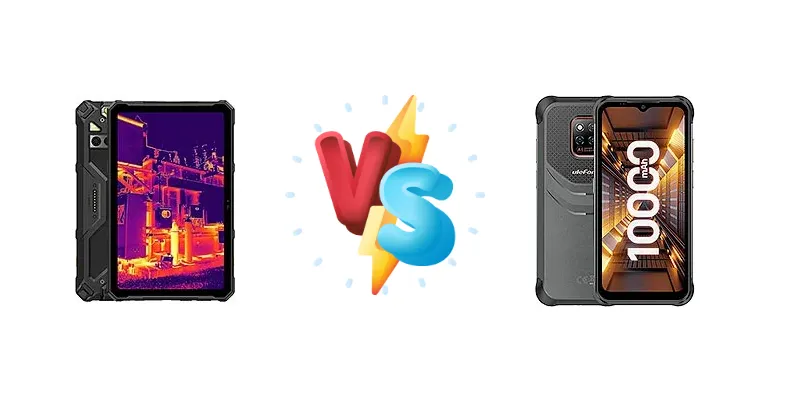
Ulefone Armor Pad 4 Ultra Thermal vs Power Armor 14 Pro: Which Rugged Tablet Reigns Supreme?
| Phones Images | |||||
|---|---|---|---|---|---|
|
🏆 Quick Verdict
For users prioritizing performance and future-proofing, the Ulefone Armor Pad 4 Ultra Thermal is the clear winner. Its Dimensity 6300 chipset offers a significant leap in processing power over the Power Armor 14 Pro’s Helio G85. However, the Power Armor 14 Pro’s wireless charging and potentially more compact form factor make it a viable option for those valuing convenience over raw speed.
| PHONES | ||
|---|---|---|
| Phone Names | Ulefone Armor Pad 4 Ultra Thermal | Ulefone Power Armor 14 Pro |
| Network | ||
|---|---|---|
| 2G bands | GSM 850 / 900 / 1800 / 1900 | GSM 850 / 900 / 1800 / 1900 |
| 3G bands | HSDPA 850 / 900 / 1700(AWS) / 1900 / 2100 | HSDPA 850 / 900 / 1700(AWS) / 1900 / 2100 |
| 4G bands | 1, 2, 3, 4, 5, 7, 8, 12, 13, 17, 18, 19, 20, 26, 28, 34, 38, 39, 40, 41, 66, 71 | 1, 2, 3, 4, 5, 7, 8, 12, 13, 17, 18, 19, 20, 25, 26, 28, 38, 40 |
| 5G bands | 1, 2, 3, 5, 7, 8, 20, 25, 28, 38, 40, 41, 66, 71, 77, 78, 79 SA/NSA | - |
| Speed | HSPA, LTE, 5G | HSPA, LTE |
| Technology | GSM / HSPA / LTE / 5G | GSM / HSPA / LTE |
| Launch | ||
|---|---|---|
| Announced | 2024, September | 2022, March 09 |
| Status | Available. Released 2024, September | Available. Released 2022, March 09 |
| Body | ||
|---|---|---|
| Dimensions | 261.7 x 166.8 x 14.3 mm (10.30 x 6.57 x 0.56 in) | 175.6 x 82.5 x 17.2 mm (6.91 x 3.25 x 0.68 in) |
| SIM | Nano-SIM + Nano-SIM | Nano-SIM + Nano-SIM |
| Weight | 834.5 g (1.84 lb) | 358.2 g (12.63 oz) |
| - | IP68 dust/water resistant (up to 1.5m for 30 min) Drop-to-concrete resistance from up to 1.5m MIL-STD-810G compliant | |
| Display | ||
|---|---|---|
| Protection | Corning Gorilla Glass Victus | Corning Gorilla Glass 3 |
| Resolution | 1200 x 2000 pixels, 5:3 ratio (~225 ppi density) | 720 x 1600 pixels, 20:9 ratio (~269 ppi density) |
| Size | 10.36 inches, 305.5 cm2 (~70.0% screen-to-body ratio) | 6.52 inches, 102.6 cm2 (~70.8% screen-to-body ratio) |
| Type | IPS LCD | IPS LCD |
| Platform | ||
|---|---|---|
| CPU | Octa-core (2x2.4 GHz Cortex-A76 & 6x2.0 GHz Cortex-A55) | Octa-core (2x2.0 GHz Cortex-A75 & 6x1.8 GHz Cortex-A55) |
| Chipset | Mediatek Dimensity 6300 (6 nm) | Mediatek MT6769Z Helio G85 (12 nm) |
| GPU | Mali-G57 MC2 | Mali-G52 MC2 |
| OS | Android 14 | Android 12 |
| Memory | ||
|---|---|---|
| Card slot | microSDXC (dedicated slot) | microSDXC (uses shared SIM slot) |
| Internal | 256GB 8GB RAM | 128GB 6GB RAM, 128GB 8GB RAM |
| - | eMMC 5.1 | |
| Main Camera | ||
|---|---|---|
| Dual | 50 MP, f/2.0, (wide), 1/1.31", 1.2µm Thermal camera by ThermoVue, 160x120 px, 25Hz, 12μm | - |
| Features | LED flash, HDR, panorama | LED flash, HDR, panorama |
| Single | - | 16 MP, f/2.2 |
| Triple | - | 20 MP, f/1.8, 26mm (wide), 1/2.78", 1.0µm, PDAF 2 MP (macro) Auxiliary lens |
| Video | 1440p@30fps, 1080p@30fps | 1080p@30fps |
| Selfie camera | ||
|---|---|---|
| Features | - | HDR, panorama |
| Single | 32 MP, f/2.4, (wide), 0.8µm | 16 MP, f/2.2 |
| Video | Yes | 1080p@30fps |
| Sound | ||
|---|---|---|
| 3.5mm jack | - | Yes |
| 35mm jack | Yes | Yes |
| Loudspeaker | Yes, with stereo speakers | Yes |
| Comms | ||
|---|---|---|
| Bluetooth | 5.2, A2DP | 5.0, A2DP, LE |
| NFC | Yes | Yes |
| Positioning | GPS, GLONASS, GALILEO, BDS | GPS, GLONASS, GALILEO, BDS |
| Radio | Wireless FM radio, RDS, recording | FM radio, RDS, recording |
| USB | USB Type-C 2.0, OTG, magnetic connector | USB Type-C 2.0, OTG |
| WLAN | Wi-Fi 802.11 a/b/g/n/ac, dual-band | Wi-Fi 802.11 a/b/g/n/ac, dual-band |
| Features | ||
|---|---|---|
| Sensors | Fingerprint (side-mounted), gyro, accelerometer, proximity, compass, barometer | Fingerprint (side-mounted), accelerometer, proximity, compass |
| Battery | ||
|---|---|---|
| Charging | 33W wired 5W reverse wired | 18W wired 15W wireless |
| Type | Li-Po 11800 mAh | Li-Po 10000 mAh |
| Misc | ||
|---|---|---|
| Colors | Black | Black |
| Price | About 460 EUR | About 260 EUR |
Ulefone Armor Pad 4 Ultra Thermal
- Significantly more powerful processor (Dimensity 6300)
- Faster wired charging (33W)
- Potentially larger display for productivity
- Likely larger and heavier form factor
- No wireless charging
Ulefone Power Armor 14 Pro
- Wireless charging for added convenience
- More portable form factor
- Potentially lower price point
- Less powerful processor (Helio G85)
- Slower wired charging (18W)
Display Comparison
While both devices are likely to feature durable, ruggedized displays (specifics are missing), the core difference lies within. The Armor Pad 4 Ultra Thermal, being a tablet, will likely have a larger display, potentially with higher resolution. The Power Armor 14 Pro, as a phone, will prioritize portability. Without specific display specs, it's difficult to compare brightness or color accuracy, but the larger screen real estate of the Pad 4 Ultra Thermal will be advantageous for productivity tasks.
Camera Comparison
Without detailed camera specifications, a direct comparison is limited. However, Ulefone typically focuses on durability over camera prowess in its rugged line. It’s reasonable to assume both devices will feature capable cameras for basic photography, but don’t expect flagship-level image quality. The larger form factor of the Armor Pad 4 Ultra Thermal *could* allow for a slightly larger sensor, potentially improving low-light performance, but this is speculative. The presence or absence of Optical Image Stabilization (OIS) would be a key differentiator, but that information is unavailable.
Performance
The performance gap is the most significant differentiator. The Ulefone Armor Pad 4 Ultra Thermal’s Mediatek Dimensity 6300 (6nm) is a substantial upgrade over the Power Armor 14 Pro’s Helio G85 (12nm). The 6nm process node inherently offers better power efficiency and thermal performance, allowing the Dimensity 6300 to sustain higher clock speeds for longer. The Dimensity 6300’s CPU configuration – 2x2.4 GHz Cortex-A76 & 6x2.0 GHz Cortex-A55 – provides a noticeable boost in single-core and multi-core performance compared to the Helio G85’s 2x2.0 GHz Cortex-A75 & 6x1.8 GHz Cortex-A55. This translates to faster app loading times, smoother multitasking, and improved gaming performance. The Armor Pad 4 Ultra Thermal will handle graphically intensive applications with greater ease.
Battery Life
The Armor Pad 4 Ultra Thermal features 33W wired charging, while the Power Armor 14 Pro offers 18W wired and 15W wireless charging. While the Armor Pad 4 Ultra Thermal’s wired charging is faster, the Power Armor 14 Pro’s wireless charging provides added convenience. The larger capacity battery expected in the Pad 4 Ultra Thermal will offset the slower charging speed to some extent. The 6nm process of the Dimensity 6300 should also contribute to better battery life under load compared to the 12nm Helio G85, despite the potential for a larger screen on the Pad 4 Ultra Thermal.
Buying Guide
Buy the Ulefone Armor Pad 4 Ultra Thermal if you need a rugged tablet capable of handling demanding tasks like CAD, video editing, or extended gaming sessions. Its superior chipset and processing capabilities will provide a smoother, more responsive experience. Buy the Ulefone Power Armor 14 Pro if you prefer a more portable, all-around rugged device with the added convenience of wireless charging and are less concerned with pushing the limits of mobile processing.