
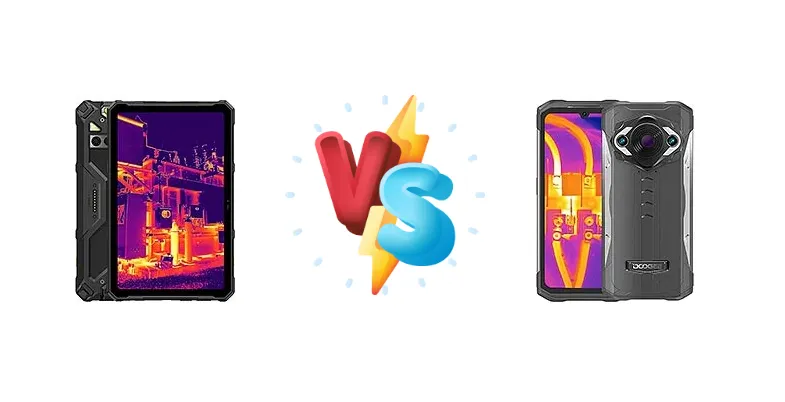
Ulefone Armor Pad 4 Ultra Thermal vs. Doogee S98 Pro: A Rugged Tablet Battle
| Phones Images | |||||
|---|---|---|---|---|---|
|
🏆 Quick Verdict
For users prioritizing sustained performance and future-proofing, the Ulefone Armor Pad 4 Ultra Thermal emerges as the winner. Its Dimensity 6300 chipset, built on a 6nm process, offers a noticeable efficiency advantage over the Doogee S98 Pro’s 12nm Helio G96, translating to less throttling during intensive tasks. However, the Doogee S98 Pro’s wireless charging is a compelling feature for some.
| PHONES | ||
|---|---|---|
| Phone Names | Ulefone Armor Pad 4 Ultra Thermal | Doogee S98 Pro |
| Network | ||
|---|---|---|
| 2G bands | GSM 850 / 900 / 1800 / 1900 | GSM 850 / 900 / 1800 / 1900 |
| 3G bands | HSDPA 850 / 900 / 1700(AWS) / 1900 / 2100 | HSDPA 800 / 850 / 900 / 1700(AWS) / 1900 / 2100 |
| 4G bands | 1, 2, 3, 4, 5, 7, 8, 12, 13, 17, 18, 19, 20, 26, 28, 34, 38, 39, 40, 41, 66, 71 | 1, 2, 3, 4, 5, 7, 8, 12, 13, 17, 18, 19, 20, 25, 26, 28, 34, 38, 39, 40, 41, 66 |
| 5G bands | 1, 2, 3, 5, 7, 8, 20, 25, 28, 38, 40, 41, 66, 71, 77, 78, 79 SA/NSA | - |
| Speed | HSPA, LTE, 5G | HSPA, LTE |
| Technology | GSM / HSPA / LTE / 5G | GSM / CDMA / HSPA / LTE |
| Launch | ||
|---|---|---|
| Announced | 2024, September | 2022, May 27 |
| Status | Available. Released 2024, September | Available. Released 2022, June 06 |
| Body | ||
|---|---|---|
| Dimensions | 261.7 x 166.8 x 14.3 mm (10.30 x 6.57 x 0.56 in) | 172 x 82 x 15.5 mm (6.77 x 3.23 x 0.61 in) |
| SIM | Nano-SIM + Nano-SIM | Nano-SIM + Nano-SIM |
| Weight | 834.5 g (1.84 lb) | 320 g (11.29 oz) |
| Display | ||
|---|---|---|
| Protection | Corning Gorilla Glass Victus | Corning Gorilla Glass |
| Resolution | 1200 x 2000 pixels, 5:3 ratio (~225 ppi density) | 1080 x 2340 pixels, 19.5:9 ratio (~409 ppi density) |
| Size | 10.36 inches, 305.5 cm2 (~70.0% screen-to-body ratio) | 6.3 inches, 97.4 cm2 (~69.1% screen-to-body ratio) |
| Type | IPS LCD | IPS LCD, 500 nits (peak) |
| Platform | ||
|---|---|---|
| CPU | Octa-core (2x2.4 GHz Cortex-A76 & 6x2.0 GHz Cortex-A55) | Octa-core (2x2.05 GHz Cortex-A76 & 6x2.0 GHz Cortex-A55) |
| Chipset | Mediatek Dimensity 6300 (6 nm) | Mediatek MT6781 Helio G96 (12 nm) |
| GPU | Mali-G57 MC2 | Mali-G57 MC2 |
| OS | Android 14 | Android 12 |
| Memory | ||
|---|---|---|
| Card slot | microSDXC (dedicated slot) | microSDXC (dedicated slot) |
| Internal | 256GB 8GB RAM | 256GB 8GB RAM |
| Main Camera | ||
|---|---|---|
| Dual | 50 MP, f/2.0, (wide), 1/1.31", 1.2µm Thermal camera by ThermoVue, 160x120 px, 25Hz, 12μm | - |
| Features | LED flash, HDR, panorama | Dual-LED flash, HDR, panorama |
| Triple | - | 48 MP, f/1.8, (wide), PDAF 20 MP, f/1.8, (night vision), 2 infrared night vision lights Thermal imaging camera |
| Video | 1440p@30fps, 1080p@30fps | 1440p, 1080p |
| Selfie camera | ||
|---|---|---|
| Single | 32 MP, f/2.4, (wide), 0.8µm | 16 MP, f/2.0, (wide) |
| Video | Yes | 1080p |
| Sound | ||
|---|---|---|
| 35mm jack | Yes | Unspecified |
| Loudspeaker | Yes, with stereo speakers | Yes |
| Comms | ||
|---|---|---|
| Bluetooth | 5.2, A2DP | 5.1, A2DP, LE |
| NFC | Yes | Yes |
| Positioning | GPS, GLONASS, GALILEO, BDS | GPS, GLONASS, BDS, GALILEO |
| Radio | Wireless FM radio, RDS, recording | FM radio |
| USB | USB Type-C 2.0, OTG, magnetic connector | USB Type-C 2.0, OTG |
| WLAN | Wi-Fi 802.11 a/b/g/n/ac, dual-band | Wi-Fi 802.11 a/b/g/n/ac, dual-band |
| Features | ||
|---|---|---|
| Sensors | Fingerprint (side-mounted), gyro, accelerometer, proximity, compass, barometer | Fingerprint (side-mounted), accelerometer, gyro, proximity, compass |
| Battery | ||
|---|---|---|
| Charging | 33W wired 5W reverse wired | 33W wired 15W wireless |
| Type | Li-Po 11800 mAh | 6000 mAh |
| Misc | ||
|---|---|---|
| Colors | Black | Black |
| Price | About 460 EUR | About 470 EUR |
Ulefone Armor Pad 4 Ultra Thermal
- More efficient Dimensity 6300 chipset for better performance and battery life.
- Likely superior thermal management due to the 6nm process.
- Potential for future software updates and support.
- Lacks wireless charging.
- Display specifications are unknown, potentially lagging behind competitors.
Doogee S98 Pro
- Convenient 15W wireless charging.
- Established market presence and potentially lower price.
- May have a slightly more refined software experience due to longer availability.
- Less efficient Helio G96 chipset leading to potential throttling.
- Older chipset may receive fewer software updates.
- 12nm process generates more heat.
Display Comparison
Neither device's display specifications are provided, so a direct comparison is limited. However, given the Armor Pad 4 Ultra Thermal's focus on 'Ultra' features, it's reasonable to expect a higher resolution and potentially brighter panel than the S98 Pro. The S98 Pro, being an older model, likely utilizes a standard LCD panel. The absence of LTPO technology in either device suggests neither will offer adaptive refresh rates for power saving.
Camera Comparison
Without detailed camera specifications, a precise comparison is difficult. However, the market positioning of rugged tablets suggests both will prioritize durability over cutting-edge camera technology. We can assume both devices will feature a primary camera, likely around 48MP or higher, but image quality will heavily depend on sensor size, lens aperture, and software processing. The inclusion of Optical Image Stabilization (OIS) would be a significant advantage, but is not specified for either device. The 2MP macro cameras often found on these devices are generally of limited practical use.
Performance
The core difference lies in the chipsets. The Ulefone’s Dimensity 6300 (6nm) boasts a more modern architecture and smaller fabrication process compared to the Doogee’s Helio G96 (12nm). This translates to significantly improved power efficiency. While both CPUs feature a similar core configuration – 2x Cortex-A76 and 6x Cortex-A55 – the Dimensity 6300’s newer design and 6nm process will deliver superior single-core and multi-core performance, especially under sustained load. The 6nm node allows for higher transistor density and lower voltage operation, reducing heat generation and minimizing performance throttling. This benefits users engaged in prolonged gaming or resource-intensive applications.
Battery Life
Both tablets offer 33W wired charging, providing a reasonable charging speed. However, the Doogee S98 Pro adds 15W wireless charging, a convenience feature the Ulefone lacks. While battery capacity isn't specified, the Dimensity 6300’s superior power efficiency in the Ulefone Armor Pad 4 Ultra Thermal will likely result in longer real-world battery life, even with a similar capacity battery to the Doogee. The 6nm process allows the Ulefone to extract more usage from each mAh.
Buying Guide
Buy the Ulefone Armor Pad 4 Ultra Thermal if you need a tablet for demanding tasks like CAD, video editing, or extended gaming sessions where sustained performance and thermal management are critical. Buy the Doogee S98 Pro if you prioritize convenience features like wireless charging and are primarily focused on everyday tasks, media consumption, and lighter workloads where the Helio G96 will suffice.