
Ulefone Armor Pad 4 Ultra Thermal vs. Blackview BV8800: A Rugged Showdown
| Phones Images | |||||
|---|---|---|---|---|---|
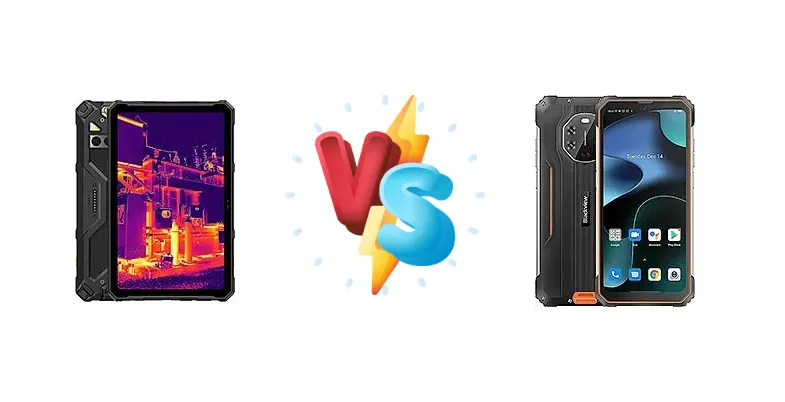
|
🏆 Quick Verdict
For users prioritizing a large display, thermal imaging, and newer processing power, the Ulefone Armor Pad 4 Ultra Thermal is the clear winner. However, the Blackview BV8800 offers excellent battery endurance and a more convenient smartphone form factor at a potentially lower price point.
| PHONES | ||
|---|---|---|
| Phone Names | Ulefone Armor Pad 4 Ultra Thermal | Blackview BV8800 |
| Network | ||
|---|---|---|
| 2G bands | GSM 850 / 900 / 1800 / 1900 | GSM 850 / 900 / 1800 / 1900 |
| 3G bands | HSDPA 850 / 900 / 1700(AWS) / 1900 / 2100 | HSDPA 800 / 850 / 900 / 1700(AWS) / 1900 / 2100 |
| 4G bands | 1, 2, 3, 4, 5, 7, 8, 12, 13, 17, 18, 19, 20, 26, 28, 34, 38, 39, 40, 41, 66, 71 | 1, 2, 3, 4, 5, 7, 8, 12, 13, 17, 18, 19, 20, 25, 26, 28, 30, 34, 38, 39, 40, 41, 66 |
| 5G bands | 1, 2, 3, 5, 7, 8, 20, 25, 28, 38, 40, 41, 66, 71, 77, 78, 79 SA/NSA | - |
| Speed | HSPA, LTE, 5G | HSPA, LTE |
| Technology | GSM / HSPA / LTE / 5G | GSM / CDMA / HSPA / CDMA2000 / LTE |
| - | CDMA2000 1x | |
| Launch | ||
|---|---|---|
| Announced | 2024, September | 2021, December 24 |
| Status | Available. Released 2024, September | Available. Released 2022, January 10 |
| Body | ||
|---|---|---|
| Dimensions | 261.7 x 166.8 x 14.3 mm (10.30 x 6.57 x 0.56 in) | 176.2 x 83.5 x 17.7 mm (6.94 x 3.29 x 0.70 in) |
| SIM | Nano-SIM + Nano-SIM | Nano-SIM + Nano-SIM |
| Weight | 834.5 g (1.84 lb) | 367 g (12.95 oz) |
| - | IP68/IP69K dust/water resistant (up to 1.5m for 30 min) Drop-to-concrete resistance from up to 1.5m MIL-STD-810H compliant | |
| Display | ||
|---|---|---|
| Protection | Corning Gorilla Glass Victus | - |
| Resolution | 1200 x 2000 pixels, 5:3 ratio (~225 ppi density) | 1080 x 2408 pixels, 20:9 ratio (~401 ppi density) |
| Size | 10.36 inches, 305.5 cm2 (~70.0% screen-to-body ratio) | 6.58 inches, 104.3 cm2 (~70.9% screen-to-body ratio) |
| Type | IPS LCD | IPS LCD, 90Hz, 480 nits |
| Platform | ||
|---|---|---|
| CPU | Octa-core (2x2.4 GHz Cortex-A76 & 6x2.0 GHz Cortex-A55) | Octa-core (2x2.05 GHz Cortex-A76 & 6x2.0 GHz Cortex-A55) |
| Chipset | Mediatek Dimensity 6300 (6 nm) | Mediatek MT6781 Helio G96 (12 nm) |
| GPU | Mali-G57 MC2 | Mali-G57 MC2 |
| OS | Android 14 | Android 11, Doke-OS 3.0 |
| Memory | ||
|---|---|---|
| Card slot | microSDXC (dedicated slot) | No |
| Internal | 256GB 8GB RAM | 128GB 8GB RAM |
| - | UFS 2.1 | |
| Main Camera | ||
|---|---|---|
| Dual | 50 MP, f/2.0, (wide), 1/1.31", 1.2µm Thermal camera by ThermoVue, 160x120 px, 25Hz, 12μm | - |
| Features | LED flash, HDR, panorama | Dual-LED flash, HDR, panorama |
| Quad | - | 50 MP, f/1.8, (wide), PDAF 8 MP, f/2.2, 117˚ (ultrawide) 20 MP, f/1.8, (IR camera), 2 IR emitters Auxiliary lens |
| Single | - | 16 MP, f/2.0, (wide) |
| Video | 1440p@30fps, 1080p@30fps | 1440p@30fps |
| Selfie camera | ||
|---|---|---|
| Single | 32 MP, f/2.4, (wide), 0.8µm | 16 MP, f/2.0, (wide) |
| Video | Yes | 1080p@30fps |
| Sound | ||
|---|---|---|
| 3.5mm jack | - | No |
| 35mm jack | Yes | No |
| Loudspeaker | Yes, with stereo speakers | Yes |
| Comms | ||
|---|---|---|
| Bluetooth | 5.2, A2DP | 5.2, A2DP, LE |
| NFC | Yes | Yes |
| Positioning | GPS, GLONASS, GALILEO, BDS | GPS, GLONASS, GALILEO, BDS |
| Radio | Wireless FM radio, RDS, recording | FM radio |
| USB | USB Type-C 2.0, OTG, magnetic connector | USB Type-C 2.0, OTG |
| WLAN | Wi-Fi 802.11 a/b/g/n/ac, dual-band | Wi-Fi 802.11 a/b/g/n/ac |
| Features | ||
|---|---|---|
| Sensors | Fingerprint (side-mounted), gyro, accelerometer, proximity, compass, barometer | Fingerprint (side-mounted), accelerometer, gyro, proximity, compass, barometer |
| Battery | ||
|---|---|---|
| Charging | 33W wired 5W reverse wired | 33W wired, 31% in 30 min, 100% in 90 min Reverse wired |
| Type | Li-Po 11800 mAh | 8380 mAh |
| Misc | ||
|---|---|---|
| Colors | Black | Black, Orange, Green |
| Price | About 460 EUR | About 350 EUR |
| Tests | ||
|---|---|---|
| Battery life | - | Endurance rating 199h |
| Camera | - | Photo / Video |
| Display | - | Contrast ratio: 1348:1 (nominal) |
| Loudspeaker | - | -29.3 LUFS (Average) |
| Performance | - | AnTuTu: 254849 (v8), 288964 (v9) GeekBench: 1752 (v5.1) GFXBench: 10fps (ES 3.1 onscreen) |
Ulefone Armor Pad 4 Ultra Thermal
- Newer, more efficient Dimensity 6300 chipset
- Integrated thermal imaging camera
- Larger display for productivity and viewing
- Likely shorter battery life due to larger screen and processor
- Tablet form factor may be less convenient for some users
Blackview BV8800
- Excellent 199-hour battery endurance
- More portable smartphone form factor
- Faster charging time (0-100% in 90 minutes)
- Older, less powerful Helio G96 chipset
- Lacks thermal imaging capabilities
Display Comparison
The Blackview BV8800 features a display with a measured peak brightness of 501 nits and a 1348:1 contrast ratio. While respectable, this is likely overshadowed by the Ulefone Armor Pad 4 Ultra Thermal’s larger screen size, though specific display specs for the Ulefone are not provided. The larger form factor of the Ulefone will be beneficial for viewing thermal images and multitasking, but the Blackview’s smaller size offers greater portability. Both share the same contrast ratio, suggesting similar panel quality in terms of color reproduction, but the Ulefone’s larger size will likely offer a more immersive experience.
Camera Comparison
Both devices offer photo and video capabilities, but details are sparse. The Ulefone’s key differentiator is its integrated thermal imaging camera, a feature absent on the Blackview. This makes the Ulefone invaluable for professionals in fields like building inspection, electrical maintenance, and search & rescue. Without specific sensor details for either device, it’s difficult to assess image quality beyond this key feature. The Blackview likely relies on software processing to enhance image quality, while the Ulefone’s thermal camera provides a unique data set.
Performance
The Ulefone Armor Pad 4 Ultra Thermal boasts the Mediatek Dimensity 6300 (6nm), a significantly newer chipset than the Blackview BV8800’s Helio G96 (12nm). The 6nm process node of the Dimensity 6300 translates to improved power efficiency and thermal performance, allowing for sustained performance under load. While both CPUs feature a similar core configuration (2x Cortex-A76 and 6x Cortex-A55), the Dimensity 6300’s Cortex-A76 cores operate at a higher clock speed (2.4 GHz vs 2.05 GHz), resulting in faster single-core performance. This difference will be noticeable in demanding applications and multitasking scenarios. The Ulefone will likely offer a smoother, more responsive experience.
Battery Life
The Blackview BV8800 is rated for 199 hours of endurance, suggesting excellent battery life. It supports 33W wired charging, reaching 31% in 30 minutes and 100% in 90 minutes. The Ulefone Armor Pad 4 Ultra Thermal also supports 33W wired charging, but its battery capacity is unknown. Given the larger screen and more powerful processor, the Ulefone will likely consume more power. While the Ulefone’s charging speed is comparable, the Blackview’s established endurance rating suggests it will last longer on a single charge, making it ideal for extended field work without access to power.
Buying Guide
Buy the Ulefone Armor Pad 4 Ultra Thermal if you need a large screen for productivity, field work requiring thermal analysis, or media consumption in harsh environments. Buy the Blackview BV8800 if you prioritize portability, all-day battery life, and a more traditional smartphone experience with robust durability.