
Ulefone Armor Pad 4 Ultra Thermal vs Blackview BL8800 Pro: Which Rugged Device Reigns Supreme?
| Phones Images | |||||
|---|---|---|---|---|---|
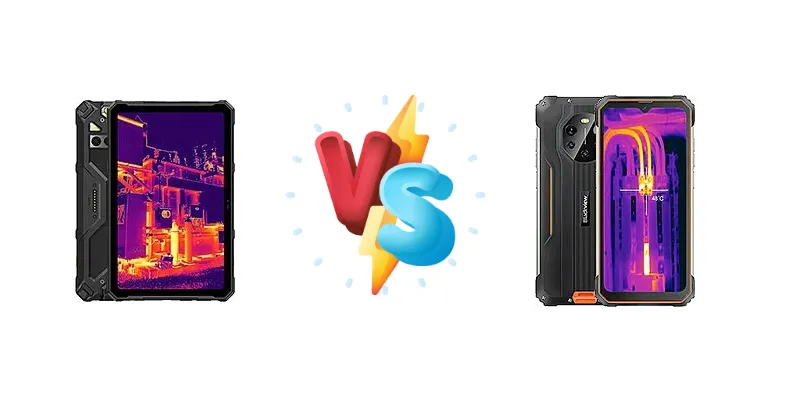
|
🏆 Quick Verdict
For users prioritizing raw processing power and a larger screen for productivity, the Ulefone Armor Pad 4 Ultra Thermal is the better choice. Its Dimensity 6300 chipset, built on a more efficient 6nm process, offers a performance advantage over the Blackview BL8800 Pro’s Dimensity 700, despite the slightly lower CPU clock speeds.
| PHONES | ||
|---|---|---|
| Phone Names | Ulefone Armor Pad 4 Ultra Thermal | Blackview BL8800 Pro |
| Network | ||
|---|---|---|
| 2G bands | GSM 850 / 900 / 1800 / 1900 | GSM 850 / 900 / 1800 / 1900 |
| 3G bands | HSDPA 850 / 900 / 1700(AWS) / 1900 / 2100 | HSDPA 800 / 850 / 900 / 1700(AWS) / 1900 / 2100 |
| 4G bands | 1, 2, 3, 4, 5, 7, 8, 12, 13, 17, 18, 19, 20, 26, 28, 34, 38, 39, 40, 41, 66, 71 | 1, 2, 3, 4, 5, 7, 8, 12, 13, 17, 18, 19, 20, 25, 26, 28, 30, 66 |
| 5G bands | 1, 2, 3, 5, 7, 8, 20, 25, 28, 38, 40, 41, 66, 71, 77, 78, 79 SA/NSA | 1, 3, 5, 7, 8, 20, 28, 38, 40, 41, 77, 78, 79 SA/NSA |
| Speed | HSPA, LTE, 5G | HSPA, LTE, 5G |
| Technology | GSM / HSPA / LTE / 5G | GSM / CDMA / HSPA / CDMA2000 / LTE / 5G |
| - | CDMA2000 1x | |
| Launch | ||
|---|---|---|
| Announced | 2024, September | 2022, May 09 |
| Status | Available. Released 2024, September | Available. Released 2022, May 09 |
| Body | ||
|---|---|---|
| Dimensions | 261.7 x 166.8 x 14.3 mm (10.30 x 6.57 x 0.56 in) | 176.2 x 83.5 x 17.7 mm (6.94 x 3.29 x 0.70 in) |
| SIM | Nano-SIM + Nano-SIM | Nano-SIM + Nano-SIM |
| Weight | 834.5 g (1.84 lb) | 367 g (12.95 oz) |
| - | IP68/IP69K dust/water resistant (up to 1.5m for 30 min) Drop-to-concrete resistance from up to 1.5m MIL-STD-810H compliant | |
| Display | ||
|---|---|---|
| Protection | Corning Gorilla Glass Victus | - |
| Resolution | 1200 x 2000 pixels, 5:3 ratio (~225 ppi density) | 1080 x 2408 pixels, 20:9 ratio (~401 ppi density) |
| Size | 10.36 inches, 305.5 cm2 (~70.0% screen-to-body ratio) | 6.58 inches, 104.3 cm2 (~70.9% screen-to-body ratio) |
| Type | IPS LCD | IPS LCD, 480 nits |
| Platform | ||
|---|---|---|
| CPU | Octa-core (2x2.4 GHz Cortex-A76 & 6x2.0 GHz Cortex-A55) | Octa-core (2x2.2 GHz Cortex-A76 & 6x2.0 GHz Cortex-A55) |
| Chipset | Mediatek Dimensity 6300 (6 nm) | Mediatek Dimensity 700 (7 nm) |
| GPU | Mali-G57 MC2 | Mali-G57 MC2 |
| OS | Android 14 | Android 11, Doke-OS 3.0 |
| Memory | ||
|---|---|---|
| Card slot | microSDXC (dedicated slot) | No |
| Internal | 256GB 8GB RAM | 128GB 8GB RAM |
| - | UFS 2.1 | |
| Main Camera | ||
|---|---|---|
| Dual | 50 MP, f/2.0, (wide), 1/1.31", 1.2µm Thermal camera by ThermoVue, 160x120 px, 25Hz, 12μm | - |
| Features | LED flash, HDR, panorama | Thermal imaging, Dual-LED flash, HDR, panorama |
| Penta | - | 50 MP, f/1.8, (wide), PDAF 5 MP, thermal assisted camera FLIR thermal camera (Lepton module) 2x Auxiliary lens |
| Single | - | 16 MP, f/2.0, (wide) |
| Video | 1440p@30fps, 1080p@30fps | 1440p@30fps |
| Selfie camera | ||
|---|---|---|
| Single | 32 MP, f/2.4, (wide), 0.8µm | 16 MP, f/2.0, (wide) |
| Video | Yes | 1080p@30fps |
| Sound | ||
|---|---|---|
| 3.5mm jack | - | No |
| 35mm jack | Yes | No |
| Loudspeaker | Yes, with stereo speakers | Yes |
| Comms | ||
|---|---|---|
| Bluetooth | 5.2, A2DP | 5.1, A2DP, LE |
| NFC | Yes | Yes |
| Positioning | GPS, GLONASS, GALILEO, BDS | GPS, GLONASS, GALILEO, BDS |
| Radio | Wireless FM radio, RDS, recording | FM radio |
| USB | USB Type-C 2.0, OTG, magnetic connector | USB Type-C 2.0, OTG |
| WLAN | Wi-Fi 802.11 a/b/g/n/ac, dual-band | Wi-Fi 802.11 a/b/g/n/ac |
| Features | ||
|---|---|---|
| Sensors | Fingerprint (side-mounted), gyro, accelerometer, proximity, compass, barometer | Fingerprint (side-mounted), accelerometer, gyro, proximity, compass, barometer |
| Battery | ||
|---|---|---|
| Charging | 33W wired 5W reverse wired | 33W wired, 31% in 30 min, 100% in 90 min Reverse wired |
| Type | Li-Po 11800 mAh | 8380 mAh |
| Misc | ||
|---|---|---|
| Colors | Black | Black, Orange, Green |
| Price | About 460 EUR | About 300 EUR |
Ulefone Armor Pad 4 Ultra Thermal
- More powerful Dimensity 6300 chipset for better performance.
- 6nm process offers improved power efficiency and thermal management.
- 5W reverse wired charging for accessory top-ups.
- Larger screen size ideal for productivity and media consumption.
- Tablet form factor may be less convenient for one-handed use.
- Battery capacity is unknown, potentially limiting endurance.
Blackview BL8800 Pro
- More portable smartphone form factor.
- Faster charging time (0-100% in 90 minutes).
- Likely more versatile camera system.
- Established rugged phone brand reputation.
- Older Dimensity 700 chipset with less processing power.
- 7nm process is less efficient than the Ulefone’s 6nm.
- No reverse wired charging.
Display Comparison
Display specifications are not provided, but given the form factors, a significant difference is expected. The Ulefone, being a tablet, will likely have a larger display with potentially higher resolution. The Blackview, as a phone, will prioritize pixel density and potentially offer a higher refresh rate. The Ulefone’s larger screen will benefit from the more powerful GPU of the Dimensity 6300 for smoother visuals. The absence of display specs makes a direct comparison impossible, but the Ulefone’s larger canvas will be a key differentiator.
Camera Comparison
Camera details are absent, but we can infer that the Blackview, being a phone, will likely have a more versatile camera system with multiple lenses. However, the Ulefone’s larger size could accommodate a larger sensor, potentially improving low-light performance. Without specific sensor sizes or aperture information, it’s difficult to definitively declare a winner. Image processing algorithms will also play a crucial role, and brand reputation suggests Blackview may have more refined software in this area.
Performance
The Ulefone Armor Pad 4 Ultra Thermal’s Mediatek Dimensity 6300 (6nm) chipset represents a generational leap over the Blackview BL8800 Pro’s Dimensity 700 (7nm). While both CPUs feature the same Cortex-A76 and A55 core configuration, the 6nm fabrication process of the Dimensity 6300 translates to improved power efficiency and thermal management. This means the Ulefone can sustain peak performance for longer periods without significant throttling. The 2.4 GHz Cortex-A76 cores in the Ulefone are slightly faster than the 2.2 GHz cores in the Blackview, further contributing to its performance edge. Users engaging in demanding tasks like video editing or 3D rendering will see a noticeable benefit on the Ulefone.
Battery Life
Both devices feature 33W wired charging, but the Blackview BL8800 Pro provides more specific charging data: 31% in 30 minutes and 100% in 90 minutes. This suggests a smaller battery capacity. While the Ulefone’s battery capacity is unknown, the more efficient Dimensity 6300 chipset could offset a potentially smaller battery, resulting in comparable real-world battery life. The Ulefone also offers 5W reverse wired charging, a feature absent in the Blackview, allowing it to charge smaller accessories.
Buying Guide
Buy the Ulefone Armor Pad 4 Ultra Thermal if you need a large, rugged display for field work, detailed map viewing, or extended media consumption. Its tablet form factor and newer chipset are ideal for multitasking and demanding applications. Buy the Blackview BL8800 Pro if you prefer the portability of a smartphone and require a more traditional mobile experience with rugged durability. It’s a solid choice for those needing communication and basic tasks on the go.