
Ulefone Armor Pad 3 Pro vs. Power Armor 18T Ultra: Which Rugged Tablet Reigns Supreme?
| Phones Images | |||||
|---|---|---|---|---|---|
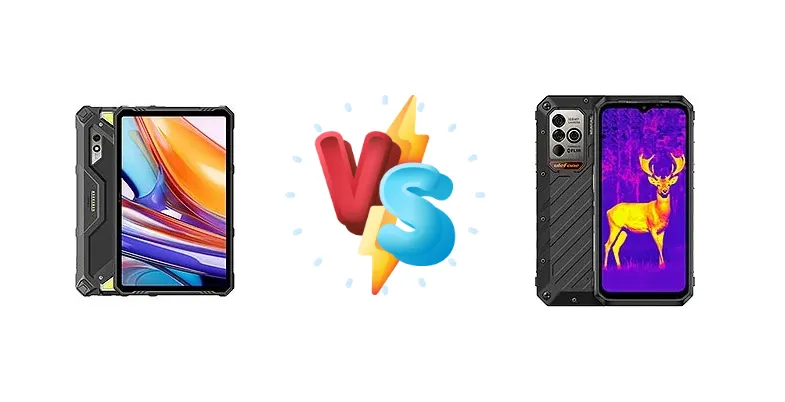
|
🏆 Quick Verdict
For the average user prioritizing longevity and all-day use, the Ulefone Armor Pad 3 Pro is the better choice, thanks to its significantly superior battery endurance of 166:39h. However, users demanding faster performance and wireless charging will find the Power Armor 18T Ultra a compelling option.
| PHONES | ||
|---|---|---|
| Phone Names | Ulefone Armor Pad 3 Pro | Ulefone Power Armor 18T Ultra |
| Network | ||
|---|---|---|
| 2G bands | GSM 850 / 900 / 1800 / 1900 | GSM 850 / 900 / 1800 / 1900 |
| 3G bands | HSDPA 850 / 900 / 1700(AWS) / 1900 / 2100 | HSDPA 800 / 850 / 900 / 1700(AWS) / 1900 / 2100 |
| 4G bands | 1, 2, 3, 4, 5, 7, 8, 12, 17, 19, 20, 28, 34, 38, 39, 40, 41, 66 | 1, 2, 3, 4, 5, 7, 8, 12, 13, 17, 18, 19, 20, 25, 26, 28, 34, 38, 39, 40, 41, 66, 71 |
| 5G bands | - | 1, 2, 3, 5, 7, 8, 12, 20, 25, 28, 38, 40, 41, 66, 71, 77, 78, 79 SA/NSA/Sub6 |
| Speed | HSPA, LTE | HSPA, LTE, 5G |
| Technology | GSM / HSPA / LTE | GSM / CDMA / HSPA / CDMA2000 / LTE / 5G |
| Launch | ||
|---|---|---|
| Announced | 2024, April | 2023, October |
| Status | Available. Released 2024, April | Available. Released 2023, November |
| Body | ||
|---|---|---|
| Dimensions | 261.7 x 166.8 x 21.2 mm (10.30 x 6.57 x 0.83 in) | 175.2 x 83.4 x 18.8 mm (6.90 x 3.28 x 0.74 in) |
| SIM | Nano-SIM + Nano-SIM | Nano-SIM + Nano-SIM |
| Weight | 1243 g (2.74 lb) | 409 g (14.43 oz) |
| Display | ||
|---|---|---|
| Protection | Corning Gorilla Glass 5, Mohs level 4 | Corning Gorilla Glass 5, Mohs level 4 |
| Resolution | 1200 x 2000 pixels, 5:3 ratio (~225 ppi density) | 1080 x 2408 pixels, 20:9 ratio (~401 ppi density) |
| Size | 10.36 inches, 305.5 cm2 (~70.0% screen-to-body ratio) | 6.58 inches, 104.3 cm2 (~71.4% screen-to-body ratio) |
| Type | IPS LCD | IPS LCD, 120Hz |
| Platform | ||
|---|---|---|
| CPU | Octa-core (4x2.0 GHz Cortex-A73 & 4x2.0 GHz Cortex-A53) | Octa-core (2x2.6 GHz Cortex-A78 & 6x2.0 GHz Cortex-A55) |
| Chipset | Mediatek MT8788 (12 nm) | Mediatek Dimensity 7050 (6 nm) |
| GPU | Mali-G72 MP3 | Mali-G68 MC4 |
| OS | Android 13 | Android 13, upgradable to Android 14 |
| Memory | ||
|---|---|---|
| Card slot | microSDXC (dedicated slot) | microSDXC (uses shared SIM slot) |
| Internal | 256GB 8GB RAM | 512GB 12GB RAM |
| Main Camera | ||
|---|---|---|
| Features | LED flash, HDR, panorama | Hexa-LED flash, HDR, panorama |
| Single | 50 MP, f/2.0, (wide), 1/1.3", 1.2µm | - |
| Triple | - | 108 MP, f/1.9, (wide), 1/1.52", 0.7µm, PDAF 5 MP (macro) 5 MP, f/2.2, (FLIR thermal camera, Lepton module) |
| Video | 1080p@30fps | 4K@30fps, 1080p@30fps |
| Selfie camera | ||
|---|---|---|
| Single | 32 MP, f/2.5, (wide), 1/2.8" | 32 MP, f/2.0, (wide), 1.2µm |
| Video | Yes | 1080p@30fps |
| Sound | ||
|---|---|---|
| 35mm jack | Yes | Yes |
| Loudspeaker | Yes, with stereo speakers | Yes |
| Comms | ||
|---|---|---|
| Bluetooth | 4.2, A2DP | 5.0, A2DP, LE |
| NFC | Yes | Yes |
| Positioning | GPS, GLONASS, GALILEO, BDS | GPS (L1+L5), GLONASS, GALILEO, BDS, NavIC |
| Radio | Wireless FM radio, RDS, recording | Wireless FM radio, RDS, recording |
| USB | USB Type-C 2.0, OTG, HDMI, magnetic connector | USB Type-C 2.0, OTG, magnetic connector |
| WLAN | Wi-Fi 802.11 a/b/g/n/ac, dual-band | Wi-Fi 802.11 a/b/g/n/ac/6, dual-band |
| Features | ||
|---|---|---|
| Sensors | Fingerprint (side-mounted), accelerometer, gyro, proximity, compass | Fingerprint (side-mounted), accelerometer, gyro, proximity, compass |
| Battery | ||
|---|---|---|
| Charging | 66W wired 5W reverse wired | 66W wired, 52% in 30 min 15W wireless 5W wireless reversed |
| Type | Li-Po 33280 mAh | Li-Po 9600 mAh |
| Misc | ||
|---|---|---|
| Colors | Black | Black |
| Price | About 370 EUR | About 700 EUR |
| EU LABEL | ||
|---|---|---|
| Battery | 166:39h endurance, 1000 cycles | 88:30h endurance, 1000 cycles |
| Energy | Class D | Class B |
| Free fall | Class A (208 falls) | Class A (270 falls) |
| Repairability | Class C | Class C |
Ulefone Armor Pad 3 Pro
- Exceptional battery endurance (166:39h)
- 1000 charge cycles for long-term reliability
- 66W wired charging provides reasonable recharge speeds
- Older Mediatek MT8788 chipset limits performance
- Lacks wireless charging capabilities
Ulefone Power Armor 18T Ultra
- Powerful Mediatek Dimensity 7050 chipset for smooth performance
- 66W wired charging with faster 30-minute charge rate
- 15W wireless charging and 5W reverse wireless charging
- Significantly shorter battery endurance (88:30h)
- Higher power consumption may lead to more frequent charging
Display Comparison
While both tablets likely feature durable, ruggedized displays, the provided data doesn't detail screen specifications. However, given the Armor Pad 3 Pro's focus on endurance, it may prioritize power efficiency over peak brightness or refresh rate. The 18T Ultra, with its more powerful chipset, could potentially support a higher resolution or refresh rate panel, though this is speculative. Bezels are likely similar, given both devices target a rugged aesthetic.
Camera Comparison
The provided data doesn't offer camera details. Given Ulefone's typical approach, both tablets likely feature a multi-camera setup, but image quality will depend on sensor size, lens aperture, and image processing algorithms. Without specific details, it's difficult to assess the camera performance, but the 18T Ultra’s more powerful ISP (Image Signal Processor) within the Dimensity 7050 chipset could potentially deliver better image processing capabilities.
Performance
The core difference lies in the chipsets. The Power Armor 18T Ultra’s Mediatek Dimensity 7050 (6nm) represents a significant leap over the Armor Pad 3 Pro’s Mediatek MT8788 (12nm). The Dimensity 7050 utilizes newer Cortex-A78 cores clocked at 2.6 GHz, compared to the Armor Pad 3 Pro’s Cortex-A73 cores at 2.0 GHz. This translates to a substantial performance advantage in CPU-intensive tasks and gaming. The 6nm process node of the Dimensity 7050 also offers improved thermal efficiency, reducing throttling under sustained load. The Armor Pad 3 Pro will be adequate for basic productivity and media consumption, but the 18T Ultra is the clear winner for demanding users.
Battery Life
Battery life is where the Armor Pad 3 Pro truly shines. Its 166:39h endurance rating dwarfs the 88:30h of the Power Armor 18T Ultra. While both offer 66W wired charging, the 18T Ultra boasts a 52% charge in 30 minutes, suggesting a faster charging curve despite the same wattage. The 18T Ultra also adds 15W wireless charging and 5W reverse wireless charging, features absent on the Armor Pad 3 Pro. However, the Armor Pad 3 Pro’s significantly longer endurance mitigates the need for frequent charging, making it ideal for users away from power outlets.
Buying Guide
Buy the Ulefone Armor Pad 3 Pro if you need a tablet that can reliably last through multi-day deployments, extended travel, or simply prefer not to worry about frequent charging. It’s ideal for field technicians, construction workers, or anyone needing a dependable workhorse. Buy the Ulefone Power Armor 18T Ultra if you prioritize responsiveness for demanding applications, enjoy mobile gaming, or value the convenience of wireless charging and a more modern chipset.