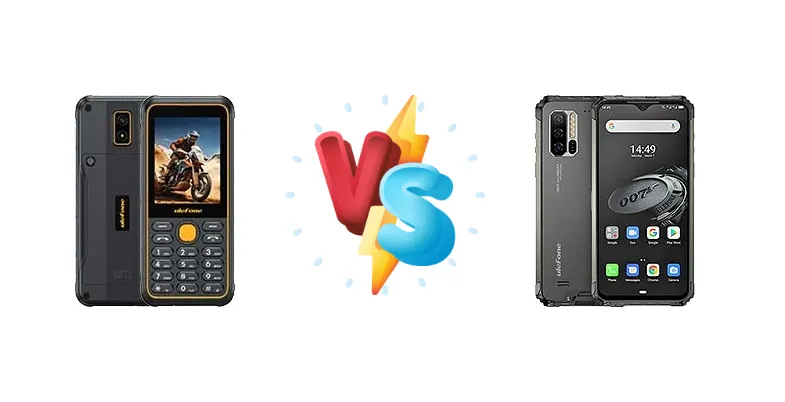
Ulefone caters to the rugged phone market, offering durable devices at competitive prices. The Armor Mini 4 and Armor 7E represent different approaches within that segment. The Mini 4 prioritizes extreme compactness, while the 7E aims for a balance of features and performance. This comparison dissects their core differences, focusing on the impact of their contrasting chipsets and charging capabilities.
🏆 Quick Verdict
For most users, the Ulefone Armor 7E is the superior choice. Its Mediatek Helio P90 chipset delivers significantly better performance than the Unisoc T117 in the Mini 4, making it more suitable for demanding tasks and future-proofing. The 15W wired and 10W wireless charging also provide a more convenient and faster charging experience.
| Network |
|---|
| 2G bands | GSM 850 / 900 / 1800 / 1900 | GSM 850 / 900 / 1800 / 1900 |
| 3G bands | HSDPA 900 / 2100 | HSDPA 850 / 900 / 1700(AWS) / 1900 / 2100 |
| 4G bands | 1, 3, 7, 8, 20, 28 | 1, 2, 3, 4, 5, 7, 8, 12, 13, 17, 18, 19, 20, 25, 26, 28, 34, 38, 39, 40, 41, 66, 71 |
| Speed | HSPA, LTE | HSPA 42.2/11.5 Mbps, LTE (2CA) Cat13 600/150 Mbps |
| Technology | GSM / HSPA / LTE | GSM / CDMA / HSPA / EVDO / LTE |
| | - | CDMA2000 1xEV-DO |
| Launch |
|---|
| Announced | 2025, March 03 | 2020, March 30. Released 2020, March 30 |
| Status | Available. Released 2025, July | Discontinued |
| Body |
|---|
| Dimensions | 142.9 x 63 x 15 mm (5.63 x 2.48 x 0.59 in) | 165.9 x 81 x 13.6 mm (6.53 x 3.19 x 0.54 in) |
| SIM | Dual SIM | Nano-SIM + Nano-SIM |
| Weight | 150 g (5.29 oz) | 290 g (10.23 oz) |
| | - | IP68 dust/water resistant
Drop-to-concrete resistance from up to 1.2m
MIL-STD-810G compliant |
| Display |
|---|
| Resolution | 240 x 320 pixels, 4:3 ratio (~143 ppi density) | 1080 x 2340 pixels, 19.5:9 ratio (~409 ppi density) |
| Size | 2.8 inches, 24.3 cm2 (~27.0% screen-to-body ratio) | 6.3 inches, 97.4 cm2 (~72.5% screen-to-body ratio) |
| Type | TFT LCD | IPS LCD |
| Platform |
|---|
| CPU | - | Octa-core (2x2.2 GHz Cortex-A75 & 6x2.0 GHz Cortex-A55) |
| Chipset | Unisoc T117 | Mediatek MT6779 Helio P90 (12 nm) |
| GPU | - | PowerVR GM9446 |
| OS | - | Android 9.0 (Pie) |
| Memory |
|---|
| Call records | Yes | - |
| Card slot | microSDHC (dedicated slot) | microSDXC (uses shared SIM slot) |
| Internal | 128MB 64MB RAM | 128GB 4GB RAM |
| Phonebook | Yes | - |
| Main Camera |
|---|
| Features | LED flash | 5-LED flash, HDR, panorama |
| Single | 2 MP | - |
| Triple | - | 48 MP, f/1.7, (wide), 1/2.0", 0.8µm, PDAF
2 MP (macro)
Auxiliary lens |
| Video | Yes | 4K@30fps, 1080p@30fps |
| Selfie camera |
|---|
| Single | - | 16 MP, f/2.0, (wide), 1/3.06", 1.0µm |
| Video | - | 1080p@30fps |
| Sound |
|---|
| 3.5mm jack | - | No |
| 35mm jack | Yes | No |
| Loudspeaker | Yes | Yes |
| Comms |
|---|
| Bluetooth | 2.4 | 5.0, A2DP, LE |
| NFC | No | Yes |
| Positioning | No | GPS, GLONASS, GALILEO, BDS |
| Radio | FM radio, built-in antenna | Stereo FM radio, RDS, recording |
| USB | USB Type-C | USB Type-C 2.0, OTG |
| WLAN | No | Wi-Fi 802.11 a/b/g/n/ac, dual-band, Wi-Fi Direct |
| Features |
|---|
| Games | No | - |
| Java | No | - |
| Messaging | Yes | - |
| Sensors | No | Fingerprint (side-mounted), accelerometer, gyro, proximity, compass, heart rate, baroceptor, coulombmeter |
| Battery |
|---|
| Charging | 5W wired | 15W wired
10W wireless |
| Type | Li-Ion 2100 mAh, removable | Li-Po 5500 mAh |
| Misc |
|---|
| Colors | Black | Black |
| Price | About 60 EUR | About 250 EUR |
Ulefone Armor Mini 4
- Extremely compact and pocketable design
- Rugged build quality for durability
- Lower price point (likely)
- Weak Unisoc T117 chipset limits performance
- Extremely slow 5W charging
- Limited multitasking capabilities
Ulefone Armor 7E
- Powerful Mediatek Helio P90 chipset
- Faster 15W wired and 10W wireless charging
- More responsive user experience
- Larger size compared to the Mini 4
- Potentially higher price
- May experience some thermal throttling under sustained load
Display Comparison
Neither Ulefone provides detailed display specifications beyond size. However, given the Armor 7E's positioning, it likely features a higher resolution panel than the Mini 4. The difference in chipsets suggests the 7E could drive a more complex display with smoother animations. Both will likely utilize IPS LCD technology common in this price bracket, and neither is expected to offer high peak brightness or advanced features like LTPO.
Camera Comparison
Without detailed camera specs, a direct comparison is difficult. However, the Armor 7E’s more powerful chipset suggests a more capable image signal processor (ISP), potentially leading to better image processing and noise reduction. Both phones likely feature a primary camera and potentially a secondary depth or macro sensor, but the P90’s processing power will be crucial for extracting detail and dynamic range. The inclusion of a 2MP macro camera on either device is largely a marketing feature with limited practical benefit.
Performance
The core difference lies in the chipsets. The Ulefone Armor Mini 4’s Unisoc T117 is an entry-level SoC designed for basic functionality. In contrast, the Armor 7E boasts the Mediatek Helio P90, a 12nm processor with an octa-core configuration (2x2.2 GHz Cortex-A75 & 6x2.0 GHz Cortex-A55). This architectural difference translates to a substantial performance gap. The P90’s Cortex-A75 cores provide significantly more processing power for demanding applications, while the T117 will struggle with multitasking and graphically intensive games. The Armor 7E will offer a noticeably smoother and more responsive user experience.
Battery Life
Battery capacity isn't specified, but the charging speeds reveal a key difference. The Armor Mini 4 is limited to 5W wired charging, meaning a full charge will take a considerable amount of time. The Armor 7E, with its 15W wired and 10W wireless charging, offers significantly faster and more convenient charging options. While a larger battery capacity on the Mini 4 could partially offset the slower charging, the 7E’s faster charging will likely result in less downtime overall.
Buying Guide
Buy the Ulefone Armor Mini 4 if you absolutely require the smallest possible rugged phone and your usage is limited to basic communication and light tasks. Its compact form factor is ideal for those prioritizing pocketability above all else. Buy the Ulefone Armor 7E if you need a more capable device for multitasking, gaming, or running demanding applications. The Helio P90 chipset and faster charging make it a more versatile and future-proof investment.
Frequently Asked Questions
❓ Will the Helio P90 in the Armor 7E overheat during prolonged gaming sessions?
The Helio P90 is known to generate some heat under sustained load. While Ulefone's rugged design likely incorporates some thermal management, expect some performance throttling during extended gaming. It won't reach critical temperatures, but peak performance may be reduced after a while.
❓ Is the 5W charging on the Armor Mini 4 realistically usable for daily charging?
5W charging is extremely slow by modern standards. Expect a full charge to take several hours, making it impractical for users who need to quickly top up their battery. It's best suited for overnight charging only.
❓ Can the Armor 7E handle demanding apps like navigation or video editing?
Yes, the Helio P90 is capable of handling navigation apps and basic video editing tasks without significant issues. However, for professional-grade video editing or extremely complex applications, performance may be limited.
❓ Does the Armor 7E support NFC for contactless payments?
This information isn't provided. However, given the Armor 7E's more feature-rich positioning, it's *likely* to include NFC, but it's crucial to verify this specification before purchasing.