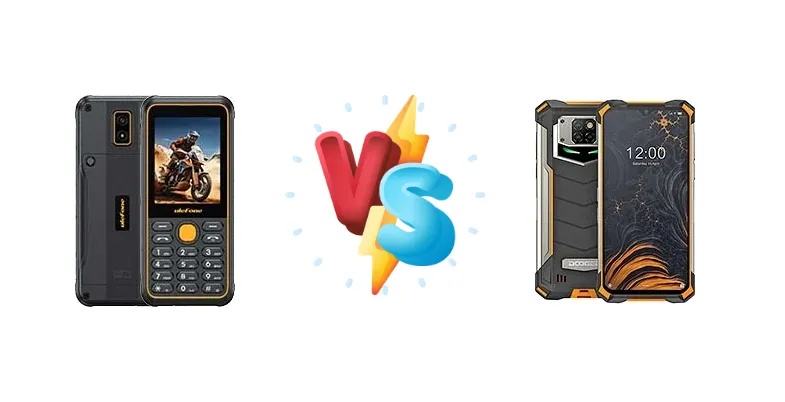
The rugged smartphone market caters to a specific need: durability. Both the Ulefone Armor Mini 4 and the Doogee S88 Pro aim to deliver that, but they approach it with different philosophies. The Mini 4 prioritizes a smaller form factor and lower price, while the S88 Pro focuses on a more capable chipset and faster charging, creating a clear divergence in user experience.
🏆 Quick Verdict
For the average user needing a reliable, durable phone with decent performance, the Doogee S88 Pro is the better choice. Its Mediatek Helio P70 chipset provides a substantial performance advantage over the Ulefone’s Unisoc T117, and the 24W charging significantly reduces downtime. While the Mini 4 is more compact, the trade-offs in processing power are too significant for most.
| Network |
|---|
| 2G bands | GSM 850 / 900 / 1800 / 1900 | GSM 850 / 900 / 1800 / 1900 |
| 3G bands | HSDPA 900 / 2100 | HSDPA 850 / 900 / 1700(AWS) / 1900 / 2100 |
| 4G bands | 1, 3, 7, 8, 20, 28 | 1, 3, 7, 8, 20 |
| Speed | HSPA, LTE | HSPA, LTE |
| Technology | GSM / HSPA / LTE | GSM / HSPA / LTE |
| Launch |
|---|
| Announced | 2025, March 03 | 2020, June 06. Released 2020, June 06 |
| Status | Available. Released 2025, July | Discontinued |
| Body |
|---|
| Build | - | Glass front (Gorilla Glass), aluminum back with rubber, aluminum frame |
| Dimensions | 142.9 x 63 x 15 mm (5.63 x 2.48 x 0.59 in) | 171.6 x 85.5 x 18.7 mm (6.76 x 3.37 x 0.74 in) |
| SIM | Dual SIM | Nano-SIM + Nano-SIM |
| Weight | 150 g (5.29 oz) | 372 g (13.12 oz) |
| Display |
|---|
| Protection | - | Corning Gorilla Glass |
| Resolution | 240 x 320 pixels, 4:3 ratio (~143 ppi density) | 1080 x 2340 pixels, 19.5:9 ratio (~409 ppi density) |
| Size | 2.8 inches, 24.3 cm2 (~27.0% screen-to-body ratio) | 6.3 inches, 97.4 cm2 (~66.4% screen-to-body ratio) |
| Type | TFT LCD | IPS LCD |
| Platform |
|---|
| CPU | - | Octa-core (4x2.1 GHz Cortex-A73 & 4x2.0 GHz Cortex-A53) |
| Chipset | Unisoc T117 | Mediatek MT6771T Helio P70 (12 nm) |
| GPU | - | Mali-G72 MP3 |
| OS | - | Android 10 |
| Memory |
|---|
| Call records | Yes | - |
| Card slot | microSDHC (dedicated slot) | microSDXC (uses shared SIM slot) |
| Internal | 128MB 64MB RAM | 128GB 6GB RAM |
| Phonebook | Yes | - |
| Main Camera |
|---|
| Features | LED flash | Dual-LED dual-tone flash, HDR, panorama |
| Single | 2 MP | - |
| Triple | - | 21 MP, f/2.2, (wide), 1/2.4", 1.12µm, PDAF
8 MP, f/2.2, 130˚, (ultrawide), 1/4.0", 1.12µm
Auxiliary lens |
| Video | Yes | 1080p@30fps |
| Selfie camera |
|---|
| Single | - | 16 MP, f/2.2, 26mm (wide) |
| Video | - | 1080p@30fps |
| Sound |
|---|
| 35mm jack | Yes | No |
| Loudspeaker | Yes | Yes |
| Comms |
|---|
| Bluetooth | 2.4 | 4.2, A2DP |
| NFC | No | Yes |
| Positioning | No | GPS, GLONASS, BDS, GALILEO |
| Radio | FM radio, built-in antenna | FM radio |
| USB | USB Type-C | USB Type-C 2.0, OTG |
| WLAN | No | Wi-Fi 802.11 b/g/n |
| Features |
|---|
| Games | No | - |
| Java | No | - |
| Messaging | Yes | - |
| Sensors | No | Fingerprint (side-mounted), accelerometer, gyro, proximity, compass |
| Battery |
|---|
| Charging | 5W wired | 24W wired
10W wireless
5W Reverse wireless |
| Type | Li-Ion 2100 mAh, removable | 10000 mAh |
| Misc |
|---|
| Colors | Black | Fire Orange, Army Green, Mineral Black |
| Price | About 60 EUR | About 130 EUR |
Ulefone Armor Mini 4
- More compact and pocketable design.
- Lower price point makes it accessible.
- Rugged build quality for basic protection.
- Significantly weaker processor performance.
- Extremely slow 5W charging.
- Limited features compared to the S88 Pro.
Doogee S88 Pro
- Faster and more capable Mediatek Helio P70 chipset.
- Significantly faster 24W wired and 10W wireless charging.
- Better display contrast ratio for improved viewing.
- Reverse wireless charging capability.
- Larger size and weight.
- Higher price compared to the Ulefone Armor Mini 4.
Display Comparison
The Doogee S88 Pro boasts a contrast ratio of 1641:1 (nominal), suggesting a more vibrant and visually appealing display compared to what is typical for the Ulefone Armor Mini 4’s price point. While neither manufacturer provides detailed specifications on panel type or peak brightness, the contrast ratio indicates a better viewing experience for media consumption on the S88 Pro. The Mini 4’s smaller size likely necessitates a smaller display, potentially impacting usability for users accustomed to larger screens.
Camera Comparison
Detailed camera specifications are limited, but the focus should be on the primary sensors. Without knowing the megapixel count or sensor size for the Ulefone, it’s difficult to make a direct comparison. However, the S88 Pro’s image processing capabilities, driven by the Helio P70’s ISP, will likely yield superior image quality, particularly in challenging lighting conditions. The presence of OIS (Optical Image Stabilization) on the S88 Pro, if equipped, would further enhance image clarity and reduce blur, a feature likely absent on the more budget-oriented Mini 4.
Performance
The core difference lies in the chipsets. The Doogee S88 Pro utilizes the Mediatek MT6771T Helio P70, a 12nm octa-core processor with a configuration of 4x2.1 GHz Cortex-A73 and 4x2.0 GHz Cortex-A53 cores. This architecture provides a significant performance boost over the Ulefone Armor Mini 4’s Unisoc T117. The Helio P70’s Cortex-A73 cores are considerably more powerful than the cores found in the T117, resulting in faster app loading times, smoother multitasking, and improved gaming performance. The 12nm process node of the Helio P70 also contributes to better thermal efficiency, potentially reducing throttling during sustained workloads.
Battery Life
The Doogee S88 Pro’s battery endurance rating of 202 hours suggests excellent battery life, though real-world usage will vary. Crucially, the S88 Pro supports 24W wired charging, 10W wireless charging, and even 5W reverse wireless charging – a feature entirely absent on the Ulefone Armor Mini 4, which is limited to 5W wired charging. This charging disparity is massive; the S88 Pro can replenish its battery far more quickly, minimizing downtime. While the S88 Pro’s battery capacity isn’t specified, the combination of efficient chipset and fast charging provides a significant advantage.
Buying Guide
Buy the Ulefone Armor Mini 4 if you absolutely require the smallest possible rugged phone and your usage is limited to basic tasks like calls, texts, and light app use. Buy the Doogee S88 Pro if you need a rugged phone capable of handling more demanding applications, multitasking, and benefit from significantly faster charging speeds, even if it means a slightly larger device.
Frequently Asked Questions
❓ Does the Mediatek Helio P70 in the Doogee S88 Pro tend to overheat during prolonged gaming sessions?
The Helio P70 is a relatively efficient chipset, and the S88 Pro’s rugged design likely incorporates adequate thermal management. While some heat generation is inevitable during intensive gaming, the 12nm process node and the phone’s construction should prevent significant throttling or overheating issues. However, sustained, high-graphics gaming will still generate some heat.
❓ Is the 5W charging on the Ulefone Armor Mini 4 realistically usable for daily charging?
5W charging is exceptionally slow by modern standards. Expect several hours to fully charge the Ulefone Armor Mini 4 from 0%. It’s best suited for overnight charging or topping up the battery when not in active use. Users accustomed to faster charging will find the Mini 4’s charging speed frustrating.
❓ What type of user would benefit most from the reverse wireless charging feature on the Doogee S88 Pro?
The reverse wireless charging feature is ideal for users who frequently travel with Bluetooth earbuds or smartwatches. It allows you to use the S88 Pro as a portable charging pad for these accessories, eliminating the need to carry additional chargers. It's a convenient feature for those invested in the wireless accessory ecosystem.