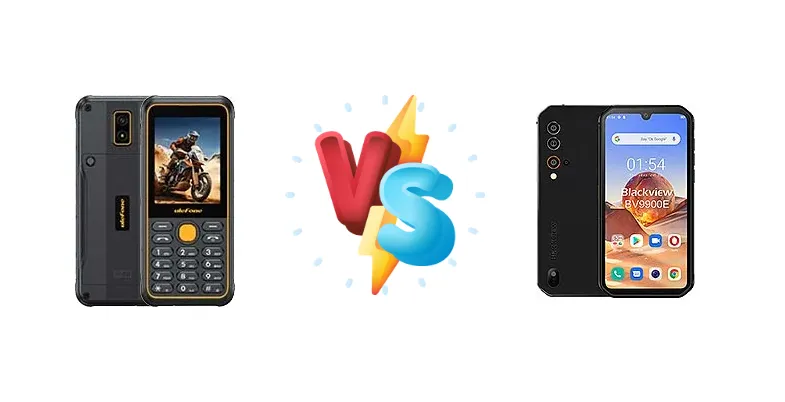
The rugged smartphone market caters to a specific need: durability. However, within this niche, choices vary greatly. We pit the Ulefone Armor Mini 4, a compact and affordable option, against the Blackview BV9900E, a more feature-packed device boasting a significantly more powerful chipset, to determine which best balances toughness with usability.
🏆 Quick Verdict
For the average user prioritizing performance and features, the Blackview BV9900E is the clear winner. Its Helio P90 chipset delivers a substantially better experience than the Unisoc T117 in the Armor Mini 4, and the inclusion of 15W wired and 18W wireless charging adds significant convenience. The Mini 4 appeals only to those needing extreme portability above all else.
| Network |
|---|
| 2G bands | GSM 850 / 900 / 1800 / 1900 | GSM 850 / 900 / 1800 / 1900 |
| 3G bands | HSDPA 900 / 2100 | HSDPA 800 / 850 / 900 / 1700(AWS) / 1900 / 2100 |
| 4G bands | 1, 3, 7, 8, 20, 28 | 1, 2, 3, 4, 5, 7, 8, 12, 13, 17, 18, 19, 20, 25, 26, 28, 34, 38, 39, 40, 41, 66 |
| Speed | HSPA, LTE | HSPA, LTE |
| Technology | GSM / HSPA / LTE | GSM / CDMA / HSPA / CDMA2000 / LTE |
| Launch |
|---|
| Announced | 2025, March 03 | 2020, September 10. Released 2020, September |
| Status | Available. Released 2025, July | Discontinued |
| Body |
|---|
| Dimensions | 142.9 x 63 x 15 mm (5.63 x 2.48 x 0.59 in) | 156.5 x 78.3 x 14.2 mm (6.16 x 3.08 x 0.56 in) |
| SIM | Dual SIM | Nano-SIM + Nano-SIM |
| Weight | 150 g (5.29 oz) | 273 g (9.63 oz) |
| Display |
|---|
| Protection | - | Corning Gorilla Glass 5 |
| Resolution | 240 x 320 pixels, 4:3 ratio (~143 ppi density) | 1080 x 2280 pixels, 19:9 ratio (~432 ppi density) |
| Size | 2.8 inches, 24.3 cm2 (~27.0% screen-to-body ratio) | 5.84 inches, 85.1 cm2 (~69.5% screen-to-body ratio) |
| Type | TFT LCD | IPS LCD |
| Platform |
|---|
| CPU | - | Octa-core (2x2.2 GHz Cortex-A75 & 6x2.0 GHz Cortex-A55) |
| Chipset | Unisoc T117 | Mediatek MT6779V/CE Helio P90 (12 nm) |
| GPU | - | PowerVR GM9446 |
| OS | - | Android 10 |
| Memory |
|---|
| Call records | Yes | - |
| Card slot | microSDHC (dedicated slot) | microSDXC |
| Internal | 128MB 64MB RAM | 128GB 6GB RAM |
| Phonebook | Yes | - |
| Main Camera |
|---|
| Features | LED flash | LED flash, HDR, panorama |
| Quad | - | 48 MP, f/1.8, (wide), PDAF
16 MP, 120˚ (ultrawide)
2 MP (macro)
Auxiliary lens |
| Single | 2 MP | - |
| Video | Yes | 4K@30fps, 1080p@60fps |
| Selfie camera |
|---|
| Single | - | 16 MP, f/2.0, (wide) |
| Video | - | 1080p@30fps |
| Sound |
|---|
| 35mm jack | Yes | No |
| Loudspeaker | Yes | Yes |
| Comms |
|---|
| Bluetooth | 2.4 | 5.0, A2DP, LE |
| NFC | No | Yes |
| Positioning | No | GPS, GLONASS, GALILEO, BDS |
| Radio | FM radio, built-in antenna | FM radio |
| USB | USB Type-C | USB Type-C 2.0, OTG |
| WLAN | No | Wi-Fi 802.11 a/b/g/n/ac |
| Features |
|---|
| Games | No | - |
| Java | No | - |
| Messaging | Yes | - |
| Sensors | No | Fingerprint (side-mounted), accelerometer, gyro, proximity, compass, barometer |
| Battery |
|---|
| Charging | 5W wired | 15W wired
18W wireless |
| Type | Li-Ion 2100 mAh, removable | 4380 mAh |
| Misc |
|---|
| Colors | Black | Black, Silver |
| Price | About 60 EUR | About 260 EUR |
Ulefone Armor Mini 4
- Extremely compact and portable design
- Lower price point (likely)
- Good option for basic communication
- Significantly weaker processor
- Slow 5W charging
- Limited multitasking capabilities
Blackview BV9900E
- Powerful MediaTek Helio P90 processor
- Fast 15W wired and 18W wireless charging
- More versatile for demanding tasks
- Larger and heavier than the Armor Mini 4
- Potentially higher price
- May experience more thermal throttling under sustained load
Display Comparison
Neither device boasts a standout display. Given the context data, we can assume both utilize IPS LCD panels, common in this price bracket. The focus here isn't on visual fidelity, but durability. The Armor Mini 4's smaller size (implied by 'Mini' in the name) will likely result in a higher pixel density, but the BV9900E's larger screen will be more comfortable for media consumption. Neither specification details refresh rates, suggesting standard 60Hz operation.
Camera Comparison
Without detailed sensor information, a direct camera comparison is difficult. However, the BV9900E likely features a more capable primary sensor due to its overall higher positioning. The inclusion of a more powerful processor allows for more sophisticated image processing, potentially resulting in better dynamic range and low-light performance. The Armor Mini 4 will likely rely on software optimization to compensate for a less powerful ISP. The presence of a 2MP macro camera on either device is largely a marketing gimmick, offering minimal practical benefit.
Performance
The performance gap is the most significant differentiator. The Blackview BV9900E’s MediaTek Helio P90 (12nm) is a substantial upgrade over the Ulefone Armor Mini 4’s Unisoc T117. The P90’s octa-core configuration, with its Cortex-A75 performance cores clocked at 2.2 GHz, provides a much faster and more responsive experience for multitasking, gaming, and demanding applications. The Unisoc T117 is geared towards efficiency, making it suitable for basic tasks, but will struggle with anything beyond light usage. The 12nm process node of the P90 also suggests better thermal management compared to the likely larger node process of the T117.
Battery Life
The Blackview BV9900E’s 15W wired and 18W wireless charging capabilities are a major advantage. The Ulefone Armor Mini 4 is limited to a slow 5W wired charge. While battery capacity isn’t specified, the faster charging of the BV9900E significantly reduces downtime. The P90’s efficiency, despite its higher performance, may offset any potential battery capacity disadvantage, offering comparable real-world battery life.
Buying Guide
Buy the Ulefone Armor Mini 4 if you absolutely require the smallest possible rugged phone and your usage is limited to basic tasks like calls, texts, and light app use. Buy the Blackview BV9900E if you need a rugged phone capable of handling demanding applications, gaming, and benefit from faster charging speeds and a more versatile feature set. The BV9900E is the better choice for professionals and outdoor enthusiasts.
Frequently Asked Questions
❓ Is the MediaTek Helio P90 in the Blackview BV9900E prone to overheating during extended gaming sessions?
While the Helio P90 is a capable processor, it can generate heat under sustained load. Blackview likely implemented thermal management solutions, such as heat pipes or graphite sheets, to mitigate this. However, users should expect some throttling during prolonged gaming, especially in warmer environments. The 12nm process node is more efficient than older nodes, but still generates heat.
❓ How useful is the wireless charging feature on the Blackview BV9900E for outdoor use?
Wireless charging is convenient, but its practicality outdoors is limited. It requires a wireless charging pad and a power source, which aren't readily available in many outdoor scenarios. However, it's a valuable feature for overnight charging or in situations where a charging cable is inconvenient. The 18W speed is also relatively fast for wireless charging.
❓ Can the Ulefone Armor Mini 4 handle basic navigation apps like Google Maps without significant lag?
The Unisoc T117 processor in the Armor Mini 4 is sufficient for basic navigation tasks like Google Maps, but expect some lag when loading maps or switching between apps. It's not ideal for intensive GPS usage or running multiple apps simultaneously. Users should close unnecessary background applications to optimize performance.