
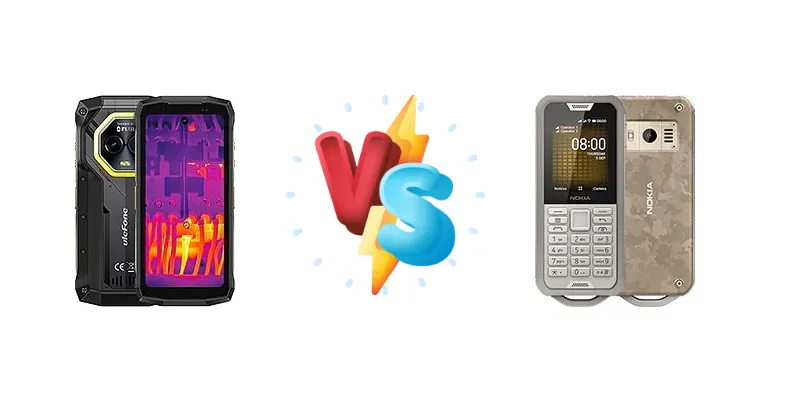
Ulefone Armor Mini 20T Pro vs. Nokia 800 Tough: A Rugged Reality Check
| Phones Images | |||||
|---|---|---|---|---|---|
|
🏆 Quick Verdict
For the average user needing a rugged phone capable of more than just calls and texts, the Ulefone Armor Mini 20T Pro is the clear winner. Its Mediatek Dimensity 6300 chipset and 33W charging offer a performance and convenience leap over the Nokia 800 Tough’s aging Snapdragon 205, despite the Nokia’s focus on extreme durability.
| PHONES | ||
|---|---|---|
| Phone Names | Ulefone Armor Mini 20T Pro | Nokia 800 Tough |
| Network | ||
|---|---|---|
| 2G bands | GSM 850 / 900 / 1800 / 1900 | GSM 850 / 900 / 1800 / 1900 |
| 3G bands | HSDPA 800 / 850 / 900 / 1700(AWS) / 1900 / 2100 | HSDPA 850 / 900 / 2100 |
| 4G bands | 1, 2, 3, 4, 5, 7, 8, 12, 13, 17, 18, 19, 20, 25, 26, 28, 32, 34, 38, 39, 40, 41, 66, 71 | 1, 3, 5, 7, 8, 20 - EU |
| 5G bands | 1, 2, 3, 5, 7, 8, 20, 25, 28, 38, 40, 41, 66, 71, 77, 78, 79 SA/NSA/Sub6 | - |
| Speed | HSPA, LTE, 5G | HSPA 42.2/5.76 Mbps, LTE Cat4 150/50 Mbps |
| Technology | GSM / CDMA / HSPA / CDMA2000 / LTE / 5G | GSM / HSPA / LTE |
| - | 1, 3, 5, 7, 8, 20, 28, 38, 39, 40, 41 - MENA, APAC, GCR | |
| Launch | ||
|---|---|---|
| Announced | 2024, September 03 | 2019, September 05. Released 2019, September 05 |
| Status | Available. Released 2024, October | Discontinued |
| Body | ||
|---|---|---|
| Dimensions | 133.5 x 63.3 x 24.9 mm (5.26 x 2.49 x 0.98 in) | 145.4 x 62.1 x 16.1 mm (5.72 x 2.44 x 0.63 in) |
| SIM | Nano-SIM + Nano-SIM | · Nano-SIM· Nano-SIM + Nano-SIM |
| Weight | 301 g (10.62 oz) | 161 g (5.68 oz) |
| - | IP68 water resistant (up to 1.5m for 30 mins) Flashlight MIL-STD-810G compliant* *does not guarantee ruggedness or use in extreme conditions | |
| Display | ||
|---|---|---|
| Protection | Mohs level 4 | - |
| Resolution | 720 x 1600 pixels, 20:9 ratio (~373 ppi density) | 240 x 320 pixels, 4:3 ratio (~167 ppi density) |
| Size | 4.7 inches, 53.3 cm2 (~63.1% screen-to-body ratio) | 2.4 inches, 17.8 cm2 (~19.8% screen-to-body ratio) |
| Type | IPS LCD, 90Hz | TFT LCD, 256K colors |
| Platform | ||
|---|---|---|
| CPU | Octa-core (2x2.4 GHz Cortex-A76 & 6x2.0 GHz Cortex-A55) | Dual-core (2x1.1 GHz Cortex-A7) |
| Chipset | Mediatek Dimensity 6300 (6 nm) | Qualcomm MSM8905 Snapdragon 205 (28 nm) |
| GPU | Mali-G57 MC2 | Adreno 304 |
| OS | Android 14 | KaiOS 2.5.2 |
| Memory | ||
|---|---|---|
| Card slot | microSDXC (uses shared SIM slot) | microSDHC (uses shared SIM slot) |
| Internal | 256GB 8GB RAM | 4GB 512MB |
| - | eMMC 4.5 | |
| Main Camera | ||
|---|---|---|
| Dual | 50 MP, f/2.0, (wide), 1/1.31", 1.2µm Thermal camera by Flir, 160x120 px, 8.7Hz, 12μm | - |
| Features | Dual-LED flash, HDR, panorama | LED flash |
| Single | - | 2 MP |
| Video | 1440p@30fps, 1080p@30fps | Yes |
| Selfie camera | ||
|---|---|---|
| Single | 32 MP, f/2.5, (wide), 1/2.8", 0.8µm | - |
| Video | 1440p@30fps, 1080p@30fps | - |
| - | No | |
| Sound | ||
|---|---|---|
| 3.5mm jack | - | Yes |
| 35mm jack | Yes | Yes |
| Loudspeaker | Yes | Yes |
| Comms | ||
|---|---|---|
| Bluetooth | 5.2, A2DP, LE | 4.1, A2DP, LE |
| Infrared port | Yes | - |
| NFC | Yes | No |
| Positioning | GPS, GALILEO, GLONASS, BDS, QZSS | GPS, GLONASS |
| Radio | Wireless FM radio | FM radio |
| USB | USB Type-C 2.0, OTG | microUSB 2.0 |
| WLAN | Wi-Fi 802.11 a/b/g/n/ac, dual-band | Wi-Fi 802.11 b/g/n, hotspot |
| Features | ||
|---|---|---|
| Sensors | Fingerprint, accelerometer, gyro, proximity, compass, barometer | - |
| - | SNS applications MP4/H.264 player MP3/WAV/AAC player Organizer Voice memo Predictive text input | |
| Battery | ||
|---|---|---|
| Charging | 33W wired 15W wireless 5W reverse wireless | - |
| Stand-by | - | Up to 1032 h (3G) |
| Type | Li-Ion 6200 mAh | Li-Ion 2100 mAh, non-removable |
| Misc | ||
|---|---|---|
| Colors | Black | Black Steel, Desert Sand |
| Models | - | TA-1189, TA-1186, TA-1180, TA-1176 |
| Price | € 359.95 / $ 329.99 / £ 299.99 | About 300 EUR |
| SAR EU | - | 1.46 W/kg (head) 1.76 W/kg (body) |
| EU LABEL | ||
|---|---|---|
| Battery | 62:30h endurance, 1000 cycles | - |
| Energy | Class B | - |
| Free fall | Class A (270 falls) | - |
| Repairability | Class B | - |
Ulefone Armor Mini 20T Pro
- Significantly faster processor for modern apps
- Brighter, more vibrant display
- Fast charging (33W wired, 15W wireless)
- Longer battery life and 1000 charge cycles
- Potentially more complex software updates
- May be slightly bulkier due to larger battery and components
Nokia 800 Tough
- Extremely durable and rugged design
- Exceptional standby time
- Simple and easy to use interface
- Very affordable
- Outdated processor limits functionality
- Limited app compatibility
- Basic camera performance
- Slow charging (if any)
Display Comparison
The Ulefone Armor Mini 20T Pro boasts a significantly brighter display, reaching 527 nits, compared to the Nokia 800 Tough’s likely lower brightness (typical of its market segment). This brightness advantage translates to better visibility in direct sunlight, crucial for outdoor work. While panel technology details for the Nokia are unavailable, the Ulefone’s modern display likely offers superior color accuracy and viewing angles. The Nokia’s smaller screen size, typical of feature phones, prioritizes compactness over immersive viewing.
Camera Comparison
Camera details for the Nokia 800 Tough are limited, but it’s safe to assume a basic sensor focused on functional photography. The Ulefone Armor Mini 20T Pro, while not a camera powerhouse, likely features a more capable sensor and image processing pipeline. Without specific sensor size information, it’s difficult to make a direct comparison, but the Ulefone’s modern chipset allows for more sophisticated image processing algorithms. The Nokia’s camera is likely intended for quick snapshots, while the Ulefone offers more versatility.
Performance
The performance gap between these devices is vast. The Ulefone Armor Mini 20T Pro’s Mediatek Dimensity 6300 (6nm) is a modern octa-core processor designed for efficient multitasking and moderate gaming. Its Cortex-A76 cores provide a substantial performance uplift compared to the Nokia 800 Tough’s Qualcomm MSM8905 Snapdragon 205 (28nm) dual-core processor. The older Snapdragon 205 is primarily suited for basic tasks like calls, texts, and light app usage. The 6nm fabrication process of the Dimensity 6300 also contributes to better thermal efficiency, reducing throttling during sustained workloads. The Nokia’s processor is a generation removed from current standards, impacting app compatibility and future software updates.
Battery Life
The Ulefone Armor Mini 20T Pro delivers a measured battery endurance of 62:30h, with an active use score of 13:50h. This is supported by its 33W wired charging, 15W wireless charging, and 5W reverse wireless charging capabilities. The Nokia 800 Tough, while likely offering excellent standby time due to its low-power processor, lacks the fast charging options and overall capacity of the Ulefone. The Ulefone’s 1000 charge cycle rating suggests a longer lifespan, even with frequent charging.
Buying Guide
Buy the Ulefone Armor Mini 20T Pro if you need a rugged phone that can handle demanding apps, streaming, and occasional gaming, alongside its durable build. It’s ideal for professionals working in challenging environments who also rely on smartphone features. Buy the Nokia 800 Tough if you prioritize absolute simplicity, exceptionally long standby time, and a phone that can withstand almost any physical abuse, even if it means sacrificing modern smartphone functionality. It’s best suited for emergency use or those who strictly need a reliable communication device.