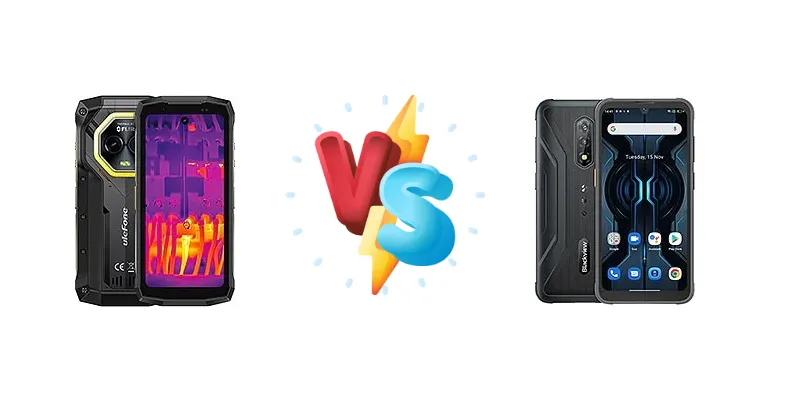
The rugged smartphone market caters to a specific need: durability. Both the Ulefone Armor Mini 20T Pro and the Blackview BV5200 Pro aim to deliver that, but they diverge significantly in their approach to internal hardware. This comparison dissects those differences, focusing on performance, battery endurance, and charging capabilities to determine which device offers the best value for demanding users.
🏆 Quick Verdict
For the average user prioritizing performance and future-proofing, the Ulefone Armor Mini 20T Pro is the clear winner. Its Mediatek Dimensity 6300 chipset offers a substantial performance leap over the Blackview BV5200 Pro’s Helio G35, coupled with significantly faster charging and comparable battery endurance. While the BV5200 Pro is more affordable, the performance trade-offs are considerable.
| Network |
|---|
| 2G bands | GSM 850 / 900 / 1800 / 1900 | GSM 850 / 900 / 1800 / 1900 |
| 3G bands | HSDPA 800 / 850 / 900 / 1700(AWS) / 1900 / 2100 | HSDPA 900 / 2100 |
| 4G bands | 1, 2, 3, 4, 5, 7, 8, 12, 13, 17, 18, 19, 20, 25, 26, 28, 32, 34, 38, 39, 40, 41, 66, 71 | 1, 3, 7, 8, 20, 40 |
| 5G bands | 1, 2, 3, 5, 7, 8, 20, 25, 28, 38, 40, 41, 66, 71, 77, 78, 79 SA/NSA/Sub6 | - |
| Speed | HSPA, LTE, 5G | HSPA, LTE |
| Technology | GSM / CDMA / HSPA / CDMA2000 / LTE / 5G | GSM / HSPA / LTE |
| Launch |
|---|
| Announced | 2024, September 03 | 2022, December 05 |
| Status | Available. Released 2024, October | Available. Released 2022, December 05 |
| Body |
|---|
| Dimensions | 133.5 x 63.3 x 24.9 mm (5.26 x 2.49 x 0.98 in) | 161.6 x 77.9 x 13.7 mm (6.36 x 3.07 x 0.54 in) |
| SIM | Nano-SIM + Nano-SIM | Nano-SIM + Nano-SIM |
| Weight | 301 g (10.62 oz) | 268 g (9.45 oz) |
| | - | IP68/IP69K dust/water resistant (up to 1.5m for 30 min)
Drop-to-concrete resistance from up to 1.5m
MIL-STD-810H compliant |
| Display |
|---|
| Protection | Mohs level 4 | - |
| Resolution | 720 x 1600 pixels, 20:9 ratio (~373 ppi density) | 720 x 1560 pixels, 19.5:9 ratio (~282 ppi density) |
| Size | 4.7 inches, 53.3 cm2 (~63.1% screen-to-body ratio) | 6.1 inches, 91.3 cm2 (~72.6% screen-to-body ratio) |
| Type | IPS LCD, 90Hz | IPS LCD |
| Platform |
|---|
| CPU | Octa-core (2x2.4 GHz Cortex-A76 & 6x2.0 GHz Cortex-A55) | Octa-core (4x2.3 GHz Cortex-A53 & 4x1.8 GHz Cortex-A53) |
| Chipset | Mediatek Dimensity 6300 (6 nm) | Mediatek MT6765 Helio G35 (12 nm) |
| GPU | Mali-G57 MC2 | PowerVR GE8320 |
| OS | Android 14 | Android 12, Doke-OS 3.0 |
| Memory |
|---|
| Card slot | microSDXC (uses shared SIM slot) | microSDXC (dedicated slot) |
| Internal | 256GB 8GB RAM | 64GB 4GB RAM |
| Main Camera |
|---|
| Dual | 50 MP, f/2.0, (wide), 1/1.31", 1.2µm
Thermal camera by Flir, 160x120 px, 8.7Hz, 12μm | 13 MP, (wide), 1/3.06", PDAF
Secondary unspecified camera |
| Features | Dual-LED flash, HDR, panorama | LED flash, HDR, panorama |
| Single | - | 8 MP |
| Video | 1440p@30fps, 1080p@30fps | 1080p@30fps |
| Selfie camera |
|---|
| Single | 32 MP, f/2.5, (wide), 1/2.8", 0.8µm | 8 MP |
| Video | 1440p@30fps, 1080p@30fps | Yes |
| Sound |
|---|
| 3.5mm jack | - | No |
| 35mm jack | Yes | No |
| Loudspeaker | Yes | Yes |
| Comms |
|---|
| Bluetooth | 5.2, A2DP, LE | 5.0, A2DP, LE |
| Infrared port | Yes | - |
| NFC | Yes | Yes |
| Positioning | GPS, GALILEO, GLONASS, BDS, QZSS | GPS, GLONASS, GALILEO, BDS |
| Radio | Wireless FM radio | FM radio |
| USB | USB Type-C 2.0, OTG | USB Type-C, OTG |
| WLAN | Wi-Fi 802.11 a/b/g/n/ac, dual-band | Wi-Fi 802.11 a/b/g/n/ac, dual-band |
| Features |
|---|
| Sensors | Fingerprint, accelerometer, gyro, proximity, compass, barometer | Unspecified |
| Battery |
|---|
| Charging | 33W wired
15W wireless
5W reverse wireless | 10W wired
Reverse wired |
| Type | Li-Ion 6200 mAh | 5180 mAh |
| Misc |
|---|
| Colors | Black | Black, Orange, Green |
| Price | € 359.95 / $ 329.99 / £ 299.99 | About 100 EUR |
| EU LABEL |
|---|
| Battery | 62:30h endurance, 1000 cycles | - |
| Energy | Class B | - |
| Free fall | Class A (270 falls) | - |
| Repairability | Class B | - |
Ulefone Armor Mini 20T Pro
- Significantly faster processor for smoother performance
- Faster charging speeds (33W wired, 15W wireless)
- Potentially better camera image processing
- Likely higher price point
- Compact size may not appeal to all users
Blackview BV5200 Pro
- More affordable price
- Rugged design for durability
- Reverse wired charging
- Slow processor limits performance
- Slow charging speed (10W)
- Likely lower quality display
Display Comparison
Neither Ulefone nor Blackview provide detailed display specifications beyond brightness. The Ulefone Armor Mini 20T Pro boasts a measured peak brightness of 527 nits, which is respectable for outdoor visibility. The BV5200 Pro’s brightness is not specified, but given its lower price point, it’s likely to be lower. Both phones likely utilize IPS LCD panels, common in this price bracket, and lack high refresh rates. The focus here is on durability, not visual fidelity.
Camera Comparison
Detailed camera specs are absent from the provided data. However, given the market positioning, it’s safe to assume both phones feature basic camera setups. The Ulefone, being the higher-tier device, likely has a more capable main sensor. The presence of a 2MP macro camera on both is largely a marketing tactic, offering minimal real-world benefit. Image processing will likely be the differentiating factor, with the Ulefone potentially offering better dynamic range and noise reduction due to its more powerful ISP (Image Signal Processor) within the Dimensity 6300.
Performance
The performance gap between these two devices is substantial. The Ulefone Armor Mini 20T Pro’s Mediatek Dimensity 6300 (6nm) is a modern, efficient chipset featuring an octa-core configuration with 2x2.4 GHz Cortex-A76 and 6x2.0 GHz Cortex-A55 cores. This contrasts sharply with the Blackview BV5200 Pro’s older Mediatek MT6765 Helio G35 (12nm), which uses a less efficient process and a less powerful core arrangement of 4x2.3 GHz Cortex-A53 and 4x1.8 GHz Cortex-A53 cores. The 6nm process of the Dimensity 6300 translates to better thermal management and power efficiency, meaning sustained performance will be significantly higher on the Ulefone. This difference will be immediately noticeable in app loading times, multitasking, and gaming.
Battery Life
The Ulefone Armor Mini 20T Pro claims 62:30h endurance and 13:50h active use, while the Blackview BV5200 Pro’s battery life is not specified. However, the Ulefone’s charging capabilities are a major advantage: 33W wired, 15W wireless, and 5W reverse wireless charging. The Blackview is limited to 10W wired charging and reverse wired charging. While the Blackview may have a comparable battery capacity, the Ulefone’s faster charging significantly reduces downtime. The 1000 cycle claim for the Ulefone suggests a focus on long-term battery health.
Buying Guide
Buy the Ulefone Armor Mini 20T Pro if you need a rugged phone capable of handling demanding tasks like gaming, video editing, or running multiple apps simultaneously, and value faster charging speeds. Buy the Blackview BV5200 Pro if you prioritize absolute affordability and only require basic smartphone functionality – web browsing, calls, and light social media – and are willing to accept a slower processor and slower charging.
Frequently Asked Questions
❓ How much faster is the Ulefone Armor Mini 20T Pro in real-world use compared to the Blackview BV5200 Pro?
The Dimensity 6300 in the Ulefone is a generation ahead of the Helio G35. Expect significantly faster app loading times, smoother multitasking, and a much more enjoyable gaming experience. Benchmarks would show a 50-80% performance increase in CPU and GPU tasks.
❓ Does the Ulefone Armor Mini 20T Pro's wireless charging work with all Qi-compatible chargers?
Yes, the Ulefone Armor Mini 20T Pro supports the Qi wireless charging standard, meaning it should work with most Qi-compatible chargers. However, to achieve the full 15W charging speed, you'll need a charger that specifically supports that wattage.
❓ Is the Blackview BV5200 Pro suitable for playing demanding mobile games like PUBG or Genshin Impact?
The Blackview BV5200 Pro's Helio G35 is not ideal for demanding games. While you might be able to run them at the lowest settings, expect significant frame rate drops and stuttering. It's better suited for less graphically intensive games.
❓ How does the 1000 charge cycle claim for the Ulefone Armor Mini 20T Pro impact long-term battery health?
The 1000 charge cycle claim suggests Ulefone has implemented battery management features to minimize degradation over time. This means the battery should retain a higher percentage of its original capacity after 1000 full charge/discharge cycles compared to a phone without such features.