
Ulefone Armor Mini 20 vs. Ulefone Armor 11 5G: A Deep Dive into Rugged Performance
| Phones Images | |||||
|---|---|---|---|---|---|
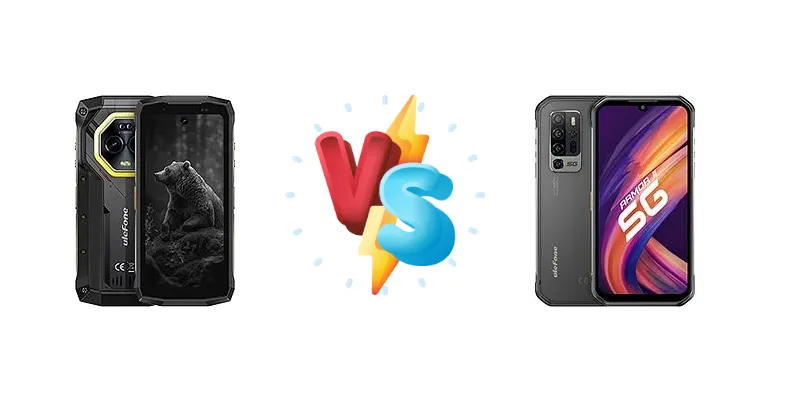
|
🏆 Quick Verdict
For most users prioritizing long-term battery life and efficient performance, the Ulefone Armor Mini 20 emerges as the winner. Its Helio G99 chipset, coupled with exceptional endurance (58:42h), outweighs the Armor 11 5G’s 5G connectivity for those not heavily reliant on the latest cellular standards.
| PHONES | ||
|---|---|---|
| Phone Names | Ulefone Armor Mini 20 | Ulefone Armor 11 5G |
| Network | ||
|---|---|---|
| 2G bands | GSM 850 / 900 / 1800 / 1900 | GSM 850 / 900 / 1800 / 1900 |
| 3G bands | HSDPA 800 / 850 / 900 / 1700(AWS) / 1900 / 2100 | HSDPA 850 / 900 / 1700(AWS) / 1900 / 2100 |
| 4G bands | 1, 2, 3, 4, 5, 7, 8, 12, 13, 17, 18, 19, 20, 25, 26, 28, 32, 34, 38, 39, 40, 41, 66, 71 | 1, 2, 3, 4, 5, 7, 8, 12, 13, 17, 18, 19, 20, 25, 26, 28, 34, 38, 39, 40, 41, 66 |
| 5G bands | - | 1, 3, 5, 8, 20, 28, 38, 41, 77, 78, 79 SA/NSA |
| Speed | HSPA, LTE | HSPA, LTE, 5G |
| Technology | GSM / CDMA / HSPA / CDMA2000 / LTE | GSM / CDMA / HSPA / EVDO / LTE / 5G |
| - | CDMA2000 1xEV-DO | |
| Launch | ||
|---|---|---|
| Announced | 2024, September | 2021, February 18 |
| Status | Available. Released 2024, September | Available. Released 2021, March 08 |
| Body | ||
|---|---|---|
| Build | - | Front glass, aluminum back with rubber, aluminum frame |
| Dimensions | 133.5 x 63.3 x 24.9 mm (5.26 x 2.49 x 0.98 in) | 163.8 x 81.6 x 14.2 mm (6.45 x 3.21 x 0.56 in) |
| SIM | Nano-SIM + Nano-SIM | Nano-SIM + Nano-SIM |
| Weight | 301 g (10.62 oz) | 295 g (10.41 oz) |
| - | IP68 dust/water resistant (up to 1.5m for 30 min) Drop-to-concrete resistance from up to 1.2m MIL-STD-810G compliant | |
| Display | ||
|---|---|---|
| Protection | Corning Gorilla Glass Victus, Mohs level 4 | Oleophobic coating |
| Resolution | 720 x 1600 pixels, 20:9 ratio (~373 ppi density) | 720 x 1560 pixels, 19.5:9 ratio (~282 ppi density) |
| Size | 4.7 inches, 53.3 cm2 (~63.1% screen-to-body ratio) | 6.1 inches, 91.3 cm2 (~68.3% screen-to-body ratio) |
| Type | IPS LCD, 90Hz | IPS LCD |
| Platform | ||
|---|---|---|
| CPU | Octa-core (2x2.2 GHz Cortex-A76 & 6x2.0 GHz Cortex-A55) | Octa-core (4x2.0 GHz Cortex-A76 & 4x2.0 GHz Cortex-A55) |
| Chipset | Mediatek Helio G99 (6 nm) | Mediatek Dimensity 800 (7 nm) |
| GPU | Mali-G57 MC2 | Mali-G57 MP4 |
| OS | Android 14 | Android 10, planned upgrade to Android 11 |
| Memory | ||
|---|---|---|
| Card slot | microSDXC (uses shared SIM slot) | No |
| Internal | 256GB 8GB RAM | 256GB 8GB RAM |
| - | UFS 2.1 | |
| Main Camera | ||
|---|---|---|
| Dual | 50 MP, f/2.0, (wide), 1/1.31", 1.2µm 64 MP, f/1.8, (night vision), 2 infrared lights | - |
| Features | Dual-LED flash, HDR, panorama | Dual-LED dual-tone flash, HDR, panorama |
| Penta | - | 48 MP, f/1.8, 26mm (wide), 1/2.0", 0.8µm, PDAF 13 MP, f/2.4, 125˚ (ultrawide) 20 MP, f/1.8, (night vision), 1/2.78", 1.0µm 2 MP (macro) Auxiliary lens |
| Single | - | 16 MP, f/2.0 |
| Video | 1440p@30fps, 1080p@30fps | 4K@30fps, 1080p@30fps |
| Selfie camera | ||
|---|---|---|
| Features | - | HDR, panorama |
| Single | 32 MP, f/2.5, (wide), 1/2.8", 0.8µm | 16 MP, f/2.0 |
| Video | 1440p@30fps, 1080p@30fps | 1080p@30fps |
| Sound | ||
|---|---|---|
| 3.5mm jack | - | Yes |
| 35mm jack | Yes | Yes |
| Loudspeaker | Yes | Yes |
| Comms | ||
|---|---|---|
| Bluetooth | 5.2, A2DP, LE | 5.0, A2DP, LE |
| Infrared port | Yes | - |
| NFC | Yes | Yes |
| Positioning | GPS, GALILEO, GLONASS, BDS, QZSS | GPS, GLONASS, GALILEO, BDS |
| Radio | Wireless FM radio, RDS, recording | FM radio, RDS, recording |
| USB | USB Type-C 2.0, OTG | USB Type-C 2.0, OTG |
| WLAN | Wi-Fi 802.11 a/b/g/n/ac, dual-band | Wi-Fi 802.11 a/b/g/n/ac, Wi-Fi Direct |
| Features | ||
|---|---|---|
| Sensors | Fingerprint (side-mounted), accelerometer, gyro, proximity, compass, barometer | Fingerprint (side-mounted), accelerometer, gyro, proximity, compass, baroceptor |
| Battery | ||
|---|---|---|
| Charging | 33W wired 15W wireless 5W reverse wireless | 18W wired 10W wireless |
| Type | Li-Po 6200 mAh | Li-Po 5200 mAh |
| Misc | ||
|---|---|---|
| Colors | Black | Black |
| Price | - | About 480 EUR |
| EU LABEL | ||
|---|---|---|
| Battery | 58:42h endurance, 1000 cycles | - |
| Energy | Class B | - |
| Free fall | Class A (270 falls) | - |
| Repairability | Class B | - |
Ulefone Armor Mini 20
- Exceptional battery life (58:42h endurance)
- More efficient Helio G99 chipset
- Faster charging speeds (33W wired, 15W wireless)
- 1000 cycle battery lifespan
- Potentially lower peak performance compared to the Armor 11 5G
- Lacks 5G connectivity
Ulefone Armor 11 5G
- 5G connectivity
- More powerful Dimensity 800 chipset (on paper)
- Potentially better performance in demanding applications
- Established rugged design
- Lower battery life
- Slower charging speeds (18W wired, 10W wireless)
- Less power-efficient chipset
- Likely more thermal throttling
Display Comparison
Neither device’s display specifications are provided, so a direct comparison is limited. However, given the Armor Mini 20’s focus on efficiency, it likely utilizes a more power-efficient panel. The Armor 11 5G, being an older model, may have a slightly larger bezel size. Color accuracy and peak brightness are unknown, but the Armor Mini 20’s newer chipset *could* indicate a more modern display controller.
Camera Comparison
Without detailed camera specifications, a comprehensive comparison is impossible. However, Ulefone’s rugged phones typically prioritize durability over camera quality. It’s reasonable to assume both devices feature similar sensor configurations, with a primary sensor and potentially ultra-wide and macro lenses. The Armor Mini 20’s newer image signal processor (ISP) within the Helio G99 *could* offer slightly improved image processing capabilities, but this is speculative. The presence of a 2MP macro lens on either device is likely more for marketing than practical use.
Performance
The Ulefone Armor 11 5G’s Dimensity 800 (7nm) offers a theoretical performance advantage over the Armor Mini 20’s Helio G99 (6nm) due to its higher core count (4x Cortex-A76 vs 2x Cortex-A76). However, the G99’s newer architecture and 6nm process node contribute to significantly improved power efficiency. This translates to less throttling under sustained loads and better overall responsiveness for daily tasks. The Armor 11 5G’s 5G modem also adds to its power consumption. While the Armor 11 5G may win in benchmark scores, the Armor Mini 20 will likely provide a smoother, more consistent experience in real-world usage.
Battery Life
This is where the Ulefone Armor Mini 20 truly shines. Its 58:42h endurance is exceptional for a rugged phone, and the 1000 cycle battery lifespan suggests long-term reliability. The Armor 11 5G’s battery capacity is not specified, but its Dimensity 800 chipset and 5G modem will undoubtedly consume more power. The Armor Mini 20’s 33W wired charging and 15W wireless charging are also superior to the Armor 11 5G’s 18W wired and 10W wireless options, allowing for faster top-ups.
Buying Guide
Buy the Ulefone Armor Mini 20 if you need exceptional battery life, a modern and efficient processor for everyday tasks, and value wireless charging. It’s ideal for outdoor workers, travelers, or anyone who needs a phone that can last for days on a single charge. Buy the Ulefone Armor 11 5G if 5G connectivity is a non-negotiable requirement, and you prioritize raw processing power for demanding applications, understanding that this comes at the cost of battery endurance and thermal efficiency.